Tractable Emergence
Here are a collection of studies that hint at universal discovery functions; recipes for finding durable structure inside small rule-sets. Each entry includes:
- an environment with simple rules that produce high expressivity, and
- a selection pressure that rewards persistence.
Broadly, I’ve broken these studies into four camps:
- Simple solvers: hand-specified procedures that reliably solve constrained problems. The reward is designed directly into the system.
- Learned solvers: systems that learn policies or models inside fixed environments. The reward is narrow but discovered through training. Think reinforcement learning, AlphaFold, AlphaZero, MuZero.
- Discovery engines: systems that search rich design spaces and use feedback to surface useful candidates. The reward is more general: interestingness, novelty, fitness, usefulness. This is the holy grail technology we’re aiming for.
- Computational media: substrates where small rules decompress into domains much larger than the rules describe. The reward is effectively unbounded: persistence, expressivity, and structure emerge from the medium itself.
No entries yet.
Particle Life
Added: 16 May 2026
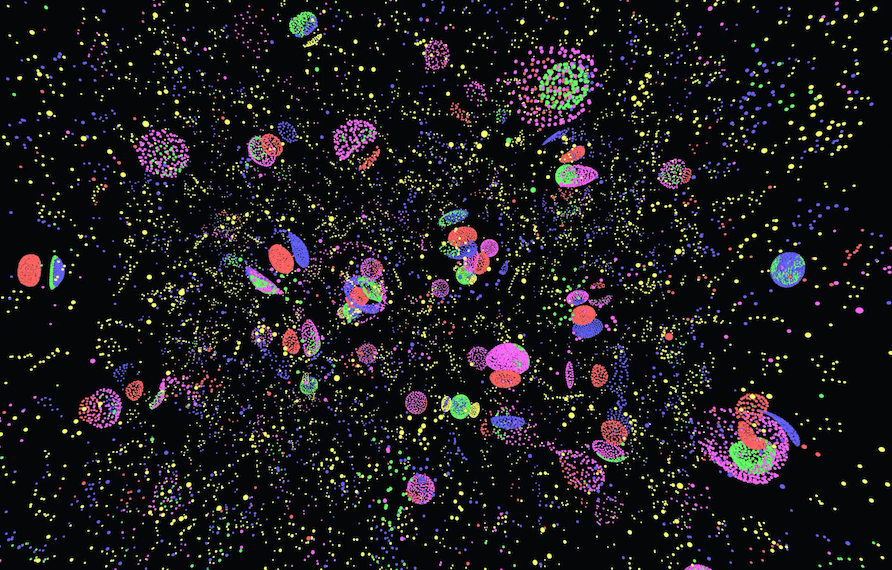
Particle Life is closer to Von Neumann’s original automata than GoL, and it functions in 3D space. Small matrices decompress into flocking, membranes, swarms, orbiting clusters, and metastable little ecologies. The re-sampling mechanic lets the observer switch vacuum state, which may be something humanity can do, too: x.com/tsarnick/status/1872766467529437685.
Resources
- Najarro, Particle Life
- Ventrella, Clusters
- ciphrd, Atomic Clusters: A Molecular Particle-Based Simulation
- Mohr, Particle Life
- Lisitsa, Particle Life simulation in browser using WebGPU
Hypergraphs (2020)
Added: 3 May 2026
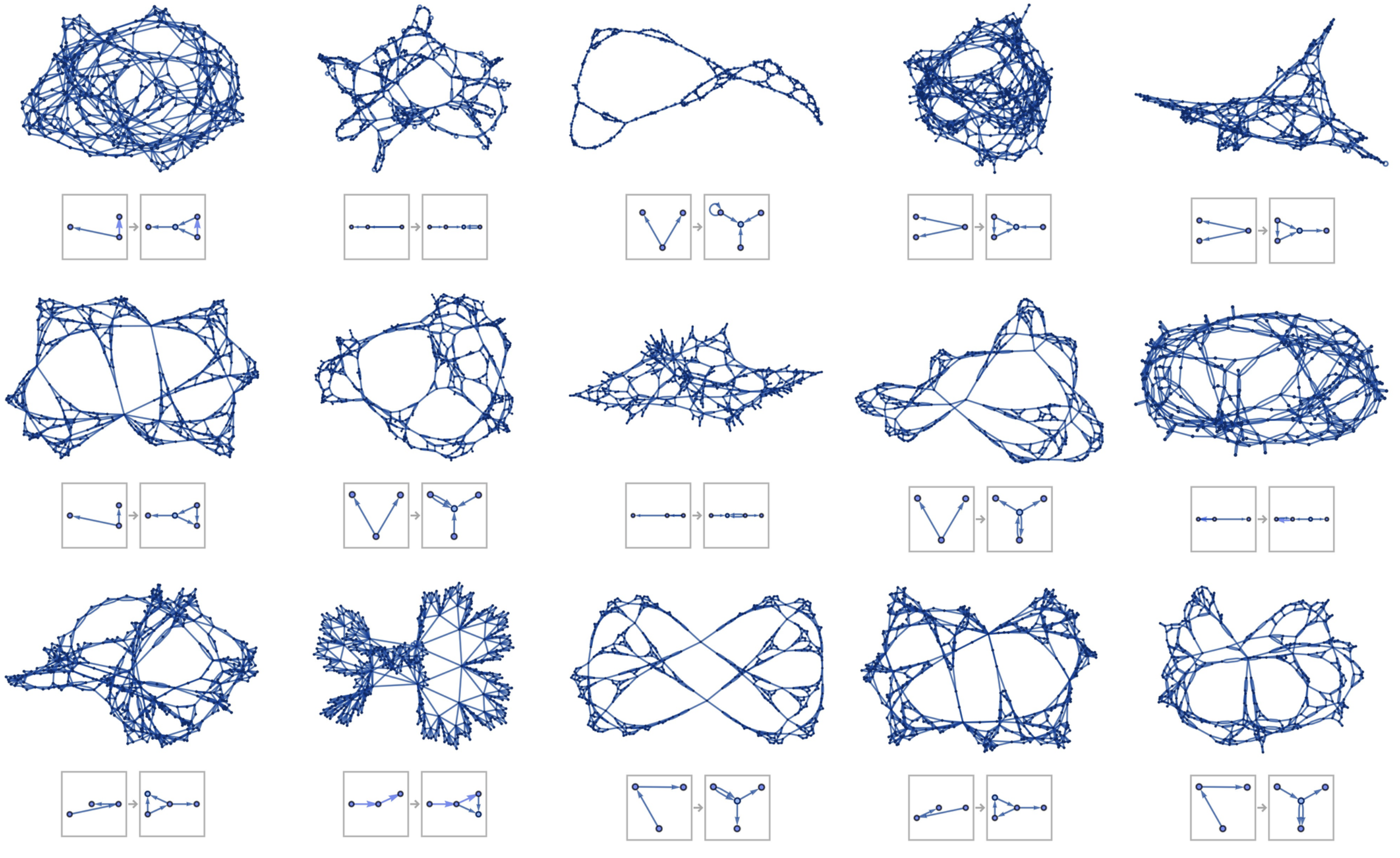
The Wolfram Physics Project treats space as an evolving hypergraph: a network whose hyperedges can connect any number of nodes, updated by local rewrite rules. Repeated substitutions generate causal graphs, multiway systems, and large-scale structure that is conjectured to recover familiar physical behaviour in the continuum limit. The medium is rule-space itself: simple replacement systems decompress into candidate geometries, with persistence rewarded when update histories preserve coherent causal structure.
Resources
- Wolfram Physics Project, Technical Introduction
- Wolfram Physics Project, The Representation of Rules
- Gorard (2020), Some Relativistic and Gravitational Properties of the Wolfram Model
AlphaZero (2017) and MuZero (2019)
Added: 3 May 2026
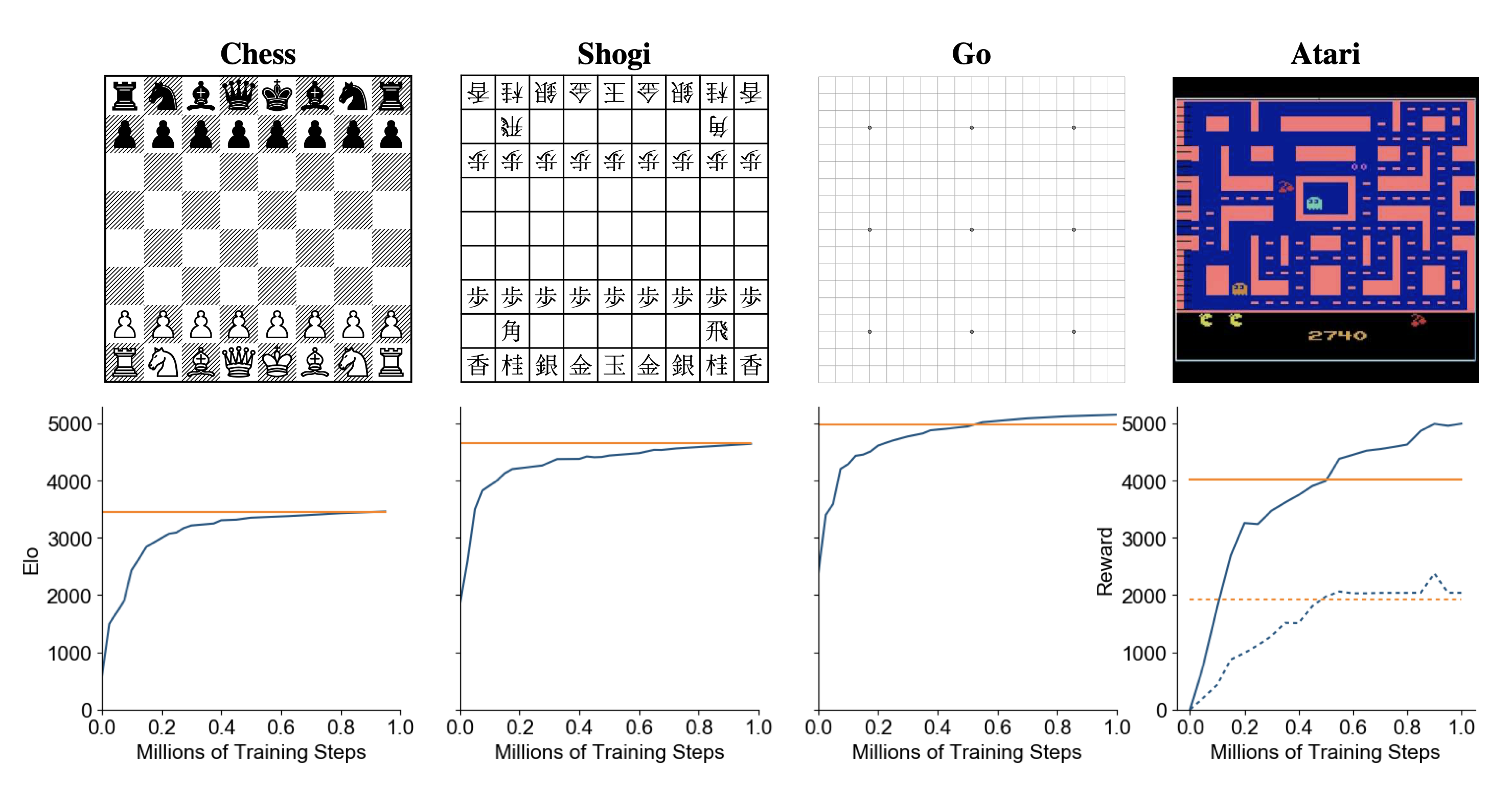
AlphaZero treats games as small, perfectly specified rule environments and uses self-play with Monte Carlo tree search to search game-trees, converting simple rules into superhuman policies in chess, shogi, and Go. MuZero is the later form: it preserves the planning/search loop, but learns the dynamics model from experience, matching AlphaZero in Go, chess, and shogi while extending the same machinery to Atari without being given the rules. The medium here is the game-tree: selection pressure is win/loss or reward, and persistence is the strategy that survives self-play.
Resources
- Silver et al. (2018), A general reinforcement learning algorithm that masters chess, shogi, and Go through self-play
- Schrittwieser et al. (2020), Mastering Atari, Go, chess and shogi by planning with a learned model
- Google DeepMind (2020), MuZero: Mastering Go, chess, shogi and Atari without rules
Lenia (2018)
Added: 3 May 2026
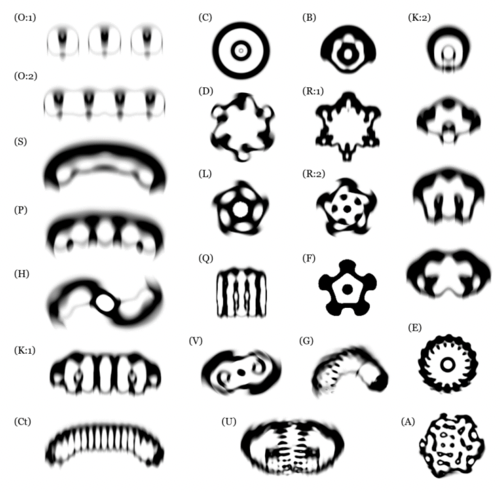
Lenia is a continuous generalisation of Conway’s Game of Life; cells are no longer binary, but smooth-valued fields evolving over continuous space and time through convolution kernels and growth mappings. It relaxes the Moore-neighbourhood grid into a richer artificial-life substrate, producing organism-like species such as Orbium with geometric, fuzzy, resilient, adaptive motion. The same ambition as GoL, but with a richer state space for discovering persistent artificial morphologies.
Resources
- Chan (2019), Lenia: Biology of Artificial Life
- Artificial Life, Lenia
- Chan (2020), Lenia and Expanded Universe
Picbreeder (2008)
Added: 30 April 2026

Picbreeder is a deceptively simple website that lets users ‘breed’ emergent complexity by applying simple covolutions in-series, collectively mapping the space of all possible patterns of a small feedforward neural net. The CPPN (a Compositional Pattern Producing Network) uses basic activations like sine, gaussian, and sigmoid that combine to produce recognisable forms like planets, butterflies, cars and mosques in 50–100 generations, before collapsing into high-entropy homogeneity as the process matures.
Resources
- Secretan et al. (2011), Picbreeder: A case study in collaborative evolutionary exploration of design space
- Woolley & Stanley (2014), Exploring promising stepping stones by combining novelty search with interactive evolution
- Lehman & Stanley (2015), Why Greatness Cannot Be Planned: The Myth of the Objective
- Stanley (2007), Compositional pattern producing networks
- Comments: Problem is that the only real discovery here is that in pure spaces like this, forecasting is intractable. This doesn’t really say much.
Conway’s Game of Life (1970)
Added: 2 May 2026
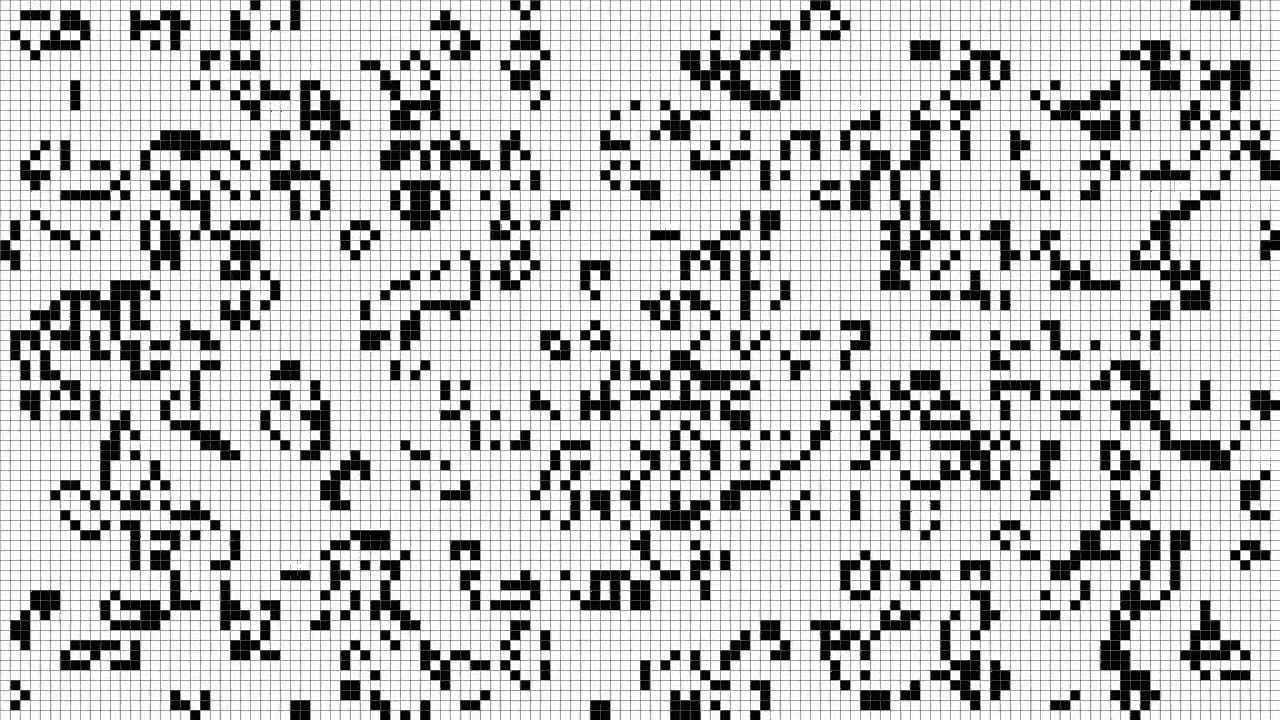
A 2-state, grid-based cellular automaton following the “B3/S23” ruleset where a dead cell awakens if it has three live neighbours, and a live cell persists if it has two or three live neighbours. Still lifes, oscillators, spaceships (the glider), guns, puffers, and eaters characterfully emerge. Selected by Conway while combing the 262,144 possible rules in the basic Moore neighbourhood as the simplest rule satisfying the three criteria: (1) no obvious unbounded growth, (2) no obvious extinction, and (3) hard-to-predict long-term behavior.
Resources
- Gardner (1970), Mathematical Games: The fantastic combinations of John Conway’s new solitaire game “Life”
- LifeWiki, Conway’s Game of Life
- LifeWiki, Life-like cellular automaton
- Scholarpedia, Game of Life
- Comments: The problem is that we don’t learn a whole lot