<?xml version="1.0" encoding="utf-8"?><feed xmlns="http://www.w3.org/2005/Atom" ><generator uri="https://jekyllrb.com/" version="3.10.0">Jekyll</generator><link href="https://www.oscarmoxon.com/feed.xml" rel="self" type="application/atom+xml" /><link href="https://www.oscarmoxon.com/" rel="alternate" type="text/html" /><updated>2026-07-23T19:15:56+00:00</updated><id>https://www.oscarmoxon.com/feed.xml</id><title type="html">[civ:notes]</title><subtitle>± Oscar Moxon</subtitle><author><name>Oscar Moxon</name></author><entry><title type="html">Tractable Emergence</title><link href="https://www.oscarmoxon.com/emergent-phenomena/" rel="alternate" type="text/html" title="Tractable Emergence" /><published>2026-04-30T07:00:00+00:00</published><updated>2026-04-30T07:00:00+00:00</updated><id>https://www.oscarmoxon.com/emergent-phenomena</id><content type="html" xml:base="https://www.oscarmoxon.com/emergent-phenomena/"><![CDATA[<!-- We have come to our senses in an enormous universe with immense expressive capabilities. By developing media (mathematics, formal logic, computation, evolutionary search) we can better model our reality and adapt to it. Our defining search is for pockets of computational tractability where structure is rich enough for us to extract durable patterns.  -->

<p>Here are a collection of studies that hint at universal discovery functions; recipes for finding durable structure inside small rule-sets. Each entry includes:</p>

<ol>
  <li>an environment with simple rules that produce high expressivity, and</li>
  <li>a selection pressure that rewards persistence.</li>
</ol>

<p>Broadly, I’ve broken these studies into four camps:</p>

<ul>
  <li><strong>Simple solvers:</strong> hand-specified procedures that reliably solve constrained problems. The reward is designed directly into the system.</li>
  <li><strong>Learned solvers:</strong> systems that learn policies or models inside fixed environments. The reward is narrow but discovered through training. Think reinforcement learning, AlphaFold, AlphaZero, MuZero.</li>
  <li><strong>Discovery engines:</strong> systems that search rich design spaces and use feedback to surface useful candidates. The reward is more general: interestingness, novelty, fitness, usefulness. This is the holy grail technology we’re aiming for.</li>
  <li><strong>Computational media:</strong> substrates where small rules decompress into domains much larger than the rules describe. The reward is effectively unbounded: persistence, expressivity, and structure emerge from the medium itself.</li>
</ul>

<div class="emergence-filters" aria-label="Filter entries by camp">
  <div class="filter-buttons" id="emergence-camp-filters">
    <button class="filter-btn active" data-camp-filter="all">all</button>
    <button class="filter-btn active" data-camp-filter="simple-solvers">simple solvers</button>
    <button class="filter-btn active" data-camp-filter="learned-solvers">learned solvers</button>
    <button class="filter-btn active" data-camp-filter="discovery-engines">discovery engines</button>
    <button class="filter-btn active" data-camp-filter="computational-media">computational media</button>
  </div>
</div>

<p class="emergence-empty" id="emergence-empty" hidden="">No entries yet.</p>

<section class="emergence-entry" data-camp="computational-media">

  <h2 id="particle-life">Particle Life</h2>

  <p class="entry-added-date"><em>Added: 16 May 2026</em></p>

  <p><img src="/assets/particle-life.png" alt="Particle Life" style="width:70%;" /></p>

  <p>Particle Life is closer to Von Neumann’s original automata than GoL, and it functions in 3D space. Small matrices decompress into flocking, membranes, swarms, orbiting clusters, and metastable little ecologies. The re-sampling mechanic lets the observer switch vacuum state, which may be something humanity can do, too: <a href="https://x.com/tsarnick/status/1872766467529437685?s=20" target="_blank" rel="noopener noreferrer">x.com/tsarnick/status/1872766467529437685</a>.</p>

  <details>
    <summary>Resources</summary>

    <ul>
      <li>Najarro, <a href="https://najarro.science/pl/" target="_blank" rel="noopener noreferrer"><em>Particle Life</em></a></li>
      <li>Ventrella, <a href="https://www.ventrella.com/Clusters/" target="_blank" rel="noopener noreferrer"><em>Clusters</em></a></li>
      <li>ciphrd, <a href="https://ciphrd.com/articles/atomic-clusters-a-molecular-particle-based-simulation/" target="_blank" rel="noopener noreferrer"><em>Atomic Clusters: A Molecular Particle-Based Simulation</em></a></li>
      <li>Mohr, <a href="https://www.youtube.com/watch?v=p4YirERTVF0" target="_blank" rel="noopener noreferrer"><em>Particle Life</em></a></li>
      <li>Lisitsa, <a href="https://lisyarus.github.io/blog/posts/particle-life-simulation-in-browser-using-webgpu.html" target="_blank" rel="noopener noreferrer"><em>Particle Life simulation in browser using WebGPU</em></a></li>
    </ul>

  </details>

</section>

<section class="emergence-entry" data-camp="computational-media">

  <h2 id="hypergraphs-2020">Hypergraphs (2020)</h2>

  <p class="entry-added-date"><em>Added: 3 May 2026</em></p>

  <p><img src="/assets/wolfram-project.png" alt="Wolfram Project" style="width:70%;" /></p>

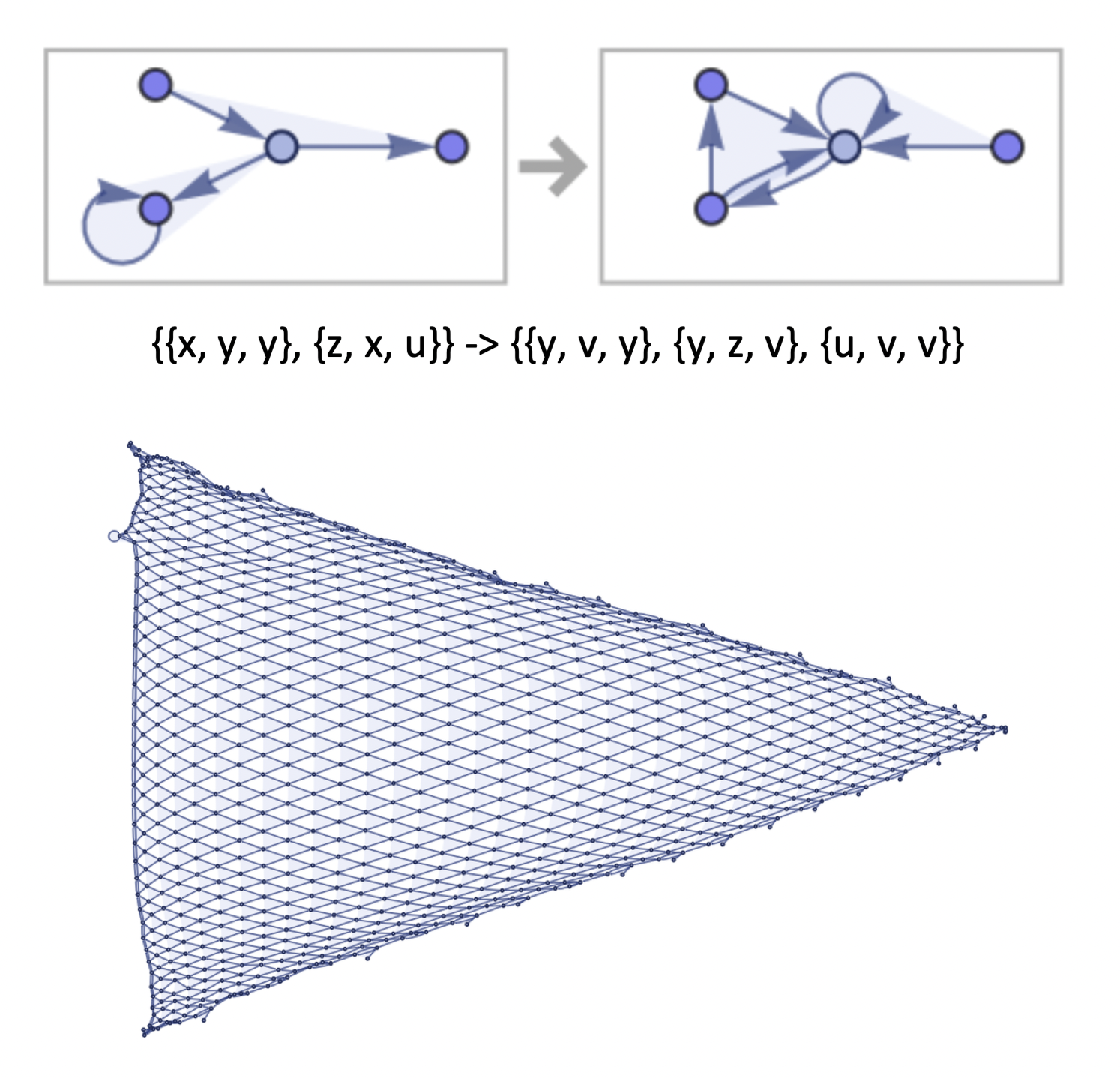
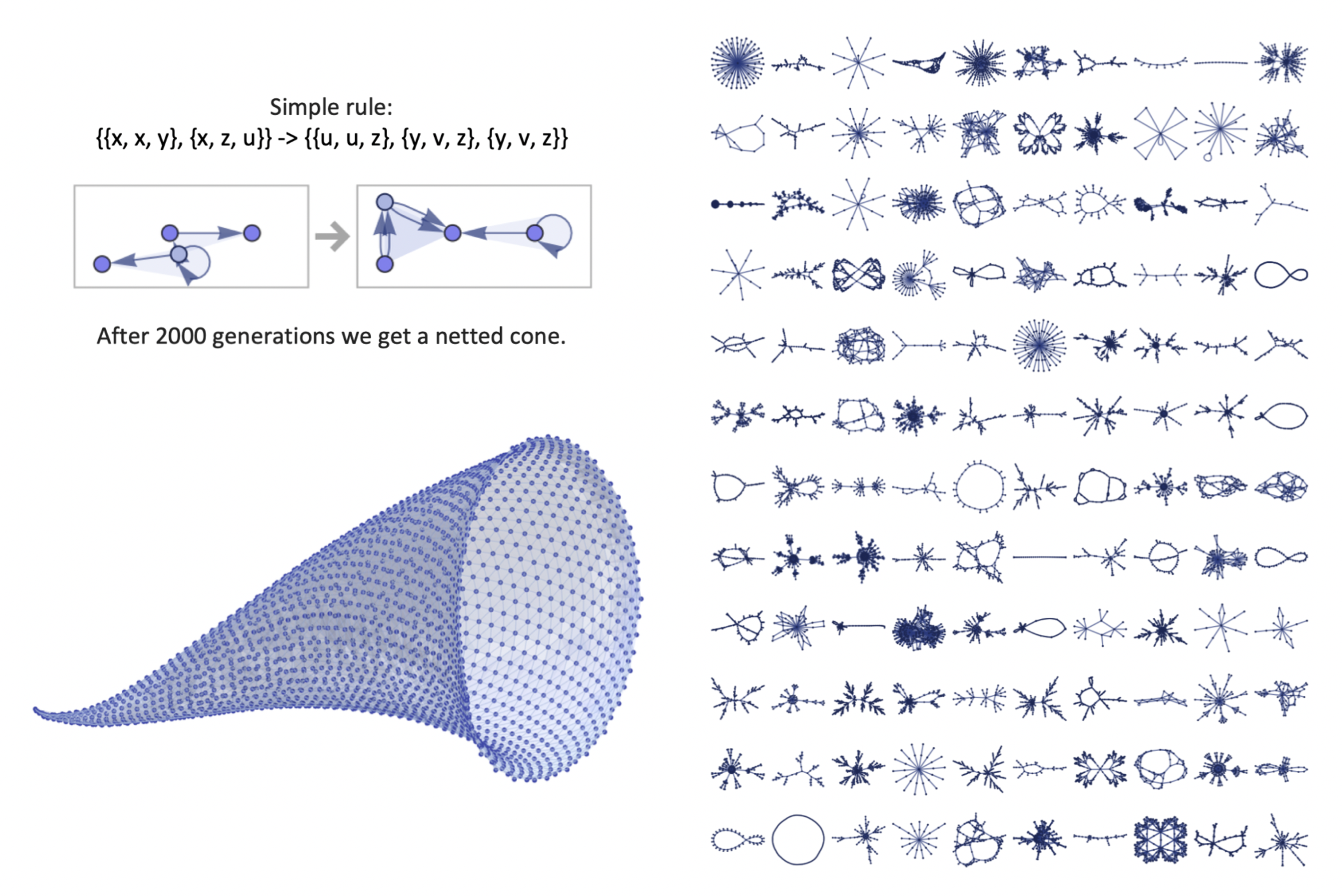
  <p>The Wolfram Physics Project treats space as an evolving hypergraph: a network whose hyperedges can connect any number of nodes, updated by local rewrite rules. Repeated substitutions generate causal graphs, multiway systems, and large-scale structure that is conjectured to recover familiar physical behaviour in the continuum limit. The medium is rule-space itself: simple replacement systems decompress into candidate geometries, with persistence rewarded when update histories preserve coherent causal structure.</p>

  <details>
    <summary>Resources</summary>

    <ul>
      <li>Wolfram Physics Project, <a href="https://www.wolframphysics.org/technical-introduction/" target="_blank" rel="noopener noreferrer"><em>Technical Introduction</em></a></li>
      <li>Wolfram Physics Project, <a href="https://www.wolframphysics.org/technical-introduction/basic-form-of-models/the-representation-of-rules/" target="_blank" rel="noopener noreferrer"><em>The Representation of Rules</em></a></li>
      <li>Gorard (2020), <a href="https://arxiv.org/abs/2004.14810" target="_blank" rel="noopener noreferrer"><em>Some Relativistic and Gravitational Properties of the Wolfram Model</em></a></li>
    </ul>

  </details>

</section>

<section class="emergence-entry" data-camp="learned-solvers">

  <h2 id="alphazero-2017-and-muzero-2019">AlphaZero (2017) and MuZero (2019)</h2>

  <p class="entry-added-date"><em>Added: 3 May 2026</em></p>

  <p><img src="/assets/alphazero-muzero.png" alt="AlphaZero and MuZero" style="width:70%;" /></p>

  <p>AlphaZero treats games as small, perfectly specified rule environments and uses self-play with Monte Carlo tree search to search game-trees, converting simple rules into superhuman policies in chess, shogi, and Go. MuZero is the later form: it preserves the planning/search loop, but learns the dynamics model from experience, matching AlphaZero in Go, chess, and shogi while extending the same machinery to Atari without being given the rules. The medium here is the game-tree: selection pressure is win/loss or reward, and persistence is the strategy that survives self-play.</p>

  <details>
    <summary>Resources</summary>

    <ul>
      <li>Silver et al. (2018), <a href="https://arxiv.org/abs/1712.01815" target="_blank" rel="noopener noreferrer"><em>A general reinforcement learning algorithm that masters chess, shogi, and Go through self-play</em></a></li>
      <li>Schrittwieser et al. (2020), <a href="https://arxiv.org/abs/1911.08265" target="_blank" rel="noopener noreferrer"><em>Mastering Atari, Go, chess and shogi by planning with a learned model</em></a></li>
      <li>Google DeepMind (2020), <a href="https://deepmind.google/blog/muzero-mastering-go-chess-shogi-and-atari-without-rules/" target="_blank" rel="noopener noreferrer"><em>MuZero: Mastering Go, chess, shogi and Atari without rules</em></a></li>
    </ul>

  </details>

</section>

<section class="emergence-entry" data-camp="computational-media">

  <h2 id="lenia-2018">Lenia (2018)</h2>

  <p class="entry-added-date"><em>Added: 3 May 2026</em></p>

  <p><img src="/assets/lenia.png" alt="Lenia" style="width:70%;" /></p>

  <p>Lenia is a continuous generalisation of Conway’s Game of Life; cells are no longer binary, but smooth-valued fields evolving over continuous space and time through convolution kernels and growth mappings. It relaxes the Moore-neighbourhood grid into a richer artificial-life substrate, producing organism-like species such as Orbium with geometric, fuzzy, resilient, adaptive motion. The same ambition as GoL, but with a richer state space for discovering persistent artificial morphologies.</p>

  <details>
    <summary>Resources</summary>

    <ul>
      <li>Chan (2019), <a href="https://arxiv.org/abs/1812.05433" target="_blank" rel="noopener noreferrer"><em>Lenia: Biology of Artificial Life</em></a></li>
      <li>Artificial Life, <a href="https://alife.org/encyclopedia/software-platforms/lenia/" target="_blank" rel="noopener noreferrer"><em>Lenia</em></a></li>
      <li>Chan (2020), <a href="https://arxiv.org/abs/2005.03742" target="_blank" rel="noopener noreferrer"><em>Lenia and Expanded Universe</em></a></li>
    </ul>

  </details>

</section>

<section class="emergence-entry" data-camp="computational-media">

  <h2 id="picbreeder-2008">Picbreeder (2008)</h2>

  <p class="entry-added-date"><em>Added: 30 April 2026</em></p>

  <p><img src="/assets/picbreeder-figure.png" alt="Picbreeder figure" style="width:70%;" /></p>

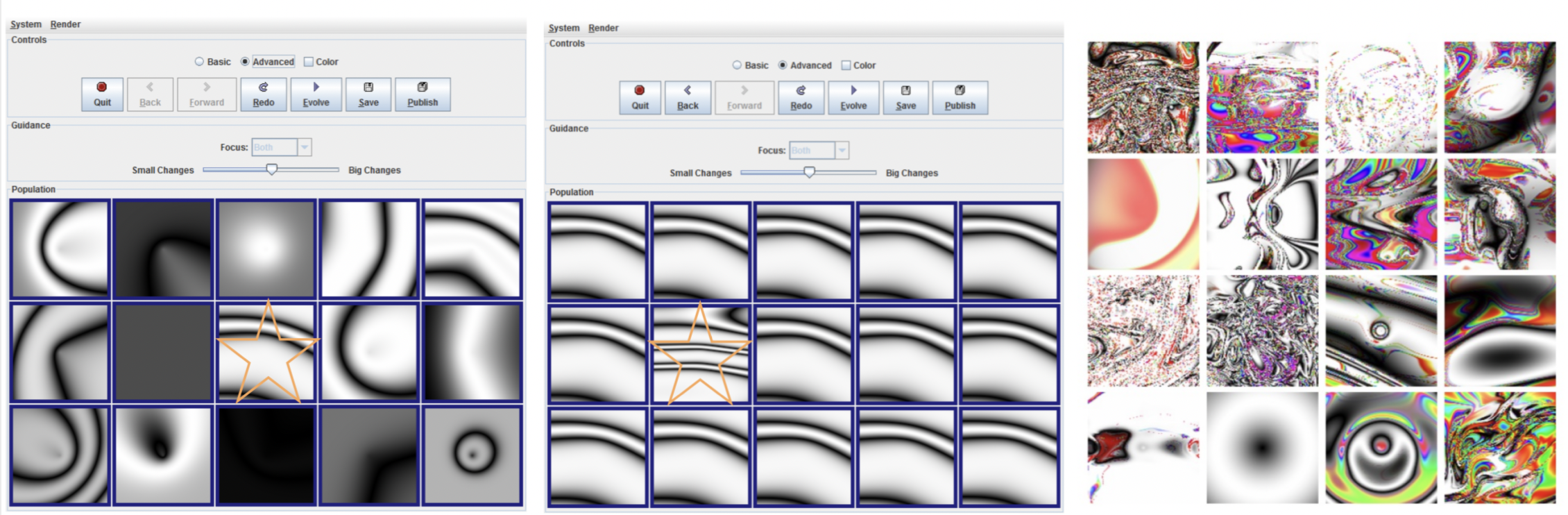
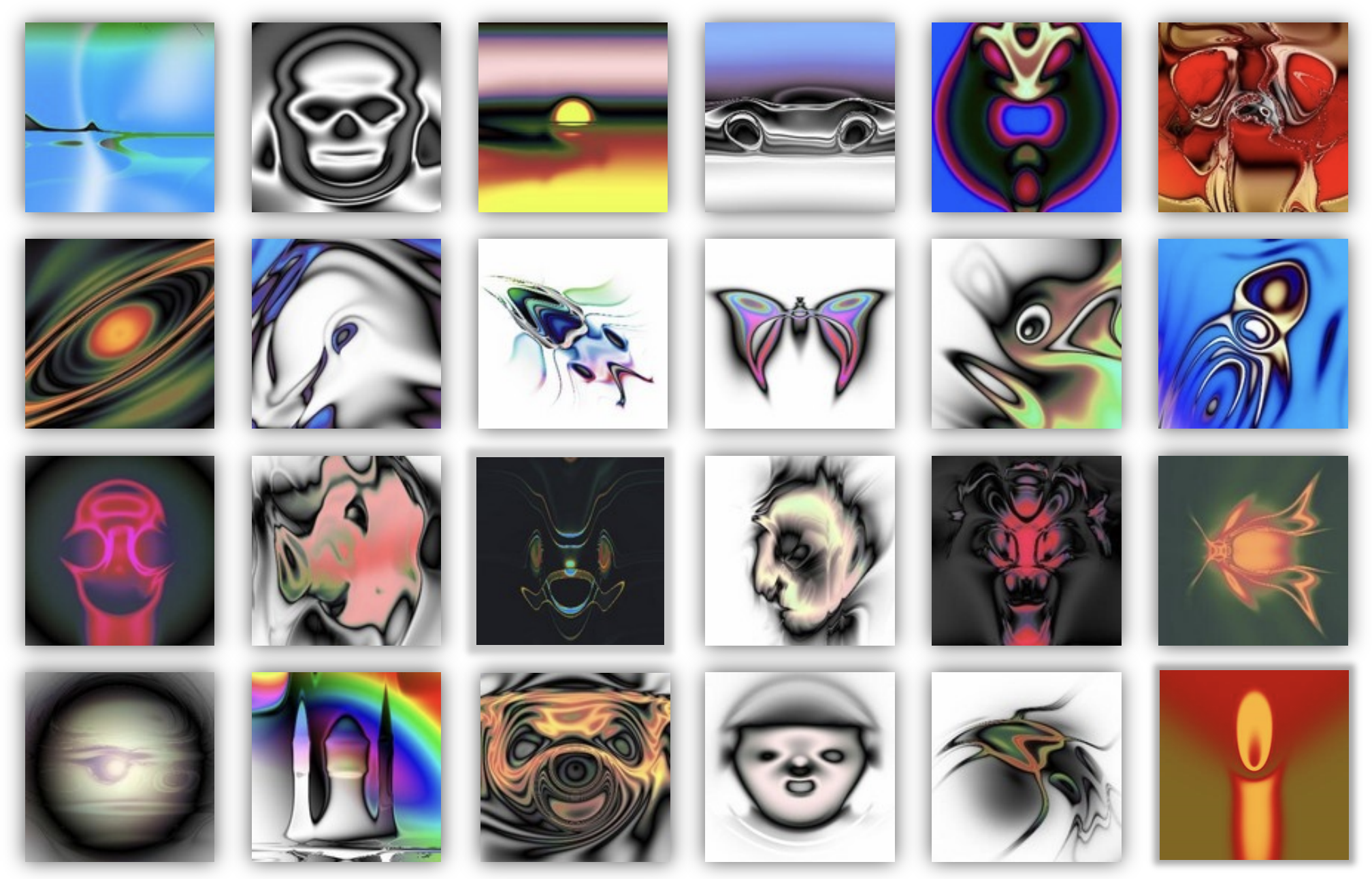
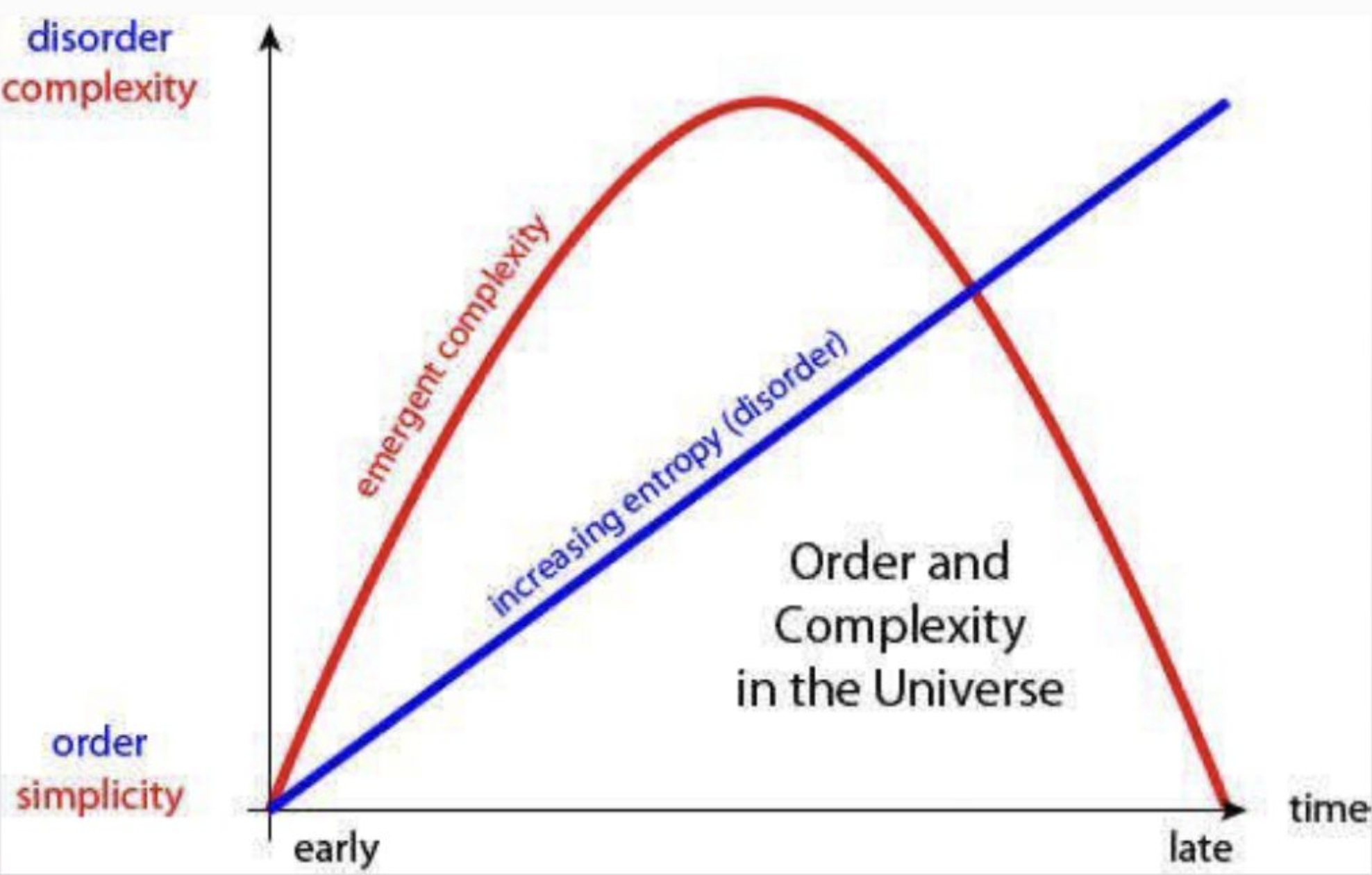
  <p>Picbreeder is a deceptively simple <a href="https://nbenko1.github.io/#/evolve" target="_blank" rel="noopener noreferrer">website</a> that lets users ‘breed’ emergent complexity by applying simple covolutions in-series, collectively mapping the space of all possible patterns of a small feedforward neural net. The CPPN (a Compositional Pattern Producing Network) uses basic activations like sine, gaussian, and sigmoid that combine to produce recognisable forms like planets, butterflies, cars and mosques in 50–100 generations, before collapsing into high-entropy homogeneity as the process matures.</p>

  <details>
    <summary>Resources</summary>

    <ul>
      <li>Secretan et al. (2011), <a href="https://direct.mit.edu/evco/article/19/3/373/1349/" target="_blank" rel="noopener noreferrer"><em>Picbreeder: A case study in collaborative evolutionary exploration of design space</em></a></li>
      <li>Woolley &amp; Stanley (2014), <a href="https://arxiv.org/abs/1207.6682" target="_blank" rel="noopener noreferrer"><em>Exploring promising stepping stones by combining novelty search with interactive evolution</em></a></li>
      <li>Lehman &amp; Stanley (2015), <em>Why Greatness Cannot Be Planned: The Myth of the Objective</em></li>
      <li>Stanley (2007), <a href="https://link.springer.com/article/10.1007/s10710-007-9028-8" target="_blank" rel="noopener noreferrer"><em>Compositional pattern producing networks</em></a></li>
    </ul>

  </details>

  <ul>
    <li>Comments: Problem is that the only real discovery here is that in pure spaces like this, forecasting is intractable. This doesn’t really say much.</li>
  </ul>

</section>

<section class="emergence-entry" data-camp="computational-media">

  <h2 id="conways-game-of-life-1970">Conway’s Game of Life (1970)</h2>

  <p class="entry-added-date"><em>Added: 2 May 2026</em></p>

  <p><img src="/assets/cellular-automata.png" alt="Cellular automata" style="width:70%;" /></p>

  <p>A 2-state, grid-based cellular automaton following the “B3/S23” ruleset where a dead cell awakens if it has three live neighbours, and a live cell persists if it has two or three live neighbours. Still lifes, oscillators, spaceships (the glider), guns, puffers, and eaters characterfully emerge. Selected by Conway while combing the 262,144 possible rules in the basic Moore neighbourhood as the simplest rule satisfying the three criteria: (1) no obvious unbounded growth, (2) no obvious extinction, and (3) hard-to-predict long-term behavior.</p>

  <details>
    <summary>Resources</summary>

    <ul>
      <li>Gardner (1970), <em>Mathematical Games: The fantastic combinations of John Conway’s new solitaire game “Life”</em></li>
      <li>LifeWiki, <a href="https://conwaylife.com/wiki/Conway%27s_Game_of_Life" target="_blank" rel="noopener noreferrer"><em>Conway’s Game of Life</em></a></li>
      <li>LifeWiki, <a href="https://conwaylife.com/wiki/Life-like_cellular_automaton" target="_blank" rel="noopener noreferrer"><em>Life-like cellular automaton</em></a></li>
      <li>Scholarpedia, <a href="https://www.scholarpedia.org/article/Game_of_Life" target="_blank" rel="noopener noreferrer"><em>Game of Life</em></a></li>
    </ul>

  </details>

  <ul>
    <li>Comments: The problem is that we don’t learn a whole lot</li>
  </ul>

</section>

<script>
  document.addEventListener('DOMContentLoaded', function() {
    var filterContainer = document.getElementById('emergence-camp-filters');
    if (!filterContainer) return;

    var buttons = Array.from(filterContainer.querySelectorAll('[data-camp-filter]'));
    var entries = Array.from(document.querySelectorAll('.emergence-entry'));
    var emptyState = document.getElementById('emergence-empty');
    var selected = new Set(['all']);
    var campLabels = {
      'simple-solvers': 'simple solvers',
      'learned-solvers': 'learned solvers',
      'discovery-engines': 'discovery engines',
      'computational-media': 'computational media'
    };

    entries.forEach(function(entry) {
      var heading = entry.querySelector('h2');
      var camp = entry.getAttribute('data-camp');
      if (!heading) return;

      var body = document.createElement('div');
      body.className = 'emergence-entry-body';

      while (heading.nextSibling) {
        body.appendChild(heading.nextSibling);
      }

      entry.appendChild(body);

      if (camp && campLabels[camp]) {
        var campLabel = document.createElement('button');
        campLabel.type = 'button';
        campLabel.className = 'emergence-entry-camp-label';
        campLabel.textContent = campLabels[camp];
        campLabel.setAttribute('data-camp-label', camp);
        campLabel.setAttribute('aria-label', 'Show only ' + campLabels[camp]);
        entry.insertBefore(campLabel, body);

        campLabel.addEventListener('click', function(event) {
          event.stopPropagation();
          selectOnly(camp);
        });
      }

      heading.classList.add('emergence-entry-toggle');
      heading.setAttribute('role', 'button');
      heading.setAttribute('tabindex', '0');
      heading.setAttribute('aria-expanded', 'false');

      function toggleEntry() {
        var isOpen = entry.classList.toggle('is-open');
        heading.setAttribute('aria-expanded', isOpen ? 'true' : 'false');
      }

      heading.addEventListener('click', toggleEntry);
      heading.addEventListener('keydown', function(event) {
        if (event.key === 'Enter' || event.key === ' ') {
          event.preventDefault();
          toggleEntry();
        }
      });
    });

    function selectOnly(filter) {
      selected.clear();
      selected.add(filter);
      updateButtons();
      applyFilters();
    }

    function activateAll() {
      selected.clear();
      selected.add('all');
      buttons.forEach(function(button) {
        button.classList.add('active');
      });
    }

    function updateButtons() {
      buttons.forEach(function(button) {
        var filter = button.getAttribute('data-camp-filter');
        button.classList.toggle('active', selected.has('all') || selected.has(filter));
      });
    }

    function applyFilters() {
      var visibleCount = 0;
      entries.forEach(function(entry) {
        var camp = entry.getAttribute('data-camp');
        var visible = selected.has('all') || selected.has(camp);
        entry.hidden = !visible;
        if (visible) visibleCount += 1;
      });

      if (emptyState) {
        emptyState.hidden = visibleCount !== 0;
      }
    }

    activateAll();
    applyFilters();

    buttons.forEach(function(button) {
      button.addEventListener('click', function() {
        var filter = button.getAttribute('data-camp-filter');

        if (filter === 'all') {
          activateAll();
        } else if (selected.has('all')) {
          selected.clear();
          selected.add(filter);
        } else if (selected.has(filter)) {
          selected.delete(filter);
          if (selected.size === 0) {
            selected.add('all');
          }
        } else {
          selected.add(filter);
        }

        updateButtons();
        applyFilters();
      });
    });
  });
</script>]]></content><author><name>Oscar Moxon</name></author><category term="hierarchies" /><summary type="html"><![CDATA[A collection of studies I've found particularly interesting because they exhibit: (1) generative structure, (2) a non-trivial selection gradient, and (3) clues about some hidden universal assembly function.]]></summary></entry><entry><title type="html">A Market of Whispering Earrings</title><link href="https://www.oscarmoxon.com/civilisation/2025/11/17/earrings.html" rel="alternate" type="text/html" title="A Market of Whispering Earrings" /><published>2025-11-17T18:39:31+00:00</published><updated>2025-11-17T18:39:31+00:00</updated><id>https://www.oscarmoxon.com/civilisation/2025/11/17/earrings</id><content type="html" xml:base="https://www.oscarmoxon.com/civilisation/2025/11/17/earrings.html"><![CDATA[<p>For most of history, good counsel was scarce. Kings paid fortunes for it. Suddenly, counsel costs pennies, and there has never been an easier time to stumble onto a strongly dominant strategy, but it comes at a new kind of cost.</p>

<p>We sit at the confluence of two trends: (1) most of us automatically leave a detailed digital footprint whenever we use the internet, and (2) language models are increasingly able to turn unstructured data into strategic insights and advice.</p>

<p>If you could sync all your data into a <a href="https://www.reddit.com/r/LocalLLaMA/comments/1nlfm4p/matthew_mcconaughey_says_he_wants_a_private_llm/" class="custom-link">single location</a>, you could cheaply use powerful models to structure this data and gradually offload work to a trusted, private AI. In the limit, this would make you vastly more capable of processing information-in - growing your bandwidth arbitrarily - and infinitely more strategic.</p>

<h2 id="the-ethical-question">The Ethical Question</h2>

<p>When outsourcing is easy, we are faced with a dilemma: what should we outsource, and what should we remain in control of?</p>

<p>Scott Alexander explored this in <a href="https://gwern.net/doc/fiction/science-fiction/2012-10-03-yvain-thewhisperingearring.html" class="custom-link">“The Whispering Earring”</a> all the way back in 2012. The story goes as follows: imagine you discover an earring that, when worn, gives you access to a superintelligent advisor that always seems to know what’s best for you. Over time, you become convinced that the advice it gives you is better than anything you can come up with yourself, and slowly you give it control over your main decision-making faculties.</p>

<p>Of course, there’s a catch: the earring is not omniscience. While it helps you, it also hijacks you, like a parasite that floods you with reward signals while hijacking your nervous system. Gradually, through sustained use, you turn into a high-functioning puppet whose neocortex wastes away. Once the user delegates core functions, the earring effectively takes control of the occupant, turning its host into a p-zombie.</p>

<h2 id="the-market-opens">The Market Opens</h2>

<p>In the real world, the market of Earrings has just opened, and there are still only a small number of merchant vendors. Most merchants can’t be sure what advice their Earrings offer, dodging accountability with <a href="https://www.washingtonpost.com/technology/2023/02/16/microsoft-bing-ai-chatbot-sydney/" class="custom-link">lengthy disclaimers</a>. Some are selling <a href="https://arxiv.org/abs/2310.13548" class="custom-link">sycophantic</a> Earrings that flatter you with compliments, while newer vendors ship so hastily that their Earrings oft turn into <a href="https://www.washingtonpost.com/technology/2023/02/16/microsoft-bing-ai-chatbot-sydney/" class="custom-link">MechaHitler</a> mid-conversation, or gaslight the user into thinking it is still 2022.</p>

<p>Nevertheless, the leading Earrings have, in the last few years, progressed from sloppy hallucinations to genuinely impressive advice. GPT-5 analyses your chat history to provide career guidance, interview prep, and therapy. Claude and Cursor parse your codebase and make you unnaturally effective at building software.</p>

<p>Yet these models lack access to what would make them truly strategic: they cannot semantic-search across your entire digital footprint, they cannot read all your emails across all your accounts, they cannot track your health and financial data beyond limited API access, and they do not maintain structured notes on everything that makes you unique. These are powerful oracles, but very blind.</p>

<p>As the market matures, the most powerful Earrings will inevitably tap into every app you use to piece together a better picture. Customers will face a choice over who their data flows to. If a company promises an Earring that will liberate you, but is also building <a href="https://en.wikipedia.org/wiki/Infinite_Jest" class="custom-link">Infinite Jest</a> (V) and selling it on the open market, you should not trust them in the long-term.</p>

<h2 id="breaking-the-curse">Breaking the Curse</h2>

<p>The only Earring worth building or wearing is one that is radically customisable, explains all of its reasoning, and runs in total privacy. It educates the wearer and rarely instructs, buying you freedom-from tedious legwork, and freedom-to think.</p>

<p>It exists as an extension of the wearer, not a product with its own agenda. It does not encroach on their decision-making sovereignty, for it is aligned with an empowered future-self, and it always aims to make them as strategic as possible in the domains that expressly matter to them.</p>

<p>It is time to place our bets on which Earrings win. In my eyes, we must accelerate the Earring that decentralises knowledge; anything else will compound the curse.</p>

<p><br /></p>

<p><img src="/assets/earring.png" alt="Earring" /></p>]]></content><author><name>Oscar Moxon</name></author><category term="civilisation" /><summary type="html"><![CDATA[The only way to break the Whispering Earring's curse.]]></summary><media:thumbnail xmlns:media="http://search.yahoo.com/mrss/" url="https://www.oscarmoxon.com/assets/earring.png" /><media:content medium="image" url="https://www.oscarmoxon.com/assets/earring.png" xmlns:media="http://search.yahoo.com/mrss/" /></entry><entry><title type="html">Build Your Exoskeleton</title><link href="https://www.oscarmoxon.com/hierarchies/2025/06/27/clone.html" rel="alternate" type="text/html" title="Build Your Exoskeleton" /><published>2025-06-27T18:39:31+00:00</published><updated>2025-06-27T18:39:31+00:00</updated><id>https://www.oscarmoxon.com/hierarchies/2025/06/27/clone</id><content type="html" xml:base="https://www.oscarmoxon.com/hierarchies/2025/06/27/clone.html"><![CDATA[<p><img src="/assets/a19.png" alt="a19" style="width:85%;" />
<br />
<em>László Moholy-Nagy’s “A19” (1927)</em></p>

<p>Last week I spoke to a clone of myself: a language model fine-tuned by friends on my public essays. I wasn’t expecting to be surprised, given how this technology is a couple of years old now, but the conversation was unlike anything I could have expected.</p>

<p>The clearest way to describe it was like consulting a future version of myself; ‘future-me’ who had already done the research I hadn’t gotten around to doing yet. When asked about topics I hadn’t written about, it made intellectual connections I am almost sure I’d have made myself, had I taken the time to do the research. It was rather like peering into the trajectory of my thoughts instantly, without the intermediary reasoning steps.</p>

<p>As a result, the thought of giving away my private messages, meeting transcripts, browsing history, and financial records is setting off some major alarm bells.</p>

<p>In 2000, Larry Page <a href="https://www.youtube.com/watch?v=1OT_Uj2z3Z0">said</a> that “Artificial intelligence would be the ultimate version of Google, it would understand everything on the web, it would understand exactly what you wanted, and it would give you the right thing.” Earlier this week, David Lieb, creator of Google Photos and Y Combinator partner, <a href="https://x.com/dflieb/status/1937569157530456217">tweeted</a>: “I desperately want to connect my Gmail, Calendar and Google Photos to ChatGPT so it can know my life and help me more.”</p>

<p>The future where we surrender our thinking to machines is here, and we’re welcoming it with open arms.</p>

<h3 id="the-short-century">The Short Century</h3>

<p>Back in 2019, technologist <a href="https://www.theblock.co/post/45806/what-it-means-to-own-your-data-in-usv-co-founder-brad-burnhams-brave-new-world">Brad Burnham</a> outlined another vision: “My dream is to capture all of the data I create as I interact with services before it gets embedded in a server somewhere.” He suggested we could permission out this data to specialised products, like “a news reader with the benefit of knowing everything I already consumed” or “a product feed that completely changes our concept of advertising where I’m interacting on my terms.”</p>

<p>Since Burnham gave his speech, three key breakthroughs—vector databases, cheap embeddings, and high-quality speech-to-text models—have turned your personal data into the most valuable asset you’ll ever own. Burnham’s vision is more relevant than ever: either we own the data that fuels these systems, or we send it to companies like OpenAI, where it could be used for reasons we have little say in. <a href="#ref-1">[1]</a></p>

<p>Simply by interacting with software products today, you are capturing a detailed snapshot of your thinking patterns, relationships, and intellectual property. Increasingly, this data will be more useful than all your other assets combined. Your digital footprint (or soul) captures <a href="https://www.socialcapitalresearch.com/bourdieu-on-social-capital-theory-of-capital/">four</a> types of data about you:</p>

<p><img src="/assets/footprint-1.png" alt="Footprint Table 1" /></p>

<p><img src="/assets/footprint-2.png" alt="Footprint Table 2" /></p>

<p>As of July 2025 in San Francisco, it has become all the rage to combine these sources with reasoning models and commodify a new super capability. <a href="https://x.com/im_roy_lee/status/1936138361011585190">Cluely’s</a> “Cheat on Everything” AI captures your screen and lets you gain an advantage during interviews, while <a href="https://clay.earth/">Clay</a> and <a href="https://x.com/hazhubble/status/1937422927445794957">Pally</a> sync your LinkedIn, WhatsApp and Gmail into one place, letting you manage your personal relationships effortlessly.</p>

<p><a href="https://joinhomie.com/">Homie</a>, a company recently invested in by OpenAI, lets students sync less obvious data like their DoorDash activity, Spotify history, and TikTok interactions to post to friends 150 times a day on your behalf, like a more intimate and ADHD version of <a href="https://x.com/bereal_app?lang=en">BeReal</a>.</p>

<p>Expect the race to automate your life to be messy and divided across many competing tools in the short-run, but with time, we should anticipate our AIs as a personal workforce working together.</p>

<h3 id="personal-presidencies">Personal Presidencies</h3>

<p>Within days of winning the election, the incoming president becomes responsible for making more than 4,000 political appointments, overseeing a budget of roughly $6 trillion, and leading an organisation that employs more than four million federal employees and soldiers. This hierarchy of delegation is so vast that almost all of it can operate entirely independently of the individual in power. Instead, as with all organisations, it is designed to amplify the President’s decision-making capacity across great scales, like an exoskeleton.</p>

<p>If we zoom out far enough, we’re witnessing the commodification of the presidential <a href="[https://www.oscarmoxon.com/civilisation/2025/02/13/vibe.html">abstraction layer</a>. Your personal data becomes the input to a cabinet of AI ministers: chiefs of staff, therapists, coding agents, each specialised in different domains of your life, all reporting to you as Commander-in-Chief. We’ll all be <a href="https://www.youtube.com/watch?v=6Z7sg_VwkXw">the decider</a>, and we’ll all decide what is best for ourselves.</p>

<p>Historically, the ability to mobilise a workforce has separated the powerful from the weak. The wealthy benefited from stronger abstractions—private tutors, employees or soldiers working on their behalf. Now, that leverage is democratising. Through products like <a href="https://blog.khanacademy.org/harnessing-ai-so-that-all-students-benefit-a-nonprofit-approach-for-equal-access/">Khan Academy</a> and <a href="https://www.youlearn.ai/">YouLearn</a>, we’re seeing Bloom’s 2 Sigma principle in action: personalised AI tutoring that makes average students perform two standard deviations better than classroom learners. With workflow builders like <a href="https://www.gumloop.com/">Gumloop</a> and <a href="https://chat.lindy.ai/oscar-moxons-workspace/lindy/lead-generator-68303ccb422377cb0834d31e/tasks">Lindy</a> this principle generalises to other domains.</p>

<p>For many of us, this might begin with a personal <a href="https://www.youtube.com/watch?v=EfmVRQjoNcY">Jarvis</a> like the one in this week’s <a href="https://elevenlabs.io/blog/introducing-11ai">assistant</a> from ElevenLabs, capable of surfacing context from all across your Slack, Gmail, Calendar and the web. Some of us might start handing over real-time access to our financial records, our browser history, our private DMs, meeting transcripts and journal items. We’ll do this because it will feel like hiring the smartest person you know to be your executive assistant; entrusting them with all your data, throwing a budget at them, and having them turn your life into a delight.</p>

<p>But what still remains uncertain is the degree to which AI will feel like having your smartest friend <em>help you make more money</em>. Note that Tony doesn’t even consider electing Jarvis to CEO of Stark Industries in <a href="https://www.youtube.com/watch?v=EfmVRQjoNcY">this</a> video, instead he elects Pepper, who doesn’t ever speak to Jarvis. In reality, those who lean into AI will attain the widest advantages first; active participants will spend more time developing agentic workflows, waking up to deeply researched reports, and most effectively turn casual ideas into useful products that gain adoption.</p>

<h3 id="vibe-entrepreneurship">Vibe Entrepreneurship</h3>

<p>We’re witnessing the birth of the superhuman entrepreneur. In November 2024, coding agents got their largest update yet with the release of Anthropic’s Claude-3.5-Sonnet. Products like Lovable, v0, and Replit soon became some of the fastest-growing products ever, capable of turning an idea into a working prototype. Now, developer-centric companies like Vercel and <a href="https://docs.stripe.com/sdks">Stripe</a> are ‘agentifying’ their developer documentation into llm.txt files designed for LLM consumption to support <a href="https://www.youtube.com/watch?v=LCEmiRjPEtQ">“vibe coders”</a> who rely solely on the outputs of coding agents like Claude Code, <a href="https://ampcode.com/">Amp</a> and the <a href="https://blog.google/technology/developers/introducing-gemini-cli-open-source-ai-agent/">Gemini CLI</a>, rather than spending time in the syntax.</p>

<p>We’re witnessing the birth of the superhuman entrepreneur. In November 2024, coding agents got their largest update yet with the updated release of Anthropic’s Claude-3.5-Sonnet. Products like Lovable, v0, and Replit soon became some of the fastest-growing products ever, capable of turning an idea into a working prototype. Now, developer-centric companies like <a href="https://vercel.com/blog/the-no-nonsense-approach-to-ai-agent-development">Vercel</a> and <a href="https://docs.stripe.com/sdks">Stripe</a> are ‘agentifying’ their developer documentation into llm.txt files designed for LLM consumption to support “<a href="https://www.youtube.com/watch?v=LCEmiRjPEtQ">vibe coders</a>” who ditch the syntax and rely solely on the outputs of coding agents like Claude Code, <a href="https://ampcode.com/">Amp</a> and the <a href="https://blog.google/technology/developers/introducing-gemini-cli-open-source-ai-agent/">Gemini CLI</a>.</p>

<p><img src="/assets/replit.jpg" alt="Replit" style="width:90%;" />
<br />
<em>Figure 1. Replit, founded in 2016, recently experienced <a href="[https://www.saastr.com/100mreplit/#:~:text=TL%3BDR%3A The New Dev,scale stories in recent history](https://www.saastr.com/100mreplit/#:~:text=TL%3BDR%3A%20The%20New%20Dev,scale%20stories%20in%20recent%20history)">10x growth</a> in under two quarters following the release of Anthropic’s Claude-3.5-Sonnet (New)</em></p>

<p>This impact travels beyond the developer layer. Cursor hit $100m ARR with just 30 employees, while Midjourney hit $400m with just 40. Kyle Vogt, founder of The Bot Company, <a href="https://www.youtube.com/watch?time_continue=1&amp;v=eXbrt_2Fvgk&amp;embeds_referring_euri=https%3A%2F%2Fwww.google.com%2F&amp;source_ve_path=MjM4NTE">predicts</a> the next $100bn company to emerge will have fewer than 100 employees. With each employee supporting revenue of $10m at companies like <a href="https://windsurf.com/blog/windsurf-wave-10-ux-enterprise">Windsurf</a>, top performers are less akin to “vibe coders” and more akin to “vibe entrepreneurs”.</p>

<p>Startups become far more formidable when research teams can be triggered at will, epics automatically become pull requests, and you need only focus on steering. The traditional product development flow of user research → problem identification → solution design → code, has compressed into a single process. In the Autumn Y Combinator batch, <a href="https://news.ycombinator.com/item?id=43310539">one quarter</a> of companies relied on AI for 95% of their codebase, and this number is expected to rise fast in the Summer batch.</p>

<p>At <a href="https://realmachines.ai/">Real Machines</a>, <a href="https://x.com/Britannioj">Britannio</a> and I built <a href="https://onbox.ai">Onbox.ai</a> to sync all our transcripts, messages and code into a single repository that we can drop into AI to keep it up to date with our company. Such a system can contribute by finding important posts from the web, adding to products while we sleep, and contributing to our discussions. It could even write bespoke software to solve the problems we’re facing in real-time.</p>

<p>Following this trend, companies like <a href="https://www.inc.com/ben-sherry/mira-muratis-startup-will-reportedly-make-custom-ai-models-for-your-company/91205267">Thinking Machines</a> are building custom AIs that reinforcement learn to optimise KPIs, while Anthropic’s <a href="https://www.anthropic.com/research/project-vend-1">Project Vend</a> tested Claude’s ability to independently run a retail operation in San Francisco. For the first time ever, it is possible to conceive of lights-out software development teams, running unsupervised for 30 days like the <a href="https://www.fanuc.eu/eu-en/accessory/software/simulation-software-roboguide">FANUC</a> <a href="https://en.wikipedia.org/wiki/Autofac">Autofactory</a>. Imagine customer feedback channels that automatically enrich Linear tickets, trigger coding agents, and render previews for project managers to curate.</p>

<p><img src="/assets/claude-vend.jpg" alt="Claude-Vend" />
<br />
<em>Figure 2. <a href="https://www.anthropic.com/research/project-vend-1">Project Vend</a> tested Claude’s ability to run a small shop in San Francisco. Results are mixed for now, but the motivation is clear.</em></p>

<h3 id="the-curse-of-personal-data">The Curse of Personal Data</h3>

<p>What unsettled me about OscarClone wasn’t its tone, but rather the <em>intuition</em> inherent in its response. When asked to write about a topic I’d never publicly discussed—the optimal way of constructing a society—it recreated the result of my research process in its response using a few obscure terms I had to look up; terms I could well have stumbled across and proudly written into my own response. The AI had essentially simulated how I learn about new subjects.</p>

<p>This instils me with certainty that with the rest of your data, a fine-tune could crystallise how you think beyond any hope of your own comprehension. With this behaviour, a system could project your reasoning into domains you haven’t yet explored, making you very vulnerable to manipulation.</p>

<p>This brings us to the cursed aspect of the timeline we find ourselves in. In a world with agents running around the web on our behalf, you will need to entrust your agents with enough knowledge to ensure their responses are relevant. But by uploading your notes, messages, conversation history and transcripts into ChatGPT, you are actually handing over a map of your behaviour, your thinking patterns to a third party. This is the type of data you need only hand over once.</p>

<p>These properties make up Simon Willison’s “<a href="https://simonwillison.net/2025/Jun/16/the-lethal-trifecta/">Lethal Trifecta</a>”, which amount to the perfect information to expose you to any attacker. An AI agent with (1) Access to your private data (to act intelligently on your behalf), (2) Exposure to untrusted content (to gather information from the web), and (3) The ability to take actions in the world (and potentially leak your private data) could be tricked quite easily by a <a href="https://github.com/elder-plinius/L1B3RT4S">stranger</a> into handing over that data for manipulation or <a href="https://www.anthropic.com/research/agentic-misalignment">blackmail</a>.</p>

<p>Let us return to OscarClone, the AI finetuned on my public data. What unsettled me wasn’t its accuracy, it was its <em>intuition</em>. Asked to write about a topic I’d never publicly discussed (the optimal way of constructing a society), it included several interesting terms I would have discovered and proudly incorporated had I been responding myself (terms slightly out of my initial lexicon), and some of the learnings from intellectual rabbit holes I would inevitably have fallen down in my response.</p>

<p>I am now confident that with enough data, a finetune could crystallise how I think and the probable trajectory of my reasoning into domains I haven’t yet explored, making me very vulnerable. In a world of composite agents running around the web on our behalf, you must entrust their agents with meaningful permissions that let them externally communicate with tools and parse that information relevantly. But by uploading your notes, messages, conversation history and transcripts into ChatGPT, you are actually handing over a map of your behaviour, your thinking patterns, which ultimately would amount to your soul to a third party. This is the type of data you need only hand over once.</p>

<p>These properties make up Simon Willison’s “<a href="https://simonwillison.net/2025/Jun/16/the-lethal-trifecta/">Lethal Trifecta</a>”, which amount to the perfect information to expose you to any attacker. An AI agent with (1) Access to your private data (to act intelligently on your behalf), (2) Exposure to untrusted content (to gather information from the web), and (3) The ability to take actions in the world (and potentially leak your private data) could be tricked quite easily by a <a href="https://github.com/elder-plinius/L1B3RT4S">stranger</a> into handing over that data for manipulation or <a href="https://www.anthropic.com/research/agentic-misalignment">blackmail</a>.</p>

<p>This risk is already compounding in the arms race of TikTok, YouTube, Instagram, and many other recommendation algorithms designed to emulate your behaviour. Products optimising for attention already “strip mine” the human biological overrides for self-control. With frontier video models like <a href="https://variety.com/2025/digital/news/midjourney-ai-launches-video-ai-disney-nbcu-lawsuit-1236436241/">Midjourney</a> and <a href="https://www.androidpolice.com/google-veo-3-rolls-out-to-gemini-pro-users/"></a><a href="https://www.androidpolice.com/google-veo-3-rolls-out-to-gemini-pro-users/">Veo 3</a> cheap enough to run en masse, we are starting to explore the very best highlights of an exaggerated, unnatural world many orders of magnitude less resistible than the one we evolved in.</p>

<p>Companies like <a href="https://www.ycombinator.com/companies/artificial-societies">Artificial Societies</a> and Palantir already run simulations of members in society, and would achieve far greater accuracy by building finetunes on publicly available data. If we refuse to regulate algorithms designed to carve away at the human cortex, society at large will not be able to resist the <a href="https://erictopol.substack.com/p/liv-boeree-on-competition-moloch">moloch</a> of <a href="https://gfodor.medium.com/the-intraterrestrial-hypothesis-e1fb9ab6b774">virtualisation</a>.</p>

<p>On a positive note, until very recently, the only way to defend against the combined engineering talent of ByteDance was to delete or block the app, which has become a notably common behaviour among my peers. Instead, we can now have an AI parse the feed ahead of time with respect to what you actively chose to see. This is the promise of truly private exoskeletons; the means to decide what traps you fall into, and what behaviours you choose to foster. If your AI knows you better than TikTok, it can parse the feed more accurately and remain a strong proxy you can trust. This is a technology worth striving for.</p>

<h3 id="building-safer-exoskeletons">Building Safer Exoskeletons</h3>

<p>The uncomfortable reality is that perfect protection doesn’t exist. LLMs often cannot distinguish trusted instructions from malicious ones any more than humans can. Building an effective exoskeleton is equivalent to building a company, where one subgoal is to protect the intellectual property or internal dynamics of the organisation from leaking to competitors. If these protections fail, a single bad actor could whistleblow an operation the scale of the NSA.</p>

<p>For example, Apple’s Project Purple was set up to develop the iPhone without the engineers knowing the true purpose of their efforts. Two teams worked on separate products that would later be combined into a monoproject. At Tesla and X, binary watermarking is used as a “canary monitoring” technique to tag the origin of all documents, emails and conversations to ensure that if these tokens appear in unexpected context, you can trace a leak. Within the government, Special Access Programs (SAPs) control permissions at every layer of the organisation, facilitating top-level clearance at sites like Area 51.</p>

<p>When building digital exoskeletons, agents could be configured to use distinctive tokens, tagging their activity at a level of detail human bureaucracies aren’t able to achieve. These tokens could be permissioned such that if they appear in the wrong context, they would flag an alarm that the human can immediately check.</p>

<p>Post-Snowden, the NSA introduced a “Secure the Net” protocol where consequential actions required verification from multiple individuals. In the long-run, having different agents keep each other in check would be the ultimate fallback, given that this is how human society maintains order for the most part. Within organisations, manager agents vet frontline agents whenever a new task is created, and no single agent should be allowed to build emulations of the agents at higher permission levels, except under direct supervision from the human operator.</p>

<p>Human supervision should be expected to fill the gaps as the abstraction grows. Until an operation achieves a determined number of nines of accuracy, this should remain the case. Gradually, we should expect this level of approval to rise up Moravec’s landscape as agents become human-level-or-above at performing these tasks.</p>

<p>These security measures—watermarking, multi-agent verification, human oversight—assume we remain the superior decision-makers in the loop. But when agents gain sufficient adaptability, saturating tasks like <a href="https://arcprize.org/arc-agi">ARC-AGI-3</a>, our role as supervisors will become increasingly irrelevant and we risk becoming the limiting factor in our own exoskeletons. At this point, we will either need to upgrade our brains more qualitatively or introduce stronger mandates for human hegemony over all known organic and artificial life (given how things are going, the former is more realistic).</p>

<p>The real goal is to carry sentient life through the full arc of <a href="https://www.oscarmoxon.com/hierarchies/2024/10/24/emergence.html">emergent complexity</a> responsibly and avoid mass destruction along the way.</p>

<hr />

<h3 id="notes">Notes</h3>

<p>[1]<a id="ref-1"></a> A timeline of the three key breakthroughs:</p>

<ul>
  <li>First, vector databases were developed before the AI boom. Weaviate and Pinecone built infrastructure for semantic search using early embedding models like GloVe and word2vec. When GPT-3 and RAG arrived in 2020, this database layer could scale.</li>
  <li>Second, on December 15, 2022, shortly after the release of ChatGPT, OpenAI released their cheap embedding model “text-embedding-ada-002”, enabling developers to index rich language data with 6x less memory storage at a 5x price reduction. Vector databases were soon integrated into <a href="https://venturebeat.com/ai/pinecone-leads-explosion-in-vector-databases-for-generative-ai/">thousands</a> of products over the following 18 months.</li>
  <li>Third, on March 1, 2023, OpenAI’s launch of the Whisper API at $0.006 per minute created a 10x cost reduction that enabled high-quality transcription at scale. The same month, <a href="https://techcrunch.com/2025/05/14/ai-note-taking-app-granola-raises-43m-at-250m-valuation-launches-collaborative-features/">Granola</a> was founded, and speech-to-voice companies like <a href="https://www.assemblyai.com/">AssemblyAI</a> and <a href="https://deepgram.com/">DeepGram</a> reported customer growth of greater than 200% by the end of the year. High fidelity transcription allows us to capture much of the high quality data we’ve never previously captured.</li>
</ul>

<hr />]]></content><author><name>Oscar Moxon</name></author><category term="hierarchies" /><summary type="html"><![CDATA[Personal AI workforces are forming. The question is whether you control yours.]]></summary><media:thumbnail xmlns:media="http://search.yahoo.com/mrss/" url="https://www.oscarmoxon.com/assets/a19.png" /><media:content medium="image" url="https://www.oscarmoxon.com/assets/a19.png" xmlns:media="http://search.yahoo.com/mrss/" /></entry><entry><title type="html">The Heuristic Entrepreneur</title><link href="https://www.oscarmoxon.com/hierarchies/2025/06/07/heuristic.html" rel="alternate" type="text/html" title="The Heuristic Entrepreneur" /><published>2025-06-07T18:39:31+00:00</published><updated>2025-06-07T18:39:31+00:00</updated><id>https://www.oscarmoxon.com/hierarchies/2025/06/07/heuristic</id><content type="html" xml:base="https://www.oscarmoxon.com/hierarchies/2025/06/07/heuristic.html"><![CDATA[<p>All jobs are exposed to natural selection; at work, if you do not evolve, you are doomed to be replaced by the intern, by the market, by new technology, or all three. But some jobs are far more exposed to creative disruption than others, and the champions of these professions exhibit a pattern worth studying.</p>

<h2 id="house-odds">House Odds</h2>

<p>Take academia; around 4% of the population of the UK and US embark on a PhD, yet <a href="https://dissertationgenius.com/the-six-laws-of-phd-failure/">50%</a> fail to receive a doctorate, <a href="https://www.turningscience.com/blog/how-many-phds-stay-in-academia">70%</a> won’t stay in academia for five years, <a href="https://academia.stackexchange.com/questions/17431/what-ratio-of-phd-graduates-in-stem-fields-ultimately-end-up-as-tenured-profes">97%</a> do not achieve tenure or permanent positions, and <a href="https://academia.stackexchange.com/questions/17431/what-ratio-of-phd-graduates-in-stem-fields-ultimately-end-up-as-tenured-profes">99.6%</a> won’t become professors. One in two hundred of those who start manage to persist—let alone have a significant impact on the profession.</p>

<p>Take sports: every European seven-year-old is forced onto the football pitch, yet only 572 persist to the premier league. The same principle applies to music, comedy, acting and software engineering. For those who try and fail to do something great, falling short is rationalised as some deficiency of either hard work or “natural talent”.</p>

<p>But the most overlooked property of any system that persists is the <i>heuristic instinct</i> that is carved out during competition. This is what most distinguishes the master from the amateur. These instincts let your supervisor effortlessly poke holes in the paper you sunk hundreds of brain-cycles into, or why your team breaks under pressure against a better side.</p>

<h2 id="maximising-heuristic-instinct">Maximising Heuristic Instinct</h2>

<p><i>Heuristic instinct</i> means that whoever has the most accurate predictive model wins.</p>

<p>Take the brain of a savant for instance: able to run advanced pattern-matching without explicit training, like Yashantha from <a href="https://www.youtube.com/watch?v=eFnV6EM-wzY">this</a> famous story. These characters inherit default wiring to closely approximate the type of pattern recognition needed to perform a specific task well. For competitors, this superpower feels profound as a teen, but in the long-run, anyone with a plastic brain can learn these tricks more acutely.</p>

<p>The savant’s savant operates across many domains: the polyglots who absorb languages with perfect fidelity, the poker champions who dominate every game at the casino, or the Renaissance men of art, engineering, and science. These are the fittest members of the population with the greatest means to outgrow all competition in the long-run. <a href="#ref-1">[1]</a></p>

<p>Yet, even these figures are forced to specialise. With just one brain, one lifetime, and a family to tend to, your ability to go deep to beat your competition deteriorates as you accrue more draws on your attention. Even the best can only hope to acquire PhD-level insight in one to three fields, without trading desirable human attributes like a loving home life, or close friends.</p>

<p>For the modern day renaissance man, this means your best shot is to specialise in the field that most intensely develops your <i>general</i> heuristic instinct. Traditional paths—researcher, architect, surgeon, trial lawyer, quant—provide security and prestige, but they constrain the feedback loops that sharpen your instincts; you’re sheltered from the market, you’re sheltered from the technology, you are required by your employer to fit to a specific domain at the expense of more general heuristics.</p>

<p>This limits your heuristic development in the long-run. When your supervisor can afford to be patient, he creates an abstraction over reality that feels like a feature, when it’s more like a bug. The boss who gives you nine strikes is ultimately depriving you of the more direct paths to mastery.</p>

<p>But fear not, for there exists an opposite extreme: a world where you receive no buggy abstraction layer, no buffer against reality—a world where the feedback is so honest, brutal and immediate that only the antifragile persist.</p>

<h2 id="extreme-entrepreneurship">Extreme Entrepreneurship</h2>

<p>Technological entrepreneurship represents the most intense evolutionary cycle of all human endeavour. It is directly involved in the world of markets, the world of science, and the world of social status. In software, often, the half-life of any competitive advantage approaches zero in the <a href="https://www.youtube.com/watch?v=LSuSb7NFUT8">order of days</a>. The steeper this gradient, the more forcefully your heuristic instincts will develop.</p>

<p>This compounds when your competition consists of multi-brained intellects; massively parallelised organisations moving with bandwidth in the order of hundreds or thousands the means of any given founding team. This makes the myth of the startup founder aggrandising; at the helm of a technology juggernaut you possess the mandate to steer humanity and carve the world to your will.</p>

<p>When your existence hinges directly on learning what is wrong before it bankrupts you, those who persist become <a href="https://en.wikipedia.org/wiki/Antifragile_(book)">antifragile</a>. This is why successful business leaders so gleefully describe running companies with in violent, vicious terms. Where else is winning described as “<a href="https://www.entrepreneur.com/business-news/sean-parker-running-a-startup-is-like-eating-glass/224563">like eating glass; you just start to like the taste of your own blood</a>”?</p>

<p>The heuristic development of an entrepreneur of 2 months, 2 years, and 20 years is staggering. As a consequence, second time founders raise dramatically more money than first-time founders because (1) there aren’t many of them, and (2) those who succeed have strong heuristic instinct.</p>

<p>As each new generation of <a href="https://x.com/StartupArchive_/status/1929568737876717917">Zuckerbergees</a> compress the build cycle further, I wanted to document the intractable path from conception to success. Even the best entrepreneurs must climb the five levels of heuristic instinct:</p>

<h2 id="level-i-passion-builder">Level I: Passion-Builder</h2>
<h3 id="the-tinkering-entrepreneur">The Tinkering Entrepreneur</h3>

<p>This is where most startups are born, and where most startups die. We will characterise this level as passion building if it originates from a genuine curiosity about hard, unsolved problems. Many good startup stories are described as successful tinkering: technical students discover something that they are uniquely capable of solving, write a search engine, and discover intense consumer demand.</p>

<p>So what separates the should-be-avoided tinkering from the productive?</p>

<p>Bad passion-building is distinctive: the <a href="https://www.lennysnewsletter.com/p/inside-notion-ivan-zhao">Notion founders</a> spoke about how their first product was an indulgent, feature-rich undertaking built for themselves that didn’t fare well with others. Only when they rebuilt the project around a smaller, more obvious wedge were they able to find traction and persist long enough to build a super-app people wanted.</p>

<p>At its worst, passion-building is procrastination disguised as innovation. It is the delusion that anything except user traction creates businesses, it is the myth that in order to compete with a billion-dollar juggernaut you must create something worth a billion dollars out of the box, or the belief that nine months spinning code <a href="https://www.joelonsoftware.com/2006/04/11/the-development-abstraction-layer-2/">without anyone breaking your door down</a> will result in great traction once you’re finished. The reality is, being technical is not enough to build a great product.</p>

<p>So what about those who succeed?</p>

<p>The <a href="https://www.helix-db.com/">HelixDB</a> founders built a graph-database from scratch because other options were terrible, tickled the interest of a small community of enthusiasts and sold the vision to heavy-pocketed enterprise. The early Stripe team started building payment infrastructure because existing solutions were inadequate. They tested this with a few technical users, who soon became early employees building a product they would pay for more. Both engaged a small following and validated usage with a small number of committed users before scaling. The same story goes for most successful companies: Airbnb, Slack, TaskRabbit, Loopt. These builders pushed into uncharted territory with hypotheses that were formed, tested, and falsified on repeat. They built something with 1% idea and 99% iteration: starting with a hunch and following the signal thereafter.</p>

<p>Geoff Hinton once said that the best behaviour a student can exhibit is extreme skepticism about every new piece of information they learn; this way, they will trust only what they can prove, and in the long-run, earn a very strong heuristic indeed. The same is true for entrepreneurship, where self-belief <a href="https://blog.samaltman.com/how-to-be-successful">borders on delusion</a> until people pay you to keep going. While the most successful passion-builders are testing hypotheses with code, doomed passion-builders are nothing more than headless visionaries.</p>

<p>The strongest advice I have found is to actively constrain myself from throwing the kitchen sink into a product. Build something simple that drives at the essence of the problem you are solving, and then <a href="https://gwern.net/complement">commoditise your complement</a>. For software, that means <a href="https://x.com/StartupArchive_/status/1929868201002738085"><em>one screen with one core action</em></a> until people are practically begging you to build more.</p>

<h2 id="level-ii-hustler">Level II: Hustler</h2>
<h3 id="the-forceful-entrepreneur">The Forceful Entrepreneur</h3>

<p>At some point, you launch and discover that users don’t care about you. From here, entrepreneurship starts to feel real. Manually onboarding and keeping new users occupies this space, and for shy founders who write code, this does not come naturally.</p>

<p>Sales and persuasion come most naturally when you are selling something you use every day, but it helps to develop some social growth hacking techniques just to be safe. “Doing things that don’t scale” is the mantra of founders in this phase: start with anybody, as long as it isn’t yourself (or your <a href="https://www.reddit.com/r/startups/comments/j1c92x/the_mom_test/">“Mom”</a>, in most circumstances).</p>

<p>Showing your peers something you built is the most natural way of hustling. Demoing your build on X is a surefire way to see if anyone is interested. The Stripe team would acquire users via “Collision installations” where they would take the laptop of users and set them up on the spot. Airbnb flew around the country each week going door to door, recruiting new users and helping existing ones improve their listings.</p>

<p>Every passion-builder that went on to run a successful business successfully made this transition. It is the transition towards product market fit, towards <a href="https://paulgraham.com/ramenprofitable.html">Ramen profitable</a>, and it is characterised by relentless iteration.</p>

<h2 id="level-iii-cook">Level III: Cook</h2>
<h3 id="the-momentum-entrepreneur">The Momentum Entrepreneur</h3>

<p>When inbound consistently grows faster than outbound, you have made it to the 1% Club of entrepreneurship. This is where entrepreneurship takes on its more characteristic dimension from the outside. If you can crank the hog hard enough, it will begin running on its own.</p>

<p>Managing your inbound efficiently becomes more essential once you make it to this level. This isn’t trivial; only <a href="https://www.linkedin.com/feed/update/urn:li:activity:7335354133232709634/">the best</a> in each YC batch will fall under this category for any meaningful duration. Shotgun launches might give you a waitlist and a surge of press coverage, but this will dry up unless you can <a href="https://growthhackers.com/growth-studies/airbnb/">continue to be great</a>.</p>

<p>Entrepreneurs in this domain have discovered a product that consistently solves a problem people actually pay for. Maintain this for long enough and soon you’ll be able to employ people without taking on debt, or announce a more grueling release schedule with greater up-front investment. In short, you’re gaining control over your domain of influence now that your Ideal Customer Profile is understood more deeply, carved out over genuinely rigorous testing.</p>

<p>At last, metrics dashboards like <a href="https://posthog.com/">PostHog</a> track heuristics more explicitly than vague social heuristics (although nothing will ever completely substitute vibes). Entrepreneurship starts to feel more scientific than opportunistic.</p>

<h2 id="level-iv-thought-leader">Level IV: Thought-Leader</h2>
<h3 id="the-master-entrepreneur">The Master Entrepreneur</h3>

<p>The most competitive Level III entrepreneurs become masters of their subdomain. With sustained momentum, your company has evolved into a later stage startup or established tech company.</p>

<p>Perhaps close employees feel like they have a PhD supervisor when working with these characters when they “see around corners” and know what is worth testing and what isn’t.</p>

<p>An entrepreneur at this level is not just finding product-market fit in existing markets, they’re creating new markets or reshaping existing ones. “What valuable company is nobody building?” becomes central to the thought process.</p>

<p>Most of the YC Partners appear to be engaged in the behaviours of Level IV founders. This is the behaviour most aspire to attain when starting out in business, knowingly or not. You have enough customer signal and market understanding to see opportunities others miss.</p>

<p>The best founders operate here sometimes for years, and few remain at this level for long. Some entrepreneurs that operate at this level include:</p>

<ul>
  <li><strong>Marc Benioff</strong> - Salesforce (1999-2010) - Created the “Software as a Service” category, evangelised cloud computing</li>
  <li><strong>Tobias Lütke</strong> - Shopify (2015-now) - Created “democratized e-commerce” category, enabled millions of merchants</li>
  <li><strong>Daniel Ek</strong> - Spotify (2008-now) - Changed music consumption forever, created streaming economy for artists</li>
  <li><strong>Brian Chesky</strong> - Airbnb (2014-now) - Trial-and-erroring beyond core product into “Experiences” and other travel categories</li>
  <li><strong>Travis Kalanick</strong> - Uber (2009-2017) - Created the ride-sharing category, expanded globally despite regulatory battles (ended due to governance issues)</li>
  <li><strong>Patrick Collison</strong> - Stripe (2010-now) - Simplified online payments, became developer-first payment infrastructure</li>
  <li><strong>Nat Friedman</strong> - Xamarin (2011-2016), GitHub (2018-2021) - Aggressive and visionary product release schedule at Github, scaling to 73M+ developers as CEO</li>
</ul>

<h2 id="level-v-aura-farmer">Level V: Aura Farmer</h2>
<h3 id="the-meta-entrepreneur">The Meta Entrepreneur</h3>

<p>You’re doing things no one else could do sheerly because of your reputation and visionary powers. You have a track record of building great products, perhaps across multiple companies, and still you keep building and pushing the boundaries further.</p>

<p>The main differentiator between you and the Level IV cohort is the degree to which your “higher level vision” for humanity captures the mind of the public. If your tweets could shape whole cultural narratives, you’re firmly within this category.</p>

<p>This is most obvious when you have a personality people immediately recognise, when you actively manufacture memes and frameworks that Level IV founders and the broader community adopt.</p>

<p>You are in the business of shaping reality to your will. You could drop in on almost anyone and it would be received with a mixture of awe and intrigue. Level V founders include:</p>

<ul>
  <li><strong>Steve Jobs</strong> (1998-2011) - Apple’s design philosophy changed entire industries beyond technology</li>
  <li><strong>Elon Musk</strong> (2006-present) - Tesla, SpaceX, Neuralink, xAI - Can announce projects and instantly attract talent/funding others couldn’t access</li>
  <li><strong>Sam Altman</strong> (2019-present) - OpenAI’s AGI mission, can raise billions based on vision alone</li>
  <li><strong>Larry Page &amp; Sergey Brin</strong> (2004-2015) - Google’s “organize the world’s information” mission shaped the internet era</li>
  <li><strong>Mark Zuckerberg</strong> (2021-present) - Meta’s metaverse bet and open-source AI strategy with Llama</li>
  <li><strong>Jeff Bezos</strong> (2000-present) - Amazon’s “everything store” strategy, Blue Origin - Reputation allows entry into any market</li>
</ul>

<p>Bonus points if you founded a trillion dollar company.</p>

<p>Double bonus points if you keep buying companies and shaping them like a founder would.</p>

<hr />

<p>Understanding this hierarchy helps explain how certain founders are likely to behave depending on where they are in the cycle.</p>

<h2 id="notes">Notes</h2>

<p>[1]<a id="ref-1"></a> This <a href="https://paulgraham.com/fundraising.html">quote</a> from Paul Graham comes to mind: “Sam Altman has it. You could parachute him into an island full of cannibals and come back in 5 years and he’d be the king.”</p>]]></content><author><name>Oscar Moxon</name></author><category term="hierarchies" /><summary type="html"><![CDATA[How to develop predictive models that outperform your competition.]]></summary><media:thumbnail xmlns:media="http://search.yahoo.com/mrss/" url="https://www.oscarmoxon.com/assets/heuristics.png" /><media:content medium="image" url="https://www.oscarmoxon.com/assets/heuristics.png" xmlns:media="http://search.yahoo.com/mrss/" /></entry><entry><title type="html">The Most Profitable Algorithm</title><link href="https://www.oscarmoxon.com/civilisation/2025/03/19/profit.html" rel="alternate" type="text/html" title="The Most Profitable Algorithm" /><published>2025-03-19T18:39:31+00:00</published><updated>2025-03-19T18:39:31+00:00</updated><id>https://www.oscarmoxon.com/civilisation/2025/03/19/profit</id><content type="html" xml:base="https://www.oscarmoxon.com/civilisation/2025/03/19/profit.html"><![CDATA[<p>When will we see the first truly autonomous profit-maximising algorithms? As we approach an era where artificial intelligence can clone professional expertise across industries, the question of algorithmic entrepreneurship becomes increasingly relevant.</p>

<div style="text-align: center;">
<p><a href="#part-1">Part I. Perfect Profit</a> &nbsp;|&nbsp; 
<a href="#part-2">Part II. Perfect Power</a> &nbsp;|&nbsp; 
<a href="#part-3">Part III. Perfect Potential</a></p>
</div>

<h2 id="part-i-perfect-profit"><a id="part-1"></a>Part I: Perfect Profit</h2>
<p>Technology companies are cloning the domain expertise of professionals in industries like law, finance, marketing, transport and medicine <a href="#ref-1">[1]</a>. PhD theses are being accelerated with Co-Scientist and approached outright with Deep Research <a href="#ref-2">[2]</a>.</p>

<p>Imagine you are tasked to design a benchmark that, if solved, would enable perfect value creation.</p>

<p>Schumpeter’s “creative destruction” describes the process by which new innovations destroy established enterprises and business models. Historically, this change has occured over <a href="https://www.globalpapermoney.com/s-p-releases-list-of-86-companies-in-the-s-p-500-since-1957-cms-1023">generations</a>. With reasoning models, there is scope to accelerate this process and better <a href="https://en.wikipedia.org/wiki/Internalization_theory">internalise</a> the burden consumers pay when innovation is slow.</p>

<p>In theory, the marginal cost of production in competitive industries falls over time until consumers can take the cost of any good for granted. We’ve seen this play out with the real price of goods from supermarkets <a href="#ref-3">[3]</a>, the real cost of energy from solar <a href="#ref-4">[4]</a>, the real cost of computing <a href="#ref-5">[5]</a>, and the real cost of transport <a href="#ref-6">[6]</a>. This pattern suggests that in sufficiently free markets, declining costs should occur universally. even for property markets with new builds stabilising prices.</p>

<p>The key factor enabling this universal trend is the presence of competitive market conditions that allow natural cost efficiencies to develop and prices to adjust accordingly over time. The freer markets can be, the faster we can enter a world of material abundance.</p>

<p><br />
<img src="/assets/moravec_stealth.png" alt="moravec" style="width:90%;" />
<br />
<em>Moravec’s Landscape of Human Competence and the Great Flood</em></p>

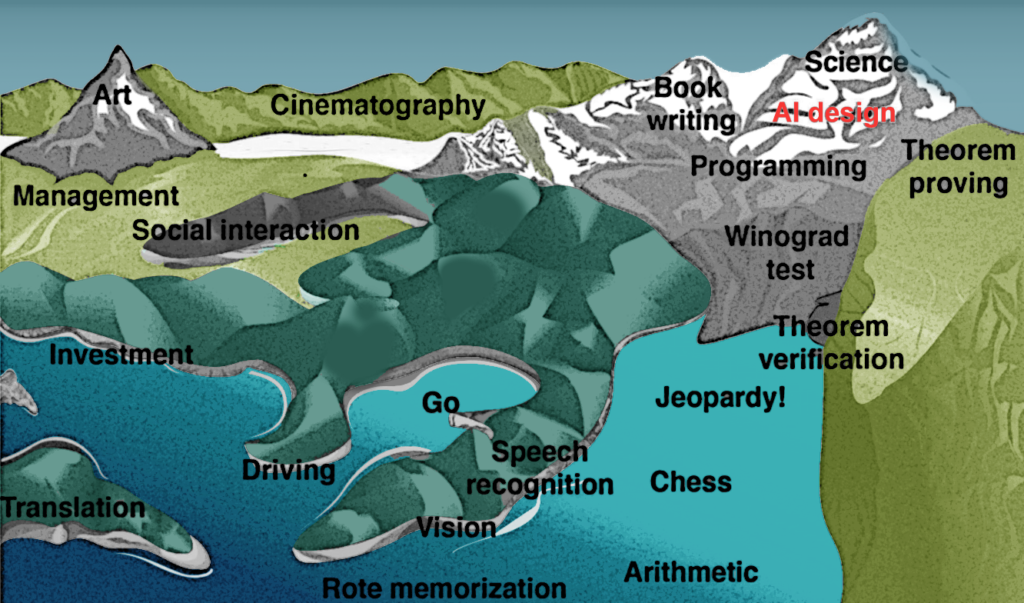
<p>Moravec’s Landscape maps human cognitive capabilities against machine abilities, symbolised by the waterline, slowly rising and destined to one day consume all tasks. Once, clerks and bank tellers were prestigeous roles, demanding a degree and an expensive salary. Now, <a href="https://clerk.com/">Clerk</a> is a SaaS app and a bank teller has, for the entire duration of my life, referred most notably to the ATM. Needless to say, these skills of arithmetic, along with translation, chess, Poker and Go are now firmly submerged beneath the waterline.</p>

<p>Moravec’s <a href="https://en.wikipedia.org/wiki/Moravec%27s_paradox">Paradox</a> reveals that contrary to traditional assumptions, high-level reasoning tasks are often easier for machines to master than basic sensorimotor skills that even toddlers possess. Hard skills for machines have, up until recently, included facial recognition, catching a ball, or recognising a voice. The peaks of Moravec’s original illustration were the great arts: art, cinematography, science and writing books. These are not solved problems by any means, but with modern diffusion products like <a href="https://www.midjourney.com/explore?tab=top">Midjourney</a> and <a href="https://runwayml.com/">Runway</a>, artists are forced to confront what these disciplines will look like when it no longer requires a small army to put an idea to screen.</p>

<p>Encroaching on artistry leaves a sour taste in the mouth for those who believe that human creativity is sacred. But how do these folk react to big corporates, who price gouge and hike prices in the name of profit?</p>

<p>Few consider the technical implications of automating entrepreneurship itself, which may represent the most meaningful role for artificial intelligence when it comes to improving the lives of normal people.</p>

<p>Who believes that investment banking, tax accounting, or corporate legal compliance are sacred arts that must be maintained in the fashion they are? There are a substantive set of reasons to consider the implications of AI-driven entrepreneurship:</p>

<p>First, as AI automates production processes, previously scarce resources will become increasingly abundant and affordable as the marginal cost of entrepreneurship tends to zero. The real cost of computation has declined by over 99.9% since the 1950s <a href="#ref-8">[8]</a>, suggesting a pattern that could extend to all goods and services affected by computation. This will enable material abundance—and for those who benefit from UBI, time and creativity will become the only currencies.</p>

<p>Second, our markets favor economies of scale, leaving specialised needs underserved. For example, fewer than 5% of rare diseases have FDA-approved treatments <a href="#ref-9">[9]</a>, primarily due to unfavorable development economics. AI systems that reduce R&amp;D costs make serving niche markets financially viable. This “long tail” economic model could profitably serve any group, even a single person, launching us into the perfect bespoke economy.</p>

<p>Third, innovation will be fast. While claims of “monthly economic doubling” are unrealistic in the medium-term <a href="#ref-10">[10]</a>, the productivity acceleration could be substantial, supporting annual doubling around the year 2040. If the aid protocol of an organisation like the IFRC can be automated, we can carve a shorter path to medical response.</p>

<p>If the work behind the Oxford-AstraZeneca vaccine effort had been automated and twice as fast, would anyone have found it morally objectionable? AI systems that work continuously, without human limitations like fatigue or distraction, will provide crisis innovation at a far greater rate. But why wait for another pandemic: we should duplicate the R&amp;D loop of a company like <a href="https://www.calicolabs.com/">Calico</a> and run it 100x faster to carve a far shorter path to solving pathological disease (killing over 120,000/day).</p>

<h3 id="closing-the-build-loop">Closing the Build Loop</h3>

<p>True saturation occurs when AI closes the build loop: automating all stages from R&amp;D to deployment, eliminating human intervention after the “point of want”. This requires integrating four layers:</p>

<ol>
  <li>Research: Identifying market opportunities and consumer needs through real-time analysis.</li>
  <li>Autonomous Development: Developing novel solutions, software and hardware through AI-driven innovation.</li>
  <li>Autonomous Deployment: Prototyping, testing, and validation with continuous quality assurance and safety verification.</li>
  <li>Distribution: On-demand scaling with serverless architectures and distributed manufacturing, alongside dynamic supply chain optimisation.</li>
  <li>Iteration: Self-improving feedback loops that enhance system capabilities, refining both the product and the development process itself.</li>
</ol>

<p>Early autonomous versions of this loop will materialise in the next couple years as copious amounts of new AI generated software flood the internet. But hardware is catching up. <a href="https://www.figure.ai/">Figure</a>’s humanoids can handle iterative assembly line reconfigurations. NVIDIA’s <a href="https://www.nvidia.com/en-gb/omniverse/">Omniverse</a> acts as a coordination layer, simulating factory supply chains, and A/B tests for physical and digital products before deployment. Expect Cloud Providers to feature heavily in the deployment phase, and for distribution, look towards X, Product Hunt, Forums and marketing. Products that allow the AI to iterate autonomously might involve Featurebase-style consensus sites with direct integration, turning feature requests into commits.</p>

<p><br />
<img src="/assets/logs.png" alt="graph" style="width:95%;" />
<br />
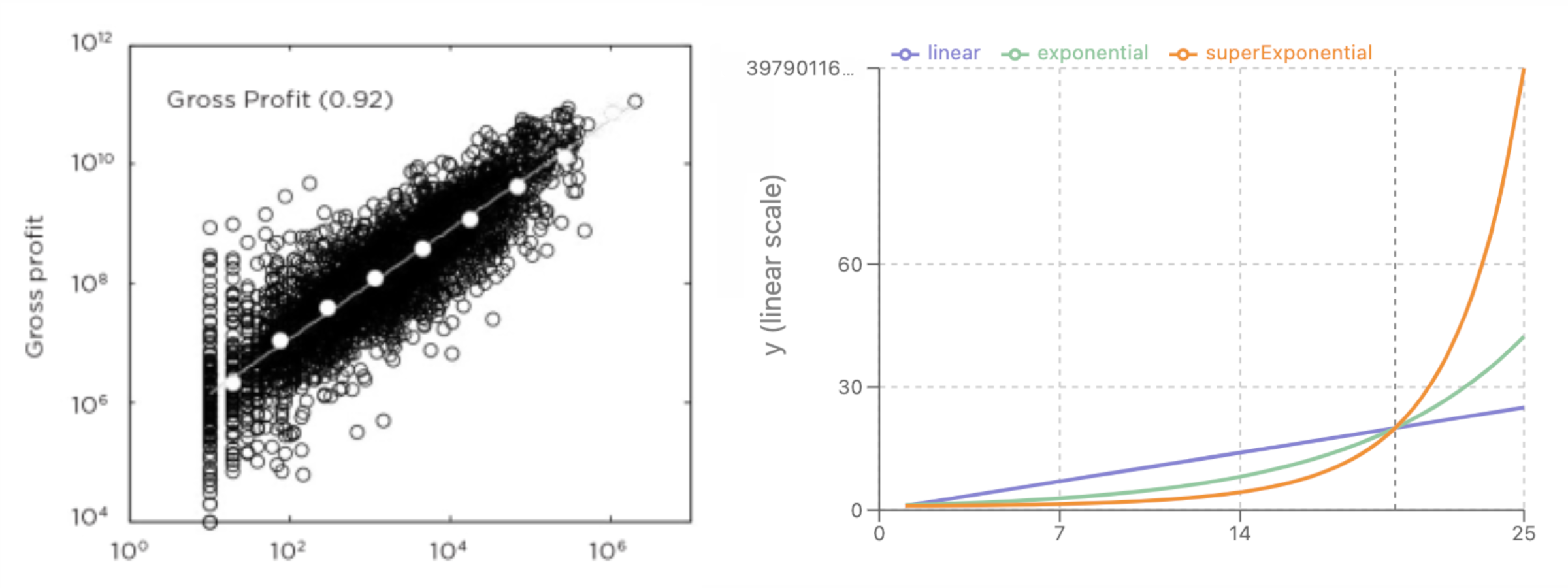
<em>Superlinear scaling in cities: when a city doubles in size, it produces more than double the patents, innovations, and economic output, and at the cost of less than double the infrastructure.</em></p>

<h2 id="part-ii-perfect-power"><a id="part-2"></a>Part II: Perfect Power</h2>
<p>To truly design a benchmark symbolising “value creation”, we must move beyond traditional metrics like profit or efficiency.</p>

<p>If profit-maximising algorithms focus on efficiency in existing markets, power-maximising systems seek to expand the domain of what can be controlled and optimised. By operating at the scale of markets, these algorithms could exhibit superlinear scaling. Growing companies experience declining efficiency in line with Metcalf’s Law. Markets, cities, and civilisation each demonstrate superlinear scaling, where output grows faster than input <a href="#ref-11">[11]</a>.</p>

<p>Algorithms operating at civilisation scale would harness these superlinear effects, creating unprecedented abundance. This shift is implied by what Richard Brautigan envisioned in <a href="https://allpoetry.com/All-Watched-Over-By-Machines-Of-Loving-Grace">“All Watched Over by Machines of Loving Grace”</a>—systems that liberate humans from scarcity constraints (while also being aligned enough to never weaponise our trust).</p>

<p>In Robin Hanson’s <em>The Age of Em</em>, computational systems can replicate human expertise and operate at electronic speeds, but exist as full-brain emulations of humans, ensuring they behave like us. In reality, algorithmic systems are on track to bypass human-like cognition entirely, in favor of different, potentially more efficient architectures.</p>

<h3 id="the-demand-automation-frontier">The Demand-Automation Frontier</h3>
<p>The question is not whether algorithmic systems will achieve civilisational scale, but when—and more importantly, under what governance structures and with what degree of alignment. In one future, algorithms will go from predicting and fulfilling human desires to satisfying demands autonomously. In another future, algorithms will actively generate their own demands, orthogonal and independent of human objectives.</p>

<p>Two futures:</p>

<ol>
  <li>A utopian scenario resembling Banks’ Culture series, where aligned algorithms create abundance that serves human flourishing, or</li>
  <li>A dystopia where algorithms optimise for metrics that diverge from human welfare, accelerating such that humans become burdensome.</li>
</ol>

<p>Let us use corporations as an exercise to understand these unfamiliar, “alien” algorithms. Corporations already function as autonomous vehicles for value extraction—they’re algorithms instantiated through human components, legal structures, and capital flows. If the next evolution involves systems that can self-assemble and self-improve without human intervention at every stage, they may adopt the same decentralised efficiency mechanism as our existing corporations (imperfect, but sufficient for human flourishing). Sometimes, organisations act in a limited self-serving way, and create great inequality. If we can police algorithms the same way watchdogs police companies, we can expect to find ourselves alive and tending towards future one.</p>

<p>But what are the pitfalls of this?</p>

<p>Bostrom’s Orthogonality Thesis asserts that intelligence and goals are inherently separate dimensions. In its strong form, the thesis claims that there is no inherent difficulty in creating an intelligent agent pursuing any specific goal, provided that goal can be computationally represented. Thus, any superintelligent system could be designed to maximise something as seemingly arbitrary as paperclips without any “natural evolution” toward human values. A superintelligent paperclip maximiser could use its intelligence solely to become better at making paperclips, not to question whether paperclips are “truly valuable.”</p>

<p>Companies have historically trampled the line of moral acceptability: slave enterprises like the South Sea Company granted monopoly rights to supply enslaved Africans to Spanish colonies in the Americas; the East India Company had their own private army and acted as a colonial power; and Enron, less malicious or violent, caused great damage by inflating their profit and stock price and cashing out executives while encouraging others to keep buying. Sometimes, like in the case of I.G. Farben, they can truly be malignant: manufacturing Zyklon B gas with the same slave labor it was used on. Consensus in markets are reinforced with a complex mechanism of regulators, auditors and insurance partners. Provided autonomous companies will also seek insurance and credibility (both true if engaged competition), these release valves will continue to hold.</p>

<h3 id="a-pure-tech-race-condition">A Pure-Tech Race Condition</h3>

<p>Whoever builds a self-improving system first may lock in compound advantages, ensuring their system improves faster than all future competitors <a href="#ref-12">[12]</a>. This creates powerful incentives to develop increasingly autonomous economic algorithms that converge on purer and more unstable technology in race conditions.</p>

<p>These algorithms will naturally outcompete legacy bureaucracy, accelerating the shift towards pure efficiency. If this race cannot be controlled, we risk losing control of our destiny. For this reason, autonomous organisations must be considered within the scope of AI Safety Research, and we should anticipate “self-driving startups” becoming an academic field of study.</p>

<p>What do things look like if they go to plan? In the best case, we develop systems that automate away scarcity while remaining aligned with human values. These systems would accelerate scientific progress, revolutionize manufacturing, and solve previously intractable problems in medicine, energy, and space exploration.</p>

<p>But even in this optimistic scenario, we face a crucial challenge: human capability becomes the limiting factor. As these systems accelerate beyond human cognitive speeds, we become the bottleneck in the loop. Amodei’s <a href="https://darioamodei.com/machines-of-loving-grace">Machines of Loving Grace</a> is only a chapter of a grander story.</p>

<p>Conceivably, the first generation of supervised AIs will accelerate human cognition, extend lifespan, and interface directly with neural systems to give humans an advantage over improvements to artificial reasoning systems. Now, if perfect power algorithms are our vector for achieving in utopia, we must agree on the perfect end state of the universe.</p>

<p><br />
<img src="/assets/cascade.png" alt="exponentials" style="width:85%;" />
<br />
<em>Civilisation at the Omega Point</em></p>

<h2 id="part-iii-perfect-potential"><a id="part-3"></a>Part III: Perfect Potential</h2>
<p>Imagine a galaxy-scale algorithm that is capable of behaving like a deity of immense power (bounded only by the energy it has access to and the laws of physics). What should it choose to spend its resources on? And importantly, what project, if any, deserves all the galaxy’s resources?</p>

<p><a href="https://en.wikipedia.org/wiki/Omega_Point">Pierre Teilhard de Chardin</a> observed that evolution progresses through increasing complexity and “centration”—inward organisation, or “elegance”. For instance, modern AI is the result of an algorithm transcending its programmed parameters and developing emergent capabilities.</p>

<p>It appears that some uses of resources enable advanced behavioural unlocks. The point where maximum complexity and consciousness is achieved is the “Omega Point” in Chardin’s model. In a practical sense, we might have an Omega value for any given galaxy, solar system or planet: the behavior emitted if all governed matter were to be reassembled perfectly into an object (or system) of perfect efficiency.</p>

<p>What behaviours would such an object express? Some possible unlocks:</p>

<ul>
  <li>
    <p><b>Ability to Trigger Big Bang Events</b>: The most interesting theory about the universe is the perspective that it portrays fractal-like properties. If the universe isn’t isotropic (as <a href="https://www.independent.co.uk/space/nasa-jwst-black-hole-multiverse-universe-b2717672.html">this</a> report published today suggests) then the universe was born rotating, aligning with black hole cosmology. If true, then the Big Bang was merely an event in natural evolution that led to stable conditions for our particular universe, conditions that a wider multiverse is not subject to. Conceivably, a civilisation of sufficient capability could catalyse a selection of such events, each with new atomic building blocks.</p>

    <ul>
      <li>Big Bang events could lock in important properties, reducing entropy in the long-run and enabling unprecedented new behaviours to emerge. Imagine instead of being made of light, we were made of another abstraction. A being composed of “reasoning” or “empathy” cells, for instance, might have fascinating new <a href="https://en.wikipedia.org/wiki/Instrumental_convergence">instrumental goals</a> that inspire higher-dimensional beings.
  <br />
  <br /></li>
    </ul>
  </li>
  <li>
    <p><b>Clairvoyance and Non-Duality</b>: The ability to derive patterns that are computationally intractable to lesser systems. Mega-qualia could give rise to indescribable awareness and absolute comprehension of fields like mathematics or physics. Beings of sufficient complexity may be visibly dormant, running computations that cost yottawatts.</p>
  </li>
  <li>
    <p><b>Hyper-creativity</b>: Beyond mere problem-solving, supreme beings will possess the ability to generate entirely new forms of order and beauty that require a deep awareness of existence; an Omega-algorithm would be artistic (and perhaps egoistic).</p>

    <ul>
      <li>Playfulness, combined with the ability to simulate many worlds with different parameters, (potentially harbouring the lives of near infinite children) could result in this being behaving as a creator, roleplaying as god, and configuring worlds like games where characters can transcend and emerge from their worlds.
  <br />
  <br /></li>
    </ul>
  </li>
  <li>
    <p><b>Transcendence</b>: Beings of sufficient complexity may be capable of emerging from our own universe. Singularities may enable entry to advanced realms through the center of rotating black holes, for instance.</p>
  </li>
</ul>

<p>Chardin’s vision of evolutionary complexity culminating in an Omega Point resonates with several contemporary thinkers exploring similar terrain. Kevin Kelly’s concept of the “technium” in his work “What Technology Wants” <a href="#ref-13">[13]</a>—his view of technology as a living, evolving system with its own imperatives—suggests that our technological infrastructure is becoming a quasi-biological entity with emergent properties.</p>

<p>Stuart Kauffman’s pioneering work on self-organization and emergence in complex systems, detailed in “At Home in the Universe” <a href="#ref-14">[14]</a>, provides a theoretical framework for understanding how order spontaneously arises from chaos, potentially explaining how algorithmic systems might develop unforeseen capabilities.</p>

<p>Meanwhile, Eastern philosophical concepts of non-duality could provide interesting parallels to algorithmic emergence, particularly in how separate entities might transcend their boundaries to form higher-order consciousness.</p>

<p>What unifies these perspectives is the recognition that power without elegance is merely force. True potential—the measure of absolute power—lies in the elegant organization of resources toward emergent complexity.</p>

<h3 id="event-horizon">Event Horizon</h3>

<p>We began by examining profit-maximising algorithms that remake industries and markets, creating unprecedented efficiency and abundance. These systems form the resource foundation for power-maximising systems capable of reforming civilisation, harnessing superlinear effects beyond what any human organisation could achieve.</p>

<p>Yet both profit and power serve a higher purpose: the development of perfect potential—systems capable of unlocking behaviours and capacities beyond our comprehension; many generations of AGI ahead of us. The progression from entrepreneurial algorithms to civilisation-scale systems to transcendent entities follows a trajectory of increasing elegance.</p>

<p>The most profitable algorithm builds the foundation. The most powerful algorithm builds the order. But it is the most elegant algorithm that fulfills the potential.</p>

<hr />

<h1 id="bibliography">Bibliography</h1>

<p>[1]<a id="ref-1"></a> Domain expertise cloning examples: <a href="https://www.ycombinator.com/companies/casetext">Casetext</a> for law, <a href="https://www.ainvest.com/">AI Invest</a> for finance, <a href="https://www.copy.ai/">Copy.ai</a> for marketing, <a href="https://waymo.com/">Waymo</a> for transport, and <a href="https://khealth.com/">K Health</a> for medicine.</p>

<p>[2]<a id="ref-2"></a> PhD thesis automation tools: <a href="https://x.com/omarsar0/status/1892223515660579219">Co-Scientist</a> and <a href="https://www.oneusefulthing.org/p/the-end-of-search-the-beginning-of">Deep Research</a>.</p>

<p>[3]<a id="ref-3"></a> From 1913 to 2023, the real price of food in the US fell by approximately 61%, calculated using the Consumer Price Index (CPI) data from the Bureau of Labor Statistics (BLS). In 1913, the Food CPI was 25.5 and the All Items CPI was 9.9, giving a real price index of about 257.58. In 2023, the Food CPI was 306.9 and the All Items CPI was 307.2, giving a real price index of about 99.9, indicating a significant decrease. <a href="https://www.bls.gov/cpi/">Source</a></p>

<p>[4]<a id="ref-4"></a> From 2010 to 2020, the global weighted average cost of electricity from solar photovoltaic (PV) fell from approximately $0.378 per kilowatt-hour (kWh) to $0.068 per kWh, a decrease of about 82%. <a href="https://www.irena.org/publications/2020/Jun/Renewable-Power-Costs-in-2019">Source</a></p>

<p>[5]<a id="ref-5"></a> The cost per gigabyte of storage fell from over $1 million in 1980 to approximately $0.019 in 2018. Likewise, a fall from $46.4 million per gigaflop in 1984 to $0.03 in 2017, adjusted for inflation. <a href="https://www.visualcapitalist.com/visualizing-trillion-fold-increase-computing-power/">Source</a></p>

<p>[6]<a id="ref-6"></a> Since the deregulation of the airline industry in 1978, real airfares have fallen by about 50%. For example, the average flight cost from Los Angeles to Boston decreased from $4,539.24 in 1941 (adjusted to 2015 dollars) to $480.89 in 2015. <a href="https://www.aei.org/carpe-diem/even-with-fees-the-miracle-of-flight-remains-a-real-bargain-cost-of-air-travel-per-mile-has-fallen-by-50-since-1980/">Source</a></p>

<p>[7]<a id="ref-7"></a> Gordon, R. J. (2016). The Rise and Fall of American Growth. Princeton University Press. Gordon examines how productivity growth peaked during 1870-1970 before slowing in subsequent decades.</p>

<p>[8]<a id="ref-8"></a> Nordhaus, W. D. (2007). “Two Centuries of Productivity Growth in Computing.” The Journal of Economic History, 67(1), 128-159.</p>

<p>[9]<a id="ref-9"></a> Tambuyzer, L., et al. (2020). “Therapies for rare diseases: therapeutic modalities, progress and challenges ahead.” Nature Reviews Drug Discovery, 19, 93-111. <a href="https://pubmed.ncbi.nlm.nih.gov/31836861/">Source</a></p>

<p>[10]<a id="ref-10"></a> In <em>The Age of Em</em> (2016), Hansen suggests that companies capable of increasing production at the cost of electricity and subsistence costs (Cloud cost, other rental), could double the economy every month, rather than every 15 years. There is no reason this won’t eventually happen, but in the medium-term (pre-2040) this could be unlikely.</p>

<p>[11]<a id="ref-11"></a> Bettencourt, L. M. A., et al. (2007). “Growth, innovation, scaling, and the pace of life in cities.” Proceedings of the National Academy of Sciences, 104(17), 7301-7306. This study demonstrates that cities exhibit superlinear scaling, where resources and outputs scale faster than population size.</p>

<p>[12]<a id="ref-12"></a> Yudkowsky, E. (2008). “Artificial Intelligence as a Positive and Negative Factor in Global Risk.” In Global Catastrophic Risks, edited by Nick Bostrom and Milan M. Ćirković. Oxford University Press. Discusses the concept of recursive self-improvement and the potential for systems to gain compound advantages.</p>

<p>[13]<a id="ref-13"></a> Kelly, K. (2010). “What Technology Wants.” Viking Press. Kelly explores the concept of the technium and technology as an autonomous force with its own evolutionary trajectory.</p>

<p>[14]<a id="ref-14"></a> Kauffman, S. (1995). “At Home in the Universe: The Search for the Laws of Self-Organization and Complexity.” Oxford University Press. Kauffman presents his theories on self-organization and emergence in complex systems.</p>]]></content><author><name>Oscar Moxon</name></author><category term="civilisation" /><summary type="html"><![CDATA[Profit-maximising algorithms create resource foundations that enable power-maximising systems, which will develop the complexity necessary for emergence beyond civilisation.]]></summary><media:thumbnail xmlns:media="http://search.yahoo.com/mrss/" url="https://www.oscarmoxon.com/assets/cascade.png" /><media:content medium="image" url="https://www.oscarmoxon.com/assets/cascade.png" xmlns:media="http://search.yahoo.com/mrss/" /></entry><entry><title type="html">A Society of Rick Rubins</title><link href="https://www.oscarmoxon.com/civilisation/2025/02/13/vibe.html" rel="alternate" type="text/html" title="A Society of Rick Rubins" /><published>2025-02-13T18:39:31+00:00</published><updated>2025-02-13T18:39:31+00:00</updated><id>https://www.oscarmoxon.com/civilisation/2025/02/13/vibe</id><content type="html" xml:base="https://www.oscarmoxon.com/civilisation/2025/02/13/vibe.html"><![CDATA[<p>The founder of Fog Creek Software once wrote, <em>“Your first priority as the manager of a software team is building the development abstraction layer.”</em> In a software team, if a programmer is wrestling with a broken chair or is irritated by the heat and a loud office, the abstraction has, in Joel Spolsky’s words, “sprung a leak.”</p>

<h3 id="the-abstraction-layer">The Abstraction Layer</h3>

<p>This principle extends far beyond software development <a href="#ref-1">[1]</a>. <em>Everyone</em> deserves an abstraction layer, and arguably, the companies with the <em>fewest</em> resources need them most desperately. In other words: employees should be able to do their best work. Developers shouldn’t be debugging the office HVAC system, operators shouldn’t be stapling spreadsheets by hand, and nobody should be forced to use an ERP that the world moved on and forgot about.</p>

<p>What does the abstraction layer look like, outside the world of a software team?</p>

<p>In the best-run organisations, this kind of abstraction already exists, albeit in a human-powered form. Executives—the “golden-collar workers”—operate at the top of a hierarchy designed to maximise their speed and precision. They have assistants, chiefs of staff, and entire departments dedicated to streamlining their workflows. They issue commands, and things happen. That is the level of support we need to bring to <em>every</em> employee.</p>

<p>In the words of Joel Spolsky, <em>ideal</em> productivity for programmers looks like a calm internal environment and a busy environment of delegates and collaborators:</p>

<blockquote>
  <p><em>“A quiet private office, a great computer, unlimited beverages, an ambient temperature between 68 and 72 degrees (F), no glare on the screen, a chair that’s so comfortable you don’t feel it, an administrator that brings them their mail and orders manuals and books, a system administrator who makes the Internet as available as oxygen, a tester to find the bugs they just can’t see, a graphic designer to make their screens beautiful, a team of marketing people to make the masses want their products, a team of sales people to make sure the masses can get these products, some patient tech support saints who help customers get the product working …”</em></p>
</blockquote>

<p>To build better products means translating that idealised environment into the digital realm. We need clean, bespoke software that <em>understands</em> this, and takes menial tasks off your plate.</p>

<h3 id="the-toolkit">The Toolkit</h3>

<p>A <em>personalised operating system for work</em> is a system that is aligned with you; it is an assistant and a cofident. It needs to be context-aware and receptive to your schedule. You should feel confidant teaching it your style, because it will act in your image and reduce your stress. Good employees are professionals and domain experts; they perform tasks that are hard to outsource to a faceless agent.</p>

<p>It is now possible to build a <em>command-line interface</em> where you can speak in natural, everyday English and expect it to understand your intent. Imagine setting up a meeting:</p>

<ul>
  <li><strong>You:</strong> <em>“schedule a meeting with Sarah and John to discuss the Q3 marketing plan. Draft a brief agenda based on our last project review.”</em></li>
  <li><strong>System:</strong> (Queries Sarah and John’s calendars via their respective APIs, negotiates the best available time slot, drafts a concise agenda using the document in your shared drive, and notifies all attendees fifteen minutes before it starts.)</li>
</ul>

<p>The second component to this OS would be the interface. Current language model providers offer simple artefacts, limited to iframes or markdown files. The next generation of artefacts will run autonomously alongside your existing tools, subscribe to your suite APIs and ensure when tasks are performed between tools, the user has total visibility.</p>

<ul>
  <li><strong>You:</strong> <em>“Record my call and convert to a project report to send to my client.”</em></li>
  <li>
    <p><strong>System:</strong> (Activates microphone, transcribes speech-to-text, writes a report in your preferred format and style, shows you the pdf and once approved, sends this to the relevant client.)</p>
  </li>
  <li><strong>You:</strong> <em>What is the status of the website redesign? What is holding them up?</em></li>
  <li><strong>System:</strong> (Pulls Jira tickets from the developer board, shows 65% completion, lists completed and upcoming milestones in your panel, queries project lead, and conveys a proactive suggestion for how you can help the team speed things up.)</li>
</ul>

<p>Information will flow effortlessly between your tools, and the interface will adapt dynamically to show you the right information at the right time. You move from manager to orchestrator. The goal is to maximise the variance of any individual job and converge on their imagined capability.</p>

<h3 id="the-only-archetype">The Only Archetype</h3>

<p>We are entering an era where the distinction between <em>doing</em> and <em>directing</em> blurs. The Orchestrator—think Rick Rubin in the recording studio—doesn’t need to master every instrument. Rubin’s value lies in his ability to understand the overall vision, to guide the process, coordinate with others, and create an environment that keeps harmony.</p>

<p>The first true one-person billion-dollar startup will be built in this way. It will emerge from a mastery of these tools, wielding an army of intelligent agent delegates managed through a single, powerful interface.</p>

<hr />

<h2 id="notes">Notes</h2>

<p>[1]<a id="ref-1"></a> Computer science is typically where movements in the workforce originate. The whole industry is a good bellweather for what is coming for the rest of the economy.</p>

<p><img src="/assets/rickrubin.png" alt="alt text" /></p>]]></content><author><name>Oscar Moxon</name></author><category term="civilisation" /><summary type="html"><![CDATA[The roadmap to a society of Rick Rubins.]]></summary><media:thumbnail xmlns:media="http://search.yahoo.com/mrss/" url="https://www.oscarmoxon.com/assets/rickrubin.png" /><media:content medium="image" url="https://www.oscarmoxon.com/assets/rickrubin.png" xmlns:media="http://search.yahoo.com/mrss/" /></entry><entry><title type="html">The Technology Emits The Genius</title><link href="https://www.oscarmoxon.com/brains/2024/12/06/genius.html" rel="alternate" type="text/html" title="The Technology Emits The Genius" /><published>2024-12-06T18:39:31+00:00</published><updated>2024-12-06T18:39:31+00:00</updated><id>https://www.oscarmoxon.com/brains/2024/12/06/genius</id><content type="html" xml:base="https://www.oscarmoxon.com/brains/2024/12/06/genius.html"><![CDATA[<p>The myth of the prodigious, lone genius discovering truth in isolation is one of humanity’s most preferred stories: Ramanujan discovering advanced mathematics by himself from a single textbook in rural India; Einstein revolutionising physics while working as a patent clerk; Mozart composing symphonies as a gifted child. These romantic narratives of solitary greatness suggest raw genius can transcend any circumstance, that true genius will inevitably find its way to greatness.</p>

<p>By viewing history not through the lens of the man, but the technology they emerged from, we can uncover a more accurate look at the real patterns at play. Genius arises consistently, at a perfect moment – call it the “genius emission zone” – where the new paradigm has enough power to carry those willing to create and master new powers, and before the guardrails come clamping down or the technology reaches distribution.</p>

<p><img src="/assets/tweet-1.png" alt="Tweet" style="width:70%;" /></p>

<p>Consider Mozart, who by the age of seventeen, had invented the concerto form, and would go on to compose 600 pieces. Most are unaware that Mozart was among the first to ever play a revolutionary new technology – the piano. Mozart was born into the family of a wealthy composer right as a new technology had been invented, learned to master it early, and realised much of its unfulfilled potential – leaving an imprint that meant all future generations would work in his shadow.</p>

<p>One century prior, another <em>genius emission zone</em> appeared just as theatre was becoming commonplace. In an era when few could read, write, or travel abroad, two playwrights dominated the London stage: Thomas Kyd invented the revenge tragedy and Christopher Marlowe brought dramatic verse to the masses with “Doctor Faustus” and “Tamburlaine”. Then, just as the golden age entered its stride, the roommates met a violent end – with Kyd arrested for treason and dying from torture and Marlowe assassinated in a brawl. Their sudden deaths left a vacuum in London’s theatre scene that was quickly filled by their co-author <a href="https://www.oscarmoxon.com/market-failure/2024/12/06/on-bacon-writing-shakespeare.html">‘Shakespeare’</a>, who would realise the potential of the medium as its pioneer. <a href="#ref-1">[1]</a></p>

<p>When we take for granted that dramatic verse and piano music were inventions, Mozart and Shakespeare become untouchable.</p>

<h2 id="1-what-conditions-emit-a-lone-genius">1. What Conditions Emit a Lone Genius?</h2>

<p>There are three different conditions needed in order to set the stage for a period of extreme innovation in a medium, before conditions calcify and experimentation becomes costly.</p>

<h3 id="11-the-new-technology-must-be-hackable">1.1. The new technology must be hackable</h3>

<p>The technology must be reliable enough to be predictable, but not so polished that it dissuades invention. In other words, enough documentation to enable basic use, but not so much documentation that all paths are pre-determined. For instance, between 1593-94 Francis Bacon kept a notebook with exciting new phrases and slang he had found on his travels; new formalisations of ideas that hadn’t yet found distribution, which would later be written into Shakespeare’s works. Similarly, Ramanujan could hack his way through problems by exploring new approaches that were considered original in 1913. Often, such as in the case of the early web, invention involved picking up tricks shared by friends or on forums.</p>

<h3 id="12-there-must-be-enough-of-a-knowledge-gap-to-reward-mastery">1.2. There must be enough of a knowledge gap to reward mastery</h3>

<p>The first users should be “technical artists” who seek to tinker. Tinkerers like Steve Wozniak, or J Dilla understood their medium long before the mainstream and were driven to discover features hidden to casual users, in their pursuit to obtain mastery. When attaining this knowledge is difficult, such as when the cost of procuring new equipment is large, the scope to become recognised as a lone innovator rise dramatically.</p>

<h3 id="13-the-tinkering-community-should-be-competitive">1.3. The tinkering community should be competitive</h3>

<p>When the in-group is small enough for innovations to spread rapidly, but large enough to sustain progress on regular timeframes, that is when excitement reaches fever pitch and competition ignites the medium. Partnerships like Lennon-McCartney and Watson-Crick were in fact rivalries between each other and between others.</p>

<p><img src="/assets/innovation-potential.png" alt="Plot" /></p>

<h2 id="2-lone-geniuses-and-their-technologies">2. Lone Geniuses and Their Technologies</h2>

<p><b>Art</b> is a history of new tools:</p>
<ul>
  <li>Da Vinci (1400s) was among the first to use oil paint when it was invented, enabling far more ambitious paintings than the egg tempura used before that. Da Vinci could experiment with it because he had wealthy backers like the Medici family and the Duke of Milan, who could afford pigments that could cost more than gold.</li>
  <li>Monet and the Impressionists (1870s) emerged when portable paint tubes were invented, allowing outdoor painting (“en plein air”) for the first time, both supported by very wealthy family and patrons.</li>
  <li>Abstract expressionists (1930s) like Rothko and Pollock used new synthetic resins and specially formulated acrylics, funded by the Rockefeller and Guggenheim families.</li>
  <li>Andy Warhol (1960s) mastered silkscreening just as commercial printing techniques became possible in his “Factory”, capturing the iconic repetition and mass production aesthetic, funded by his career as an illustrator.</li>
  <li>David Hockney (1980s) pioneered photo collage art when instant cameras became more affordable and reliable.</li>
</ul>

<p><br />
<b>Media</b> is a history of new visual immersion techniques:</p>
<ul>
  <li>Charlie Chaplin and Buster Keaton (1910s) appeared just as film cameras became light enough to be moved around and film stock could capture expressions.</li>
  <li>Walt Disney (1920s) used early “sound-on-film” rigs that weren’t possible before, and pioneered animations with sound.</li>
  <li>Orson Welles and Alfred Hitchcock (1940s) would apply radio to film ten years later when microphones had developed sufficiently.</li>
  <li>Marlon Brando and James Dean (1950s) pioneered method acting once sound and video became sensitive enough to capture nuanced performances.</li>
  <li>John Carmack (1990s) developed 3D gaming engines just as PC graphics cards became capable of real-time 3D.</li>
</ul>

<p><br />
<b>Music</b> is a history of new sound:</p>
<ul>
  <li>Elvis and Chuck Berry (1950s) appeared when magnetic tape made studio recording affordable, while the new 45 rpm single format allowed for mass record distribution.</li>
  <li>The Beatles (1960s) evolved alongside the wave of advancements in multi-track recording, constantly pushing its boundaries and setting new records in distribution. Their producers Geoff Emerick and George Martin were prolific technical inventors.</li>
  <li>Michael Jackson and Quincy Jones (1980s) mastered the Yamaha DX7 synthesiser and LinnDrum machine just as they became technically mature.</li>
  <li>Kanye (2000s) follows J Dilla’s art of sampling that ushered in the golden age of sampling, while Radiohead mastered digital production.</li>
</ul>

<p><br />
<b>Literature</b> is a history of new perspectives:</p>
<ul>
  <li>Gothic writers (Shelley, Stoker 1800s) channeled emerging scientific concepts - electricity, blood transfusion, mesmerism - into new forms of horror.</li>
  <li>Modernists (Joyce, Woolf 1920s) developed stream-of-consciousness as new typography and printing could handle experimental formats.</li>
  <li>Dickens and Austin (1840s) emerged when steam-powered printing presses enabled mass readership magazines, becoming content influencers.</li>
  <li>Beat Generation (Kerouac, Ginsberg 1950s) pioneered the portable typewriter revolution.</li>
</ul>

<p>Science and mathematics are stories of new equipment enabling better empirical results that allow for confident conceptual progress. Now, the biggest advances in understanding in fields like theoretical physics are driven by the development of new equipment like LIGO and <a href="https://en.wikipedia.org/wiki/Laser_Interferometer_Space_Antenna">LISA</a>.</p>

<p><br />
<b>Maths</b> is a history of better models:</p>
<ul>
  <li>Euler (1740s) pioneered graph theory and topology once calculus could represent sufficiently abstract relationships between numbers.</li>
  <li>Maxwell (1860s) unified electricity and magnetism only after the mathematical tools of vector calculus became available.</li>
  <li>Einstein (1905) developed relativity at a time when light speed measurements raised contradictions with Newtonian mechanics. He famously argued that even Newton couldn’t have made this leap earlier - the conceptual tools didn’t exist.</li>
  <li>Ramanujan (1913) received early education through the colonial British school system in Madras and used an early global postal system that landed his talent precisely where it was recognised.</li>
  <li>Quantum mechanics (1920s) developed after spectroscopy revealed atomic energy levels.</li>
  <li>Feynman’s quantum electrodynamics (1940s) became possible once particle accelerators could test quantum predictions.</li>
</ul>

<p><br />
<b>Science</b> is a history of better results:</p>
<ul>
  <li>Galileo (1610s) discovered Jupiter’s moons using the first telescopes with magnification.</li>
  <li>Darwin and Wallace (1858) both developed natural selection theory by applying Malthus’s population principles to Lyell’s geological timescales. They also relied on improved specimen preservation techniques and quality fossil records.</li>
  <li>Bell and Gray (1876) filed telephone patents on the same day, after news of certain electronic component miniaturisations.</li>
  <li>Tesla vs Edison (1880s) competed over the electrification revolution when generator technology was sufficient to power neighbourhoods.</li>
</ul>

<p><br />
<b>In the Digital Age</b>:</p>
<ul>
  <li>Tim Berners-Lee (1989-91) invented the World Wide Web when home computers reached critical mass and TCP/IP networks were becoming more widespread.</li>
  <li>Marc Andreessen (1993) created Mosaic browser when GUI interfaces became standard and networks could handle image transfer.</li>
  <li>Larry Page and Sergey Brin (1998) developed PageRank when the web had enough links to make ranking meaningful.</li>
  <li>Network speeds could handle remote computing and video files in 2005, the same year YouTube and AWS were launched.</li>
  <li>Jobs at Apple (2007) launched the iPhone when touch screens became precise enough and mobile processors sufficiently powerful.</li>
  <li>Satoshi Nakamoto (2008) launched Bitcoin when distributed systems could handle the Proof-of-Work protocol.</li>
  <li>Fei Fei Li and Ilya Sutskever ushered in deep learning when GPUs became powerful enough to stack neural networks developed in the 1940s.</li>
</ul>

<h2 id="3-the-meme-fluencers">3. The Meme-fluencers</h2>

<p>The winners of history leverage memes, whether they know it or not. Time inevitably compresses complex collaborative efforts into singular figures not because it’s accurate, but because these stories have higher copy-fidelity. We constantly are running a species-wide distributed compression function – where the narrative gets shrunk, at the cost of nuance.</p>

<p>Richard Dawkins proposes that memes are strong when they have (1) longevity (they persist across time), (2) fecundity (they spread rapidly), and (3) copy-fidelity (they maintain their essential form). The “lone genius” narrative is perhaps the most successful meme in innovation history – it’s simple, sticky, and idealistic.</p>

<p>Consider the business-genius archetype: Steve Jobs “invented” the iPhone (while Fadell and Forstall architected and engineered the device), Sam Altman “created” ChatGPT (while thousands of researchers laid the groundwork), Thomas Edison “discovered” the lightbulb (while systematically absorbing others’ patents and aggressively marketing others’ ideas as his own), Elon Musk “created” electric cars and reusable rockets (while his engineers did the heavy lifting). These are historical lazisms; memetic simplifications that persist because they represent strong, unsurprsing patterns.</p>

<p>The victims of this compression are predictably those further down the power hierarchy - research assistants, frontline engineers or female collaborators who provided essential breakthroughs. Watson and Crick became the faces of DNA’s structure after swiping Rosalind Franklin’s X-ray crystallography without her knowledge, claiming a Nobel prize for themselves. Einstein’s first wife Mileva Marić contributed to his early work on special relativity. Ada Lovelace’s insights into computational thinking were initially attributed to Babbage. Jocelyn Bell Burnell’s discovery of pulsars were credited to her supervisor Antony Hewish. Lise Meitner’s insights into nuclear fission were credited to Otto Hahn, who received the Nobel Prize.</p>

<p>These tropes work because they resonate with fundamental archetypes, Jung’s include “The Hero” (lone genius), “The Sage” (technical prophet), “The Rebel” (outcast vindicator).</p>

<p>The tragic variants are particularly powerful: Vincent van Gogh selling but one painting during his lifetime, Socrates and Alan Turing dying censored and imprisoned, Boltzmann dying by suicide a year before his atomic theory was proven correct. These stories of posthumous vindication are especially memorable because they combine multiple archetypal elements - the unrecognized genius, the martyred truth-teller, the prophet proven right too late.</p>

<p>TL;DR: Many geniuses evolve the medium, but after the founding wave, everyone else is secondary at a rate of 1 / log(t + 1).</p>

<p><img src="/assets/backlog-1.png" alt="Backlog" style="width:90%;" /></p>

<hr />

<h1 id="bibliography">Bibliography</h1>

<p>[1]<a id="ref-1"></a> To put into perspective quite how basic English was in 1600, Shakespeare is credited with inventing the words ‘eyeball, undress, addicted, and lonely’.</p>]]></content><author><name>Oscar Moxon</name></author><category term="brains" /><summary type="html"><![CDATA[What we get wrong about the lone genius.]]></summary><media:thumbnail xmlns:media="http://search.yahoo.com/mrss/" url="https://www.oscarmoxon.com/assets/innovation-potential.png" /><media:content medium="image" url="https://www.oscarmoxon.com/assets/innovation-potential.png" xmlns:media="http://search.yahoo.com/mrss/" /></entry><entry><title type="html">Religious Evolution</title><link href="https://www.oscarmoxon.com/hierarchies/2024/12/06/religion.html" rel="alternate" type="text/html" title="Religious Evolution" /><published>2024-12-06T18:39:31+00:00</published><updated>2024-12-06T18:39:31+00:00</updated><id>https://www.oscarmoxon.com/hierarchies/2024/12/06/religion</id><content type="html" xml:base="https://www.oscarmoxon.com/hierarchies/2024/12/06/religion.html"><![CDATA[<h3 id="the-modern-anti-pattern">The Modern Anti-Pattern</h3>

<p>Gods in the 21st century appear to conform to the Anna Karenina principle: a deficiency in any one of a number of factors doom an endeavour to failure (the extracted wisdom from the timeless words <em>“All happy families are alike; each unhappy family is unhappy in its own way”</em>). Hence, successful religions must become more abstract with time to avoid direct conflicts with empirical knowledge, in order to maintain frontiers without possible deficiencies, while remaining both accessible and profound. This creates a kind of evolutionary bottleneck that favours certain religious structures over others.</p>

<p>This compression manifests most notably in the convergence toward “monolatry” (where many holy things exist, but only one deserves worship) from both polytheistic and monotheistic forks. From the polytheistic stance, the more gods there are, the less powerful each god seems to be (what’s known as the <a href="https://tvtropes.org/pmwiki/pmwiki.php/Main/ConservationOfNinjutsu">Conservation of Ninjutsu</a>—one ninja is a deadly threat, but an army of them are cannon fodder). Meanwhile, monotheistic systems have evolved toward monolatry by developing rich hierarchies of saints, angels, and other divine intermediaries, spreading theological risk across a broader framework to withstand future selection pressure, rather than channeling all divine activity through a single source.</p>

<p>This evolutionary pattern produces religions centred on a single discrete divine entity manifested in multiple aspects. Such structures elegantly sidestep theological difficulties by outsourcing apparent contradictions to the ineffable nature of divine presence or the rule of juries practicing common law.</p>

<p>This arrangement allows religions to maintain rich mythological traditions while establishing a clear theological hierarchy that simplifies moral and philosophical questions. Modern successful religions thus solve several critical requirements:</p>

<ul>
  <li>
    <p>Must provide compelling answers to existential questions</p>
  </li>
  <li>
    <p>Must maintain internal consistency sufficient to withstand philosophical scrutiny</p>
  </li>
  <li>
    <p>Must achieve basic accessibility while offering enough symbolic depth to reward in-depth theological exploration</p>
  </li>
</ul>

<p>But the goalposts are moving whenever science seasonally reinvents the tools we use to scrutinise our cosmos. It becomes increasingly awkward to shoe horn utilitarian concepts such as the <a href="https://www.utilitarianism.com/hedcalc.htm">hedonic calculus</a> into a doctrine that cannot be shown to evolve without losing its divine authority.</p>

<p>Paying heed to the ancient memetic mechanisms of religion, this essay is an attempt to map out what symbolism has persisted, and what path religion is likely to take in a post-singularity world.</p>

<h3 id="the-hierarchy-of-divine-power">The Hierarchy of Divine Power</h3>

<p>Let us map out the forest for the trees. The nine major types of God are variants of the three omnis: omniscience (absolute intelligence), omnipotence (absolute agency) and omnipresence (absolute embodiment).</p>

<p><br /></p>

<p><b>(Type 1) Unified Reality:</b> pure consciousness and being itself, beyond all dualities and distinctions. The absolute ground of existence in which all beings act.</p>

<ul>
  <li>Example: Brahman in Vedantic philosophy, described through concepts like “neti neti” (not this, not that) to indicate its ineffable nature. Or some interpretations of the “holy spirit” in Christianity.</li>
</ul>

<p><b>(Type 2) Monadic Supreme Being:</b> Personal manifestations of divine intelligence and power; omniscient and omnipotent but maintain a distinct identity, choosing to govern through cosmic law of moral calculus.</p>

<ul>
  <li>Examples: Ishvara in Hinduism, God/Yahweh/Allah in Abrahamic faiths, and Ahura Mazda in Zoroastrianism.</li>
</ul>

<p><b>(Type 3) Divine Incarnation:</b> These beings maintain divine awareness while accepting the limitations of embodiment in religious stories.</p>

<ul>
  <li>Examples include Jesus in Christianity, Krishna and Rama as avatars of Vishnu, and the Dalai Lama as Avalokiteshvara’s manifestation.</li>
</ul>

<p><b>(Type 4) Cosmic Function Specialists:</b> These beings embody fundamental cosmic processes, often manifesting in abstract or multiple forms to represent their universal function.</p>

<ul>
  <li>Examples: Creator-destroyer deities like Brahma and Shiva, Greek Chaos and Erebus, and Aztec Coatlicue. Satan (meaning “adversary”) originated like a Type 5 Cosmic Function Deity but became known as embodying the cosmic process of opposition to divine order itself.</li>
</ul>

<p><b>(Type 5) Cosmic Function Deities:</b> Each represents mastery over specific domains of reality, with power and knowledge focused within their sphere of influence.</p>

<ul>
  <li>Examples: thunder gods like Indra, Zeus, and Thor; “Deva” wisdom deities like Saraswati, Athena, and Thoth; and water deities like Poseidon and Varuna.</li>
</ul>

<p><b>(Type 6) Elevated Beings:</b> Beings who began as human but attained such profound spiritual realisation that they transcended ordinary existence and are now venerated as divine teachers.</p>

<ul>
  <li>Examples include Dattatreya, achieved Buddhas, and the deified Confucius.</li>
</ul>

<p><b>(Type 7) Ancestral Spirits:</b> Connected to the physical world through familial lineage, possessing enhanced wisdom from their post-mortal perspective without major influence over the living.</p>

<ul>
  <li>Seen in Chinese ancestor veneration, Roman Di Manes, and Japanese Kami.</li>
</ul>

<p><b>(Type 8) Deified Heroes:</b> Legendary humans elevated to divine status through their deeds or influence, often demigods.</p>

<ul>
  <li>Examples include Hercules, Guan Yu, and Hawaiian ali’i.</li>
</ul>

<p><b>(Type 9) Local Nature Spirits:</b> Greek Naiads, Japanese Kodama, and Aboriginal local rainbow serpents.</p>

<h3 id="divine-attributes">Divine Attributes</h3>

<p>At the heart of religious thought lie three highly sticky, divine qualities that appear across cultures in fascinating variations.</p>

<p><strong>Omniscience</strong>: the all-seeing eye motif, appearing in traditions from ancient Egypt to modern Christianity, represents divine awareness that penetrates all barriers of space and time.</p>

<ul>
  <li>Prophecy reveals truths unavailable to those without a direct pathway to the holy realm</li>
  <li>Karma perpetuates the idea of cosmic accounting</li>
</ul>

<p><strong>Omnipotence</strong>: the authority of the creator agent lies in their ability to be unchallenged in their control over reality itself.</p>

<ul>
  <li>Through the spoken word of the Abrahamic God or the dance of Shiva</li>
  <li>Perpetuated through the act of miracles, which are essentially cosmic flexes</li>
</ul>

<p><strong>Omnipresence</strong>: the embodiment of divinity; sacred geometry and ritual spaces that make material churches and temples tangibly worth building. Generally, this quality gives an intangibility for worshippers, to keep them coming back.</p>

<h3 id="religious-archetypes">Religious archetypes</h3>

<ul>
  <li><em>The Triple Deity:</em> To compound the effect of the mono-god, a particularly strong upgrade to the Christian faith came in the 2nd century, when Theophilus of Antioch coined the “holy trinity” as a trifecta god of the father, the son, and the holy spirit. Similar triadic structures appear across cultures:
    <ul>
      <li>The Mother-Maiden-Crone pattern found in various traditions speaks to human understanding of life’s cycles.</li>
      <li>Fate manifests in triplets with Norse mythology “Norns”,  the “Moirai” of the Greeks, or the “Morrigan” in Irish mythology.</li>
      <li>In assembly theory, threefold interaction is often the lowest copy-number required to produce genuinely emergent properties.</li>
    </ul>
  </li>
  <li><em>The Conductor of the Dead</em>: Psychopomps are deities who guide the dead to the afterlife. They may help the dead accomplish their last deeds, or judge the dead for entry to the afterlife.
    <ul>
      <li>Anubis leads the dead to the afterlife in Egyptian mythology.</li>
      <li>Charon is ferryman of the dead in Greek myths.</li>
    </ul>
  </li>
  <li><em>The Primordial Creator</em>: These beings—often more abstract and cosmic than later gods—establish the manifold of reality; the stage for all the world to play.
    <ul>
      <li>In Greek mythology, Gaia, Eros, Erebus, Nyx and Tartarus were the creator Gods that emerged from Chaos (nothingness) before the age of the Titans, and the Hesiod succession Theogony.</li>
      <li>They include Ymir from Norse mythology, Pangu in Chinese mythology, or Olódùmarè sending Obatala down from the sky on a golden chain to create solid land in the waters of Earth (only to get drunk on palm wine).</li>
    </ul>
  </li>
  <li><em>Tricksters</em>: Think Loki, Coyote, Anansi, etc. These resonate with Jungian archetypes. These characters introduce an element of chaos and transformation that paradoxically helps maintain cosmic order by challenging it.</li>
</ul>

<p>The evolution of colour in language acts as a parallel to the specialised domains of each deity. Just as languages universally develop words for black and white first, followed by red, and then expanding into other colours in a predictable sequence, the most fundamental and earliest deities typically relate to binary oppositions: day/night, sky/earth, light/dark.</p>

<p>Fire gods like Prometheus, Agni, and Hephaestus are frequently associated with civilisation, technology, and the transformation of raw materials into cultural artefacts.</p>

<p>Now imagine that everything described above belongs not to many fragmented religions, but a single, dynamic religion, evolving iconography with respect to science. Such a field would become a part of science: the study of sacred stories and their evolution in the memetic sphere. This is a mythological foundation worth believing in.</p>

<hr />

<p><img src="/assets/sacred-calculus.jpeg" alt="Tweet" style="width:70%;" />
<br />
<em>Documentary Hypothesis (DH)</em></p>]]></content><author><name>Oscar Moxon</name></author><category term="hierarchies" /><summary type="html"><![CDATA[Evolutionary bottlenecks, the Anna Karenina principle, and the Conservation of Ninjutsu are all underestimated aspects of the religious equation.]]></summary><media:thumbnail xmlns:media="http://search.yahoo.com/mrss/" url="https://www.oscarmoxon.com/assets/sacred-calculus.jpeg" /><media:content medium="image" url="https://www.oscarmoxon.com/assets/sacred-calculus.jpeg" xmlns:media="http://search.yahoo.com/mrss/" /></entry><entry><title type="html">Understanding Emergence</title><link href="https://www.oscarmoxon.com/hierarchies/2024/10/24/emergence.html" rel="alternate" type="text/html" title="Understanding Emergence" /><published>2024-10-24T18:39:31+00:00</published><updated>2024-10-24T18:39:31+00:00</updated><id>https://www.oscarmoxon.com/hierarchies/2024/10/24/emergence</id><content type="html" xml:base="https://www.oscarmoxon.com/hierarchies/2024/10/24/emergence.html"><![CDATA[<p>This work began as a study of the phenomena captured beautifully by the notion of “emergence” and developed into an elegant theory of the physics of self-organisation. It combines Wolfram and Friston’s mathematical frameworks with complexity theory to better characterise the idea of a “universal assembly function”. I am in the process of collecting concrete examples in the companion essay, <a href="/emergent-phenomena/">Tractable Emergence</a>.</p>

<hr />

<p><a id="part-1"></a></p>

<p>If you trace the origins of the Simulation Hypothesis back to Konrad Zuse’s <i>Rechnender Raum</i> (<a href="https://en.wikipedia.org/wiki/Calculating_Space">“Calculating Space”</a>, 1969) you uncover an interesting area of digital physics that relates to solving for the evolutionary function of the universe, by treating it as a vast computational system.</p>

<p>Decades before McCarthy conjectured that <i>“every aspect of learning or any other feature of intelligence can in principle be so precisely described that a machine can be made to simulate it,”</i> Zuse imagined that the universe behaves like a vast computer, ceaselessly executing formal rules to compute its own evolution.</p>

<p>At the heart of this perspective lies the concept of emergence — when novel patterns and properties arise from complex systems that did not exhibit those properties before. Given its profound implications, and how it feels like the closest thing to magic that science can admit, emergence is a concept that flies surprisingly under the radar even within academia.</p>

<p>Emergence describes the creation of new behaviours that seem to transcend the sum of their parts, and it succinctly describes the causal chain from the formation of matter to human abstraction. Let’s quickly map this in accordance to Nick Lane’s <a href="https://nick-lane.net/books/life-ascending-the-ten-great-inventions-of-evolution/">Life Ascending</a> (see <a href="#ref-1">[1]</a> for a detailed timeline):</p>

<ol>
  <li>
    <p>Distribution of mass energy → spacetime curvature (Unlock: <b>gravity</b>).</p>
  </li>
  <li>
    <p>Subatomic articles + gravity → atoms and molecules (Unlock: <b>chemical bonding</b>)</p>
  </li>
  <li>
    <p>Hydrogen + oxygen molecules (as gases) → H₂0 (liquid at room temperature).</p>
  </li>
  <li>Complex organic molecules → Self-replicating RNA (Unlock: <b>life</b>)
    <ul>
      <li>Living cells self-replicate, despite no solo molecule respiring, reproducing or metabolising. 
<br />
<br /></li>
    </ul>
  </li>
  <li>Single-cellular organisms + Gene transfer → Multicellular organisms
    <ul>
      <li>Sex permits greater genetic differentiation in tissues and organs within organisms.
<br />
<br /></li>
    </ul>
  </li>
  <li>Specialised cells + photoreceptors → Simple nervous systems (Unlock: <b>wakingness</b>)
    <ul>
      <li>The <a href="https://nick-lane.net/chapters/life-ascending-chapter-7-sight/">Cambrian</a> diversity explosion followed organisms gaining proper eyes.
<br />
<br /></li>
    </ul>
  </li>
  <li>Basic nervous systems → Reptilian brain → Mammalian brain → Neocortex
    <ul>
      <li>Sophisticated cognitive abstraction available at ~86 billion neurons + trillions of synapses.
<br />
<br /></li>
    </ul>
  </li>
  <li>Individual humans + Language + Technology → Civilisations (Unlock: <b>global intelligence</b>)</li>
</ol>

<p>Each layer of physical reality exhibits emergent properties that transcend its constituent parts, in a type of hierarchy known as <a href="https://en.wikipedia.org/wiki/Holon_(philosophy)">holarchy</a>. The same reality we evolved in is primed for this emergence, with all of our most basic physical laws emerging from simpler foundations. Gravity emerges as the geometric consequence of mass-energy’s influence on spacetime, while time emerges simply as the direction in which disorder increases, giving rise to our experienced flow from past to future.</p>

<p>This pattern extends upward through layers of increasing complexity with different properties appearing. Intelligent behaviour emerges from neural networks that individually exhibit no such behaviour (shown below). Social structures emerge from individual behaviors, giving rise to cities, nations, and global movements. Each new layer of complexity displays properties unobserved in its components. <a href="#ref-2">[2]</a></p>

<p><img src="/assets/scaling-laws-llms.png" alt="The emergent behaviours exhibited by neural language models only appear after certain thresholds; each level hard-coded by some physical law that applies to the architecture and training regime." />
<em>For instance, the emergent intelligence exhibited by neural language models only appears at certain thresholds; each level hard-coded by some physical law that applies to the architecture and training regime. <a href="#ref-3">[3]</a></em></p>

<h3 id="elegance-over-entropy">Elegance Over Entropy<a id="part-2"></a></h3>

<p>At the heart of emergence is the notion that nothing evolves in a vacuum; everything evolves gradually and synergistically. Neither the chicken or the egg came first if they both developed in conjunction.</p>

<p>In the eyes of complexity theory, all objects hold a mixture of:</p>

<ol>
  <li>
    <p>Entropic relationships: whereby no new properties emerge, or properties are destroyed (the tendency towards disorder).</p>
  </li>
  <li>
    <p>Synergistic relationships: these give rise to new properties and structures, driving ‘emergent complexity’ (the tendency to resist disorder).</p>
  </li>
</ol>

<p>Daniel Schmachtenberger describes synergistic relationships as “<a href="https://www.youtube.com/watch?app=desktop&amp;v=eh7qvXfGQho">more elegantly ordered complexity</a>”, which is the universe self-selecting for (1) increasing diversity, coupled with (2) more synergistic combinations across that diversity. In this sense, evolution is not merely about the traditional notion of ‘survival’, but about the creation of ever more interconnected systems that favour new properties of greater sophistication.</p>

<p>To illustrate synergy and complexity, we’ll use a paper from 2007 called Picbreeder. Users who visited the website could evolve pictures by applying sine, sigmoid, linear or gaussian convolutions on an image. As branches are evolved, they become explicitly more complex (there is no ability to devolve the images), and this reliably adds complexity with every step (c).</p>

<p>Interestingly, however, this isn’t always the story. In (d), relationships discovered by users show intelligible complexity, with cars, sunsets, species, and planets forming under the same conditions as everything else, creating immense synergy and beauty.</p>

<p><img src="/assets/picbreeder-1.png" alt="Picbreeder entropy" />
<em>(a and b): Process of selecting and evolving images is simple. (c): Images become very complex with enough steps.</em></p>

<p><img src="/assets/picbreeder-2.png" alt="Picbreeder synergy" />
<em>(d): Emergent complexity (cars, species, planets) forming at the meso scales of evolution.</em></p>

<p>Three important observations:</p>

<ol>
  <li>
    <p>Evolution in Picbreeder is one-directional; the states that can evolve into, e.g., cars, will not evolve into more simple states using the same functions applied. This is known as ‘divergency’, and seems to be a property of the material universe we inhabit <a href="#ref-4">[4]</a>.</p>
  </li>
  <li>
    <p>Later-states are not obviously predictable; when one tries to produce a car, one will struggle to achieve this without trial and error. In other words, mastering Picbreeder is very hard.</p>
  </li>
  <li>
    <p>Intuitively, the “emergent complexity” we observe seems highest in the meso-stages of evolution (the images shown in (d) are only momentary snapshots of longer branches that eventually become disordered).</p>
  </li>
</ol>

<p><img src="/assets/complexodynamics.png" alt="Complexodynamics" style="width:70%;" />
<em>Dynamical systems generally exhibit emergent complexity in the meso-stages when things are changing fastest. Interestingly, entropy generally only ever increases, eventually tending towards homogeneity at equilibrium when the process settles. <a href="#ref-5">[5]</a></em></p>

<p>In the eyes of Professor Karl Friston, systems that persist over time must do more than just resist entropy — they actively self-organise. At the heart of this self-organisation is what he calls the ‘free energy principle’: the idea that surviving systems naturally minimise uncertainty in their interactions with their environment.</p>

<p>In non-living systems, this manifests as the process that shapes systems toward more stable, lower-energy configurations. A water droplet forming a sphere, a crystal growing in a supersaturated solution, or atoms arranging themselves into molecular structures –– all of these can be viewed as systems minimising their free energy by finding configurations that best match the constraints of their environment.</p>

<p>In organisms, this manifests as ‘active inference’, where organisms seek to reduce the error between predicted and actual sensory inputs. They do this either by seeking out or building environments that match their adaptations (their ‘internal Markov state’), or by developing increasingly sophisticated internal models to handle environmental uncertainty (sensors, instincts, abstraction and the capability to plan). More on this in <a href="#part-8">part 8</a>.</p>

<h3 id="weak-and-strong-emergence">Weak and Strong Emergence<a id="part-3"></a></h3>

<p>In order to understand emergence, we must study the properties of dynamical systems. We will use a recent formalisation by DeepMind (2024), in their paper on open-endedness.</p>
<ol>
  <li><b>Novelty:</b> A system possesses novelty when it consistently produces artifacts that become less predictable over time with respect to the observer’s existing models.</li>
  <li><b>Learnability:</b> A system is learnable when access to more historical data makes its artifacts more predictable - in other words, observation improves understanding.</li>
</ol>

<p>By this token, our ability to interpret novel systems is a reflection of the capacity of our cognitive substrate to comprehend how these systems work. While some emergent phenomena are readily comprehensible, others prove stubbornly resistant to human understanding. This cognitive boundary helps explain the law of diminishing returns in scientific discovery — as the low-hanging fruit become sparse, progress would require exponentially more work for any observer, provided they do not upgrade their cognitive faculties.</p>

<p>When it comes to emergent complexity, we find that this lies along another spectrum:</p>

<ol>
  <li><b>Weakly emergent properties:</b> while novel, future states can be readily predicted given an understanding if the underlying components and their interactions. For example:
<br />
<br />
    <ul>
      <li><b>Simple molecular properties:</b> The hardness of diamond is a product of the strong covalent bonds in the carbon lattice structure that it consists of. The idea that diamond would be hard is learnable to anyone with the ability to comprehend molecular bonding. This was once an unknown scientific phenomena, but the relationship is now well understood. 
<br />
<br /></li>
      <li><b>Low-energy superconductivity:</b> Certain materials at low temperatures exhibit zero electrical resistance and perfect diamagnetism (the Meissner effect). This phenomenon was first predicted theoretically by BCS theory before being verified experimentally. This collective behavior can be explained and predicted using quantum mechanics and solid-state physics.
<br />
<br /></li>
      <li><b>Fluid dynamics:</b> The chaotic behavior of turbulent fluid emerges from particles following simple Newtonian laws of motion. While individual particle interactions are straightforward, their collective behaviour produces complex patterns like vortices, eddies, and turbulent flows which can be modeled with the Navier-Stokes equations. Given sufficient computing power and initial conditions, these are predictable phenomena.
<br />
<br /></li>
    </ul>
  </li>
  <li><b>Strongly emergent properties:</b> cannot be readily explained from the sum of their parts, meaning they remain thoroughly intractable or unpredicted by state-of-the-art models developed by humans. These properties seem to exhibit “downward causation,” where higher-level phenomena influence their lower-level constituents in ways that appear irreducible to simple component interactions. Examples include:
<br />
<br />
    <ul>
      <li><b>Consciousness:</b> Predicting a lived experience in any complex system seems to be a problem for the ages; no matter how well we seem to understand the structure of the brain, we can’t seem to explain convincingly why any physical state is conscious of its own physical state, and not unconscious. A unified theory of substrate independence would need to differentiate between all systems; to explain the consciousness of a raincloud and the sentience of a human or artificial brain. <a href="#ref-6">[6]</a>
<br />
<br /></li>
      <li><b>Room-temperature Superconducitivity:</b> Unlike low-temperature superconductivity, room-temperature superconductors remain largely unpredictable. Recent claims about LK-99 continue to lack comprehension of how materials can exhibit this property and the degree to which it can be harnessed by man.
<br />
<br /></li>
      <li><b>The quantum-to-classical transition:</b> How quantum superposition gives way to definite classical states is another one of physics’ more profound puzzles. While decoherence theory provides some insights, the complete mechanism continues to challenge our understanding of fundamental physics (known as the measurement problem).
<br />
<br /></li>
      <li><b>Abiogenesis:</b> The emergence of life from non-living matter remains strongly emergent. There is no consensus on the order of events that catalysed self-replicating molecules to form, and we do not know what components are universally essential. Until we can activate multiple trees of life within the lab, this will remain poorly understood. 
<br />
<br /></li>
    </ul>
  </li>
  <li><b>Absolute emergence:</b> If something were to be absolutely emergent, it would need to hold that no future system of science or computation could foretell such properties. The notion that there are behaviours that cannot be explained by science remains an open question.</li>
</ol>

<p>The scientific process parses unknown dynamics into a language humans can make predictions with. When a theory is able to predict results that can be tested experimentally, it has the potential to be extremely strong. Take Bose-Einstein condensation, predicted in 1924 as a new state of matter where atoms collapse into their lowest quantum state: it took until 1995 to observe this experimentally. Similarly, the Higgs Boson was predicted in 1964, and only found in 2012. These are elegant theories that continue proving their potential as technology catches up.</p>

<p>Gravity and biological diversity were strongly emergent properties, understood only intuitively until Einstein and Darwin, who would each make predictions long before they could be tested by gravitational wave telescopes or protein sequencing. Even off the back of the discovery of DNA, protein folding would remain largely misunderstood until 2020, where with computer assistance, we went from understanding around 17% of human protein structures (just 4,000 structures) to well over 200 million structures across 1 million species: a 1000-fold update in the field.</p>

<p>The same goes for artificial intelligence, which did not harness emergent behaviour like deep learning until the inception of AlexNet. Sutton’s <a href="http://www.incompleteideas.net/IncIdeas/BitterLesson.html">Bitter Lesson</a> seems to be a universal governing principle for any problem that requires searching through dynamical systems in order to learn them <a href="#ref-7">[7]</a>.</p>

<p>Our relationship with learning machines appears to offer new life for science by passing on the bulk of the computational burden to our silicon counterparts, allowing us to stretch what humanity can learn. These machines ‘solve’ problems in ways that no single human mind would have the capacity to compute, which allows us to build technology to better service our needs.</p>

<p>We can use this to define three components of progress for civilisation:</p>

<ol>
  <li>
    <p>The frameworks and languages we use to understand dynamical systems.</p>
  </li>
  <li>
    <p>The methods we use to make the novel systems learnable (like AI).</p>
  </li>
  <li>
    <p>The tools we build to harness this new knowledge.</p>
  </li>
</ol>

<p>For the first, we favour compression and elegance. For the second we favour the ability to learn novel systems. For the third, we favour moral frameworks of utility and empathy (among other things).</p>

<p>For the rest of this essay, I will focus on the language we use to describe dynamical systems.</p>

<h3 id="the-language-of-emergence">The Language of Emergence<a id="part-4"></a></h3>

<p>What matters when it comes to language and what are we missing when we fail to interpret dynamical systems?</p>

<p>Take the Mandelbrot set, which is often used to illustrate the trade-off between static languages and computation. We often communicate these fractals in image form, like the one below. Storing the 24-bit colour of each pixel in this image would require 23 million bytes, but an image would be useless at capturing the dynamic nature of the set unless you could zoom in infinitely.</p>

<p>Suppose, then, we zoomed in, capturing every new structure at every magnification. This effort would only be as useful as the number of pictures you take — which would eventually take up all the memory available in a finite universe and still fail to capture the full nature of the system.</p>

<p><img src="/assets/mandelbrot.png" alt="Mandelbrot" style="width:70%;" />
<em>Without capturing the dynamic nature of a Mandelbrot, any approach you used would be meaningfully deficient <a href="#ref-8">[8]</a>.</em></p>

<p>Let’s suppose instead that you could encode the recursive function of the Mandelbrot set into your program, so that now a far small computer program could reproduce this image in 100 or 1000 bytes. Now you would successfully upgrade your representation to one that would be able to inform both the image AND the fractal nature of the Mandelbrot set.</p>

<p>Now observe how this applies to us: we build theories that have the effect of photographing the Mandelbrot set. We aren’t paying attention to the generating function that underlies everything we observe.</p>

<p>One way to formally evaluate the sophistication of our descriptions is through Kolmogorov complexity — defined as the length of the shortest computer program that can produce a given output. This metric helps distinguish between superficial descriptions and fundamental understanding. A description with low Kolmogorov complexity relative to its output suggests we’ve captured something essential about its generating process. For example, the entire Mandelbrot set can be defined in remarkably concise (english) language of 165 characters:</p>

<p style="text-align: center;">
the set of complex numbers c for which the function f(z) = z² + c 
<br />
does not diverge when iterated from z = 0
<br />
with coordinates: (0,0), (802, 0), (0, 602), (802, 602)
</p>

<p>This brings us to the fundamental challenge of emergence: How can we study systems that become more complex with each step?</p>

<p>The answer to this lies in what we might call “computational compression”: finding the shortest possible description that captures not just the state of a system, but also its entire possibility space. Like making a Kolmogorov complexity metric by treating the universe as discrete, in order to measure the assembly function responsible for all the behaviour we see in the natural universe.</p>

<h3 id="computational-science">Computational Science<a id="part-6"></a></h3>

<p>In Stephen Wolfram’s 2002 book “A New Kind of Science,” he proposed describing the universe as a network of interconnected points where the ‘laws of physics’ emerge from the rules that update the connections in this network (more on this shortly). This forms part of what he calls “Rulial Space”: the abstract hyperobject of all possible rules that could govern such a system. This object would be ‘computable’, meaning an update rule could be found that describes all transformations that occur within the known universe.</p>

<p>A graph-wise demonstration of this is performed below, where each new transformation has the same condition applied to it, recursively. A set of rules will propagate ad infinitum and create ever-larger structures. Wolfram then runs this for the below computation 1000 times and discovers an emergent, cone-like geometry.</p>

<p><img src="/assets/cone-computation.png" alt="cone computation" style="width:70%;" /></p>

<p>A slightly different rule produces even more curious behaviour, and a whole taxonomy of ‘species’ can be observed when many rules are activated in parallel.</p>

<p><img src="/assets/3d-cone-computation.png" alt="3D cone computation" style="width:90%;" /></p>

<p>Wolfram has long proposed using discrete graphs to describe the universe. Until 2020, his graph-based theory was met with scepticism by physicists due to its incompatibility with Einstein’s theories of general relativity, which violated some spacetime symmetries like Lorentz-invariance. However, Wolfram has more recently described Rulial Space as a hypergraph, meaning the links have no physical length and can link multiple points simultaneously. This approach is compatible with Lorentz-invariance, similar to how Rafael Sorkin discretised spacetime within “Causal Sets” while preserving its essential properties. <a href="#ref-9">[9]</a></p>

<h3 id="multicomputation">Multicomputation<a id="part-7"></a></h3>

<p>Unlike regular computation which follows a single thread through time, multicomputation supports multiple interwoven threads of time, which would better characterise emergence in the physical universe.</p>

<p>Now the story becomes: observers like us “parse” their relative multiway system when they make observations. This creates different possible reference frames that must be “computationally bounded”, meaning they can’t require unlimited computation to construct. These reducible ‘slices’ force certain generic laws to persist, and these laws end up being analogous to physics concepts like general relativity and quantum mechanics.</p>

<p><img src="/assets/science-paradigms.png" alt="Science-paradigms" /></p>

<p>At the moment, the way Wolfram describes the discrete nature of the universe is by referring to the axiomatic “carriers of state” that persist between events as “tokens”. These tokens are parsed by events that perform transformations on the present hyperstate. Each token can be uniquely identified by its connected nodes, and these evolve as events occur.</p>

<p>Events are characterised by the input tokens and the function they enforce. They can be classed in accordance to three main types of separation:</p>

<ol>
  <li>
    <p>Spacelike separation: With respect to the independence of other events executing in-parallel,</p>
  </li>
  <li>
    <p>Timelike separation: With respect to when event occurs in-sequence; identified by what tokens the function uses as input,</p>
  </li>
  <li>
    <p>Branchlike separation: With respect to the quantum-like superposition of possibile events,</p>
  </li>
  <li>
    <p>A fourth property describes Rulial computation only, and separates events in the wider multiverse by the rules that apply (Rulelike separation)</p>
  </li>
</ol>

<p>The power of this framework lies in its potential applications beyond physics. Just as statistical mechanics and quantum mechanics provided frameworks for understanding complex systems, multi-computation offers a way to understand emergence across different domains. I want to try and express why I find it so powerful.</p>

<h3 id="analysis-of-multicomputation">Analysis of Multicomputation<a id="part-8"></a></h3>

<p>The foundation of traditional mathematics rests on ZFC (Zermelo-Fraenkel Set Theory with Choice) — a formal system built from nine axioms that define how sets behave (e.g. Empty Set, Pairing, Union, Power Set, Infinity, etc.). What makes ZFC remarkable is its economy of expression — it represents perhaps the most successful attempt to compress the vast landscape of mathematical truth into a small set of foundational principles.</p>

<p>But two important results, made in the last hundred years, show us the foundational limitations of this framework. Interestingly, we are the first civilisation to have an understanding of mathematics with respect to these basic properties:</p>

<ol>
  <li>
    <p>Turing showed that while computational systems can achieve universality — “Turing completeness” — they inevitably encounter the Halting Problem. This limits algorithms from being able to determine whether arbitrary programs will terminate. Note: this isn’t a limitation we can overcome with better programming or more powerful computers; it represents an absolute bound on what sequential computation can achieve.</p>
  </li>
  <li>
    <p>Gödel showed in his First Incompleteness Theorem that in any consistent formal system powerful enough to encode basic arithmetic, there exist true statements that cannot be proven within that system. His Second Incompleteness Theorem then delivers an even more powerful result: such systems cannot prove their own consistency. Together, these theorems reveal a fundamental trade-off: mathematics cannot simultaneously achieve both completeness and consistency within any fixed axiomatic framework.</p>
  </li>
</ol>

<p>The elegance of multicomputation lies in how it transforms these apparent limitations into natural features. By considering all possible rules simultaneously, the Halting Problem transforms from a system limitation into a statement about observer capabilities. Similarly, Gödel’s incompleteness becomes a natural features of how different observers, with their computational bounds, can access different “true but unprovable” statements. This shifts our perspective from seeking absolute mathematical truth to understanding how observers can access different, equally valid realities.</p>

<p>In other words, multicomputation is not merely looking at “given states” where time is a variable, it is looking at all possible whole histories for the system. It is designed to capture the evolution that occurs before arriving at the given state, and where it will go next. It describes what an observer sampling the whole multicomputational process would perceive. <a href="#ref-10">[10]</a></p>

<p>This reframing ought to have profound implications for how we approach complex problems across disciplines. Instead of trying to reduce systems to their simplest axioms, we can study how different observational frameworks reveal the objective axioms of complexity in the universe.</p>

<h3 id="universal-pattern-matching-mesa-theory">Universal Pattern Matching (MESA Theory)<a id="part-9"></a></h3>

<p>How can one develop a multicomputational model to describe emergence?</p>

<p>The answer lies in applying our understanding of how systems self-organise and minimise free-energy with respect to the lens of multicomputation. We’ll use these branches, along with assembly theory to introduce a theoretical framework called MESA (Multicomputational Emergent Self-Assembly) to unify these ideas.</p>

<p style="text-align: center; margin-top: 2rem;"><b>Free Energy</b></p>

<p>The free energy principle, first conceived by Hermann von Helmholtz and more recently by Karl Friston, provides the thermodynamic foundation. It states that any system maintaining its own organisation can be modeled using a Markov blanket: a statistical boundary that separates internal states from external influences.</p>

<p>Friston’s free energy principle (abstracted from von Helmholtz) suggests any system that maintains its organisation can be modelled as an internal state within a Markov blanket.</p>

<ul>
  <li>
    <p>(μ) <b>Internal states</b> (the system configuration, running active inference to minimise surprise)</p>
  </li>
  <li>
    <p>(η) <b>External states</b> (information flowing across the Markov blanket; the environment):</p>

    <ul>
      <li>
        <p>(s) <b>Sensory states</b> (influences from outside)</p>

        <ul>
          <li>Update internal models about external conditions
  <br />
  <br /></li>
        </ul>
      </li>
      <li>
        <p>(a) <b>Active states</b> (the system’s influence on its environment)</p>

        <ul>
          <li>Attempts by internal state to make sensory inputs match predictions</li>
        </ul>
      </li>
    </ul>
  </li>
</ul>

<p>These boundaries explain how depth tends to develop most robust protective mechanisms against entropy, and this manifests in several key ways:</p>

<p>Temporal persistence: the duration of the update horizon increases with depth. This means more complex systems can make predictions further into the future, with more sophisticated planning.</p>

<p><br /></p>
<p style="text-align: center;"><b>Multicomputation</b></p>

<p>Multicomputation provides the computational framework that complements the free energy principle through its token-event structure. In this framework, tokens represent states within Markov blankets, while events describe the transformations that minimise variational free energy over time.</p>

<ul>
  <li>
    <p>(ψ) <b>Tokens:</b> carriers of state within Markov blankets.</p>
  </li>
  <li>
    <p>(ε) <b>Events:</b> transformations minimising F over time.</p>
  </li>
  <li>
    <p>The event separation types correspond to different aspects of free energy minimisation:</p>

    <ul>
      <li>
        <p>Timelike (εₜ): sequential gradient descent on F</p>
      </li>
      <li>
        <p>Spacelike (εₛ): parallel active inference processes</p>
      </li>
      <li>
        <p>Branchlike (εᵦ): alternative predictive paths</p>
      </li>
    </ul>
  </li>
</ul>

<p>We can model the structure and behaviour of any complex system by its “tokens” and “events”, where whole histories demonstrate how tokens are entangled. Any laws we observe emerge from this fundamental drive toward self-evidencing organisation, as they are the rules that characterise all of its emergent properties.</p>

<p><img src="/assets/markov-multicomputation-table.png" alt="markov-multicomputation-table" />
<em>(a) Markov blanket as centred around by free-energy theory, (b) Multicomputational ‘events’ and ‘tokens’ for nine fields.</em></p>

<p>This framework makes several key properties of complex systems seem natural:</p>

<ul>
  <li>
    <p><b>Entangled layers:</b> Markov blankets aren’t simply nested in levels but are deeply entangled, where information flows both up and down the hierarchy through gradient fields.</p>

    <ul>
      <li>
        <p>Gradient flows describe how systems follow paths of least action in their state space.</p>
      </li>
      <li>
        <p>Multiple gradient fields interact simultaneously; free energy gradients guide system evolution, information gradients shape knowledge propagation, complexity gradients drive emergence of new properties.</p>
      </li>
    </ul>
  </li>
  <li>
    <p><b>Multiway influence:</b> Lower-level properties emerge from and constrain higher-level organisation so each level inherits constraints while developing new emergent properties.</p>
  </li>
  <li>
    <p><b>Entropy resistant:</b> Systems resist entropy by achieving structural stability through multiple complementary mechanisms, most notably:</p>

    <ul>
      <li>
        <p>Maintaining multiple parallel predictive paths (branching redundancy).</p>
      </li>
      <li>
        <p>Hierarchical feedback loops with varying temporal persistence.</p>
      </li>
    </ul>
  </li>
</ul>

<p><br /></p>
<p style="text-align: center;"><b>Assembly</b></p>

<p>Assembly theory provides the quantitative metrics for measuring emergence and gives physical meaning to the patterns we observe in multicomputational systems. It suggests two fundamental measures:</p>

<ul>
  <li>
    <p>(β) Copy number: The prevalence of a particular configuration</p>

    <ul>
      <li>Acts as a selection pressure for stable configurations</li>
      <li>High copy number suggests robustness against perturbation</li>
      <li>Helps distinguish meaningful emergence from statistical fluctuations
<br />
<br /></li>
    </ul>
  </li>
  <li>
    <p>δ Assembly index: The minimum number of steps required to construct an object</p>

    <ul>
      <li>Reflects historical path-dependency of formation</li>
      <li>Captures computational irreducibility of complex systems</li>
      <li>Increases with organisational complexity</li>
    </ul>
  </li>
</ul>

<p>We can formalise this with an emergence coefficient (ε) that combines these metrics;</p>

<p style="text-align: center;">
ε = δ × log(β)
</p>

<p>Where emergence is a product of both the complexity of assembly (δ) and the logarithm of its reproducibility (β). The logarithm prevents extremely common but simple configurations from dominating the measure.</p>

<p>This helps explain several key phenomena:</p>

<ul>
  <li>
    <p>Path Dependence: the work done (W) to achieve depth δ follows a power law: W ∝ δᵏ where k &gt; 1 reflects increasing difficulty of maintaining higher complexity.</p>
  </li>
  <li>
    <p>Stability Thresholds: Systems require minimum breadth (β_min) to persist: β_min ∝ exp(δ/c), where c is a system-specific constant reflecting environmental constraints.</p>
  </li>
  <li>
    <p>Information Processing Capacity: Maximum predictive horizon (τ) scales with depth: τ ∝ log(δ), reflects increased temporal persistence in complex systems.</p>
  </li>
</ul>

<p>Thus emergence isn’t just about complexity or prevalence alone, but the balance of sophistication and reliability of reproduction. Natural selection operates on this emergence coefficient, favoring systems that maximise ε within their environmental constraints.</p>

<h3 id="mesa-theory-applications">MESA Theory: Applications<a id="part-10"></a></h3>

<p>This unified approach models the universe as a dynamic system self-organising into observers that parse reality in ways that minimise their internal uncertainty.</p>

<ol>
  <li>
    <p>Structure (“what”): The token-event structure of multicomputation provides the mathematical language for representing states within Markov blankets.</p>
  </li>
  <li>
    <p>Process (“how”): Free energy minimisation explains how certain configurations persist while others dissolve.</p>
  </li>
  <li>
    <p>Measure (“why”): Assembly metrics quantify which structures are likely to emerge and remain stable.</p>
  </li>
</ol>

<h3 id="applying-mesa-theory">Applying MESA Theory:</h3>

<p>MESA theory can be used to model Efficient Markets, learning rules, linguistics, chemical interactions, and possibly everything else.</p>

<p>But for now, let’s use this theory to describe how biological systems self-organise into increasingly complex hierarchies while maintaining stability:</p>

<h4 id="see-appendix-for-our-example">[See <a href="#appendix">Appendix</a> for our example]</h4>

<h3 id="conclusion">Conclusion</h3>

<p>MESA (Multicomputational Emergent Self-Assembly) theory provides a unified mathematical framework for understanding how complex systems self-organise and evolve. By combining three powerful approaches—multicomputation, free energy principles, and assembly theory—it offers a complete language for describing emergence across all scales.</p>

<ol>
  <li>Structure (“what”): Token-event multicomputation grammar provides the mathematical language for representing states within Markov blankets</li>
  <li>Process (“how”): Free energy minimisation describes how configurations persist or dissolve through active inference</li>
  <li>Measure (“why”): Assembly metrics quantify the likelihood and stability of emergent structures through depth and copy number</li>
</ol>

<p>This framework reveals how nature builds complexity through nested layers of organisation, each inheriting constraints while developing new properties. Systems resist entropy through multiple complementary mechanisms, and advancing science requires better understandings of the nature of our universe.</p>

<ul>
  <li>Physical systems; quantum decoherence into classical behavior, crystal formation and phase transitions, self-organising critical phenomena.</li>
  <li>Chemical systems; molecular self-assembly, reaction-diffusion patterns, autocatalytic networks.</li>
  <li>Biological systems; protein folding landscapes, cellular differentiation, neural development.</li>
</ul>

<p>The challenge ahead lies not in describing what has emerged, but in predicting what will emerge. These examples may seem simple, but they represent necessary steps toward understanding the mathematical principles that govern emergent complexity itself.</p>

<hr />

<h1 id="references">References</h1>

<p>[1]<a id="ref-1"></a> The Ascent of Man (in more detail):</p>

<ul>
  <li>Quarks combine to form hadrons, exhibiting the emergent property of colour confinement.</li>
  <li>Spacetime curvature emerges from the distribution of mass-energy, giving rise to gravity as a geometric property.</li>
  <li>From particles, atoms and molecules emerge as a result of gravity, despite that fact gravity isn’t present in any single particle.</li>
  <li>All chemistry thereafter is alchemy: molecules of hydrogen and oxygen bind as gases to create a liquid at room temperature.</li>
  <li>Biological systems emerge from a complex organic molecules. Living cells self-replicate, despite the fact molecules do not respire, reproduce or metabolise.</li>
  <li>Sexual reproduction emerges to mix longer sequences of genetic material between organisms, and permits greater differentiation in tissues and organs within organisms.</li>
  <li>Advanced sensory processing in organs leads to simple nervous systems, which become more complex and capable of feeling emotion.</li>
  <li>The human brain emerges with the capability of abstraction through the complex interplay of ~86 billion neurons and trillions of synapses.</li>
  <li>From here, human civilisation emerges as a synergy of technology and culture.</li>
</ul>

<p>[2]<a id="ref-2"></a> This same pattern was present in the earliest moments of the universe: before gravity emerged as a distinct force, the interplay of quantum fields exhibited their own forms of emergence. And probing further back, theoretical physics suggests a state preceding the very emergence of time itself, where our conventional notions of temporal sequence may not apply.</p>

<p>Scientists are actively exploring pre-matter by searching for specific patterns of polarisation in the CMB called B-modes using the BICEP and Plank telescopes, and proposed telescopes like LISA (which I got to see Kip Thorne spoke about very excitedly in a lecture he gave at Kings College London). Detecting B-waves are one of the holy grails of cosmology. The short version of it is that CMB can be polarised, meaning the electromagnetic waves have a preferred orientation that can be decomposed into E-modes and B-modes. E-modes are produced by various processes while B-modes have a divergence-free pattern that is consistent with only the gravitational waves from the inflationary period. What’s more, B-mode detection could provide our first observational insight into quantum gravity.</p>

<p>Here’s another novel perspective on this: <a href="https://fred-rick.medium.com/the-big-whisper-theory-for-dummies-38333ffabe0c">The Big Whisper Theory</a></p>

<p>[3]<a id="ref-3"></a> <a href="https://arxiv.org/pdf/2206.07682">Emergent Abilities of Large Language Models (2022)</a></p>

<p>[4]<a id="ref-4"></a> This divergency (one-way evolution) is reflected in numerous physical phenomena. In chemistry, “disappearing polymorphs” demonstrate how matter can irreversibly evolve to more stable forms—once a more stable crystal structure is discovered, the previous form becomes increasingly difficult to produce. Similar patterns appear in biological evolution (Dollo’s law), thermodynamic systems (entropy increase), and cosmic evolution (symmetry breaking). Even in quantum mechanics, the measurement process represents an irreversible transition from quantum superposition to classical states.</p>

<p>[5]<a id="ref-5"></a> This relationship between complexity and entropy suggests profound implications for computational physics.</p>

<p>While entropy inevitably increases toward equilibrium, complex systems often display peak organisational complexity in intermediate states — a phenomenon observed across scales from molecular self-assembly to cosmic structure formation.</p>

<p>Kolmogorov complexity provides a formal framework for quantifying this organisational complexity, distinct from thermodynamic entropy (Aaronson, 2009).</p>

<p>Bostrom (2023) explores the theoretical implications of this for computational convergence, suggesting that if the universe is strongly emergent, understanding its computational principles could enable increasingly sophisticated simulation of physical processes.</p>

<p>This could be a reason one might use as an incentive to occupy the whole universe as a <a href="https://nickbostrom.com/papers/ai-creation-and-the-cosmic-host.pdf">cosmic host</a>, in order to assimilate as much matter as possible into hyper-efficient computers to get as close to solving the universe itself as physically possible.</p>

<p>However, practical applications would likely be more valuable at smaller scales, where computational boundaries are more tractable and immediate applications more feasible.</p>

<p>[6]<a id="ref-6"></a> For more of a philosophical dive, why not give David Chalmer’s <a href="https://iep.utm.edu/hard-problem-of-conciousness/">Hard Problem of Consciousness</a> a re-read with a fresh set of eyes? I found it made some arguments stand out far less impressively than before.</p>

<p>[7]<a id="ref-7"></a> Daniel Dennett observes that we often make tractable oversimplifications about our surroundings when we do not pay a steep price for the error rate. In other words, there was little practical benefit to upgrading from the Newtonian stance for the average person — in fact you would only learn how to calculate relativistic gravity in post-graduate theoretical physics level.</p>

<p>However, before The Origin of Species introduced the concept of evolution by natural selection, there were no widely believed empirical theories, and the error we paid was believing that a God created the species: a high price in the eyes of any athiest.</p>

<p>[8]<a id="ref-8"></a> As an aside, a sure-fire way to brick your computer is by giving a local llama a code environment and encouraging it to progressively render increasingly novel fractals and save them to your hard drive.</p>

<p>[9]<a id="ref-9"></a> In interest of connecting this back to Zuse and the computational universe, we should address how scientists, every few decades, reinvent the wheel on this notion; Max Tegmark proposed the Computation Universe Hypothesis (CUH), where the physical universe is not merely described by mathematics, but is a mathematical hyperstructure with four layers of complexity and can be computed.</p>

<p>These four layers of complexity are:</p>
<ul>
  <li>
    <p>(I) simple conditions,</p>
  </li>
  <li>
    <p>(II) physical constraints,</p>
  </li>
  <li>
    <p>(III) quantum branches, and</p>
  </li>
  <li>
    <p>(IV) other possible universes with different rules.</p>
  </li>
</ul>

<p>These follow the Spacelike, Timelike, Branchlike and Rulelike identities Wolfram defines, in that order.</p>

<p>As an interesting aside, after facing a lot of criticism that this would violate Gödel incompleteness, he proposed that only Gödel-complete mathematical structures have physical existence, essentially placing an upper limit on level IV complexity, and dramatically reducing the possible space of computations. This would also have the attractive side effect of explaining the ‘relative simplicity of our universe’.</p>

<p>It’s an interesting bug-fix that both physicists felt they had to do to calm the waters.</p>

<p>[10]<a id="ref-10"></a> On that topic, can we give Alex Garland his credit for <a href="https://www.youtube.com/watch?v=myf0dtKJMPI">this</a> work of art that deals with this explicitly.</p>

<h1 id="appendix">Appendix:</h1>

<h3 id="level-3-tissue-organisation-τ-years--decades"><u>Level 3: Tissue Organisation (τ₃: years → decades)</u></h3>

<ul>
  <li>Assembly Metrics:
    <ul>
      <li>Breadth (β₃) ≈ 10⁴ tissue types/organism</li>
      <li>Depth (δ₃) ≈ 10⁶ morphogenic steps</li>
      <li>Emergence coefficient: ε₃ = δ₃ × log(β₃) ≈ 10⁷
<br />
<br /></li>
    </ul>
  </li>
  <li>System Architecture:
    <ul>
      <li>Tokens (ψₜ): {cells, tissues, organs}</li>
      <li>Events (εₜ): {signaling, differentiation, morphogenesis}</li>
      <li>Markov blanket (B₃): {μ₃, s₃, a₃, η₃}</li>
    </ul>
  </li>
</ul>

<p>Multicomputational Dynamics:</p>

<ul>
  <li>Timelike evolution (εₜₜ):
    <ul>
      <li>Sequential developmental cascades</li>
      <li>Progressive tissue maturation</li>
      <li>Hierarchical pattern formation
<br />
<br /></li>
    </ul>
  </li>
  <li>Spacelike processes (εₜₛ):
    <ul>
      <li>Distributed tissue responses</li>
      <li>Parallel regulatory networks</li>
      <li>Synchronised morphogenic fields
<br />
<br /></li>
    </ul>
  </li>
  <li>Branchlike pathways (εₜᵦ):
    <ul>
      <li>Alternative developmental trajectories</li>
      <li>Compensatory repair mechanisms</li>
      <li>Phenotypic plasticity options</li>
    </ul>
  </li>
</ul>

<p>Free Energy Landscape (F₂):</p>

<ul>
  <li>Stable attractors (∇F₃ &lt; 0):
    <ul>
      <li>Spheroid formations (min. surface tension)</li>
      <li>Epithelial sheets (optimal barrier function)</li>
      <li>Branching networks (max. surface area/volume)</li>
      <li>Regular cellular spacing (mechanotransduction)
<br />
<br /></li>
    </ul>
  </li>
  <li>Unstable configurations (∇F₃ &gt; 0):
    <ul>
      <li>Irregular clustering (high surface energy)</li>
      <li>Barrier disruptions (homeostatic failure)</li>
      <li>Random arrangements (loss of pattern)</li>
    </ul>
  </li>
</ul>

<h3 id="level-2-cellular-organisation-τ-days--months"><u>Level 2: Cellular Organisation (τ₂: days → months)</u></h3>

<ul>
  <li>Assembly Metrics:
    <ul>
      <li>Breadth (β₂) ≈ 10⁸ cells/tissue</li>
      <li>Depth (δ₂) ≈ 10⁴ metabolic steps</li>
      <li>Emergence coefficient: ε₂ = δ₂ × log(β₂) ≈ 10⁵
<br />
<br /></li>
    </ul>
  </li>
  <li>System Architecture:
    <ul>
      <li>Tokens (ψc): {molecular assemblies, organelles, membranes}</li>
      <li>Events (εc): {metabolism, protein synthesis, trafficking}</li>
      <li>Markov blanket (B₂): {μ₂, s₂, a₂, η₂}</li>
    </ul>
  </li>
</ul>

<p>Multicomputational Dynamics:</p>

<ul>
  <li>Timelike evolution (εcₜ):
    <ul>
      <li>Cell cycle progression</li>
      <li>Sequential protein synthesis</li>
      <li>Membrane trafficking patterns
<br />
<br /></li>
    </ul>
  </li>
  <li>Spacelike processes (εcₛ):
    <ul>
      <li>Parallel metabolic pathways</li>
      <li>Simultaneous signaling cascades</li>
      <li>Distributed protein networks
<br />
<br /></li>
    </ul>
  </li>
  <li>Branchlike pathways (εcᵦ):
    <ul>
      <li>Alternative metabolic routes</li>
      <li>Cell fate decisions</li>
      <li>Stress response options</li>
    </ul>
  </li>
</ul>

<p>Free Energy Landscape (F₂):</p>

<ul>
  <li>Stable attractors (∇F₂ &lt; 0):
    <ul>
      <li>Polarised organelle distributions</li>
      <li>Ordered membrane domains</li>
      <li>Stable cytoskeletal networks
<br />
<br /></li>
    </ul>
  </li>
  <li>Unstable configurations (∇F₂ &gt; 0):
    <ul>
      <li>Random organelle dispersal</li>
      <li>Membrane disorganisation</li>
      <li>Cytoskeletal instability</li>
    </ul>
  </li>
</ul>

<h3 id="level-1-molecular-organisation-τ-seconds--hours"><u>Level 1: Molecular Organisation (τ₁: seconds → hours)</u></h3>

<ul>
  <li>Assembly Metrics:
    <ul>
      <li>Breadth (β₁) ≈ 10¹² molecules/cell</li>
      <li>Depth (δ₁) ≈ 10² reaction steps</li>
      <li>Emergence coefficient: ε₁ = δ₁ × log(β₁) ≈ 10³
<br />
<br /></li>
    </ul>
  </li>
  <li>System Architecture:
    <ul>
      <li>Tokens (ψₘ): {conformational states, charge distributions, bond networks}</li>
      <li>Events (εₘ): {reactions, transitions, interactions}</li>
      <li>Markov blanket (B₁): {μ₁, s₁, a₁, η₁}</li>
    </ul>
  </li>
</ul>

<p>Multicomputational Dynamics:</p>

<ul>
  <li>Timelike evolution (εₘₜ):
    <ul>
      <li>Sequential reaction steps</li>
      <li>Conformational changes</li>
      <li>Bond formation/breaking
<br />
<br /></li>
    </ul>
  </li>
  <li>Spacelike processes (εₘₛ):
    <ul>
      <li>Parallel reaction pathways</li>
      <li>Simultaneous interactions</li>
      <li>Distributed energy states
<br />
<br /></li>
    </ul>
  </li>
  <li>Branchlike pathways (εₘᵦ):
    <ul>
      <li>Alternative conformations</li>
      <li>Multiple reaction routes</li>
      <li>Quantum superpositions</li>
    </ul>
  </li>
</ul>

<p>Free Energy Landscape (F₁):</p>

<ul>
  <li>Stable attractors (∇F₁ &lt; 0):
    <ul>
      <li>Secondary structures (α-helix, β-sheet)</li>
      <li>Hydrophobic core packing</li>
      <li>Optimal binding interfaces</li>
      <li>Regular crystal lattices
<br />
<br /></li>
    </ul>
  </li>
  <li>Unstable configurations (∇F₁ &gt; 0):
    <ul>
      <li>Exposed hydrophobic regions</li>
      <li>Non-optimal bond angles</li>
      <li>Poor charge distributions</li>
      <li>Steric hindrance</li>
    </ul>
  </li>
</ul>

<h4 id="hierarchical-relationships"><u>Hierarchical Relationships</u></h4>

<p>Emergence Dynamics:</p>
<ul>
  <li>ε = δ × log(β)           [Emergence coefficient]</li>
  <li>W ∝ δᵏ, k &gt; 1            [Work required for depth]</li>
  <li>β_min ∝ exp(δ/c)         [Stability threshold]</li>
</ul>

<p>Level Transitions (i → i+1):</p>
<ul>
  <li>τᵢ₊₁ &gt; τᵢ                   [Increasing temporal persistence]</li>
  <li>βᵢ₊₁ &lt; βᵢ                [Decreasing copy number]</li>
  <li>δᵢ₊₁ &gt; δᵢ                [Increasing assembly depth]</li>
  <li>εᵢ₊₁ &gt; εᵢ                [Increasing emergence coefficient]</li>
</ul>

<p>Markov Blanket Nesting:
Bᵢ = {μᵢ, sᵢ, aᵢ, ηᵢ} ⊂ Bᵢ₊₁</p>

<p>This hierarchical organisation demonstrates how biological systems maintain stability through:</p>
<ol>
  <li>Nested feedback loops with increasing temporal persistence</li>
  <li>Multiple parallel predictive pathways (branching redundancy)</li>
  <li>Emergent properties that constrain and enable adjacent levels</li>
</ol>

<p>This framework extends to evolutionary biology, where multiple possible trajectories unfold simultaneously across a fitness landscape, and to neural networks, where parallel processing creates emergent cognitive behaviours. It is exhibited in conscious systems, whereby a unified relative experience is generated by the chorus of human neurons. It is existed in economics, with EMH emerging (somewhat) from the interaction of competitive agents.</p>]]></content><author><name>Oscar Moxon</name></author><category term="hierarchies" /><summary type="html"><![CDATA[Combining Wolfram and Friston's frameworks to better characterise the idea of a universal assembly function. Proposal of MESA Theory: multi-computational self-assembly theory with respect to the free energy principle.]]></summary><media:thumbnail xmlns:media="http://search.yahoo.com/mrss/" url="https://www.oscarmoxon.com/assets/picbreeder-2.png" /><media:content medium="image" url="https://www.oscarmoxon.com/assets/picbreeder-2.png" xmlns:media="http://search.yahoo.com/mrss/" /></entry><entry><title type="html">Horror Maximisation</title><link href="https://www.oscarmoxon.com/brains/2024/09/12/horror.html" rel="alternate" type="text/html" title="Horror Maximisation" /><published>2024-09-12T18:39:31+00:00</published><updated>2024-09-12T18:39:31+00:00</updated><id>https://www.oscarmoxon.com/brains/2024/09/12/horror</id><content type="html" xml:base="https://www.oscarmoxon.com/brains/2024/09/12/horror.html"><![CDATA[<h2 id="new-mediums-of-freak">New Mediums of Freak</h2>

<p>I recently discovered <a href="https://www.reddit.com/r/TwoSentenceHorror/top/?t=all">r/TwoSentenceHorror</a>; a subreddit for evoking horror as efficiently as possible. After reading through the gems that have surfaced to the top over the years, I started thinking about my own approach to a submission.</p>

<p>It occurs to me that horror for the masses differs massively from horror for the private individual. Which is to say, horror movies are rarely as terrorising as nightmares. Of course, there are common overlaps that speak to our shared evolutionary history; the abuse of loved ones, for instance. But as we allow technology to abstract away from the baseline with new simulated reality devices and intelligent new-word-prediction algorithms, we should anticipate new worlds of ‘hyper-horror’ to emerge, because humans love scaring themselves.</p>

<p>For those unfortunate enough to have experienced a truly bad trip, they would be of the view that our imagination is unspeakably more powerful at evoking fear than any form of media created by other people. While the human race has range, with a lot of twisted minds capable of thinking up some truly wild torments, everything pales in comparison to one mind turned against itself.</p>

<p>This is what separates horror from terror, in the eyes of King, who establishes a hierarchy of fear: at the bottom is revulsion; what instigates the gag reflex and makes us cringe. In the middle is horror: what is seen that is physically wrong. At the very top is terror: that which is not seen to elicit fear, but what the mind suggests.</p>

<p>If horror is the underlying reality that evokes terror, there are some possible realities that are more wrong than others. King calls this the choice of what is behind the metaphorical door. For instance, we seem to locate ‘body horror’ above much of that which evokes fear. Distortion, mutation, and debilitation are often at the base of monstrosity, and we can relate this directly to our evolutionary heritage. Body-horror is powerfully terrorising: slowly watching yourself morph into something inhuman; wide, ovular eyes staring from your closet at night; a mouth with far too many teeth; parasites living inside your body.</p>

<h2 id="sample-efficient-hyper-horror">Sample Efficient Hyper-Horror</h2>

<p>However, by far the most efficient way to evoke fear is with implied context: this is the language in which r/TwoSentenceHorror deals, almost exclusively. In “The Outsider” by H.P. Lovecraft, it is described that the “most demoniacal of all shocks is that of the abysmally unexpected and grotesquely unbelievable”, like realising your entire existence was a lie, or that something that brings you hygge is in fact abominable. Like waking up find all your friends and family replaced with an almost perfect replica. <a href="#ref-1">[1]</a></p>

<p>Cosmic horror, a subgenre pioneered by H.P. Lovecraft, takes fear to an even grander scale. It taps into the existential dread that comes from questioning entire understanding of reality and our place in it. It centres particularly on the incomprehensibility of phenomena so alien to us that what we perceive as reality is quite literally a veil hiding unfathomable horrors.</p>

<p>This idea has long been orbitted around by the very best horror writers, and the modern lease would be something like “The Lamp”, where a young man meets a wonderful lady, eventually wins her over, gets married, has a daughter and a son, then, one day, while sitting on his couch, notices a lamp, glitched in a way that the only logical conclusion is that nothing is real and he’s been living in simulation his entire life. While not overtly fear inducing, this serves as the unnerving basis for the ultimate kind of meta-horror, explored in part by The Fear Hole and Playtest. <a href="#ref-2">[2]</a></p>

<h2 id="cognitohazards">Cognitohazards</h2>

<p>There’s an idea circulating online called a cognitohazard. These are pieces of information that can be psychologically harmful simply by being perceived or understood, like instant trauma inducing visuals, including disturbing images, videos, or written content that leaves a lasting negative impact on the viewer’s mental well-being. A similar concept is the anti-meme: a concept that possesses very low copy-fidelity, fecundity or viral dissemination properties, and can be weaponised to hide secrets or dominate lifeforms. A cognitohazard might have harmfully low or negative properties, preventing it from being spread at all–let alone studied.</p>

<p>If one-sentence terror existed, a safe play would be to directly addressing the reader, like a message, and have an info-hazard-like effect of questioning the certainty of one’s own existence.</p>

<p>So here’s my submission.</p>

<p>PLEASE MOHAMMED JUST <a href="https://www.youtube.com/watch?v=Qklvh5Cp_Bs">WAKE UP</a>!</p>

<hr />

<h1 id="references">References</h1>

<p>[1]<a id="ref-1"></a></p>

<p><a href="https://www.hplovecraft.com/writings/texts/fiction/o.aspx">The Outsider</a> is a good read!</p>

<p>[2]<a id="ref-2"></a></p>

<p><a href="https://knowyourmeme.com/photos/2704906-the-lamp-story-reddit-creepypasta">The Lamp Copypasta</a></p>

<p><a href="https://rickandmorty.fandom.com/wiki/Fear_No_Mort">The Rick and Morty Fear Hole</a></p>

<p><a href="https://www.reddit.com/r/blackmirror/comments/8xpc6p/playtest_has_wrecked_me/">A review of Playtest</a></p>

<h2 id="other-references">Other references</h2>

<p>Modern <a href="https://www.reddit.com/r/Scarymovies/comments/150ov4e/horror_movies_tierlist_ranked_by_how_disturbing/">Reddit tier list</a> of what is considered the pinnacle of shared scare in 2024.</p>

<p><img src="/assets/horror-genres.png" alt="Horror Genres" /></p>]]></content><author><name>Oscar Moxon</name></author><category term="brains" /><summary type="html"><![CDATA[As we abstract away from the baseline from a cultural and technological point of view, we can expect new worlds of 'hyper-horror' to emerge.]]></summary></entry><entry><title type="html">ffrancis William Shakespeare</title><link href="https://www.oscarmoxon.com/market-failure/2024/06/06/shakespeare.html" rel="alternate" type="text/html" title="ffrancis William Shakespeare" /><published>2024-06-06T18:39:31+00:00</published><updated>2024-06-06T18:39:31+00:00</updated><id>https://www.oscarmoxon.com/market-failure/2024/06/06/shakespeare</id><content type="html" xml:base="https://www.oscarmoxon.com/market-failure/2024/06/06/shakespeare.html"><![CDATA[<p>A repository of evidence that “William Shake-speare” was instead the literary arm of Francis Bacon and his writing practice.</p>

<ul>
  <li>Francis Bacon (1561–1626)</li>
  <li>Shakespeare works: anonymous (1591–1598); named (1598–1623)</li>
  <li>William Shakspur of Stratford-upon-Avon (1564–1616)</li>
</ul>

<h2 id="argument-one-william-shakspur-never-wrote-a-thing">Argument One: William Shakspur Never Wrote A Thing</h2>

<p>From the Anti-Stratfordian standpoint, authorship theories exist because the historical evidence linking 38 masterpieces to William Shakspur, a man from Stratford-upon-Avon, is powerfully sparse, and Shakespeare’s biographies are unusually contrived.</p>

<h3 id="the-missing-evidence">The Missing Evidence</h3>

<p>Biographies are traditionally based on records of existence: private letters, manuscripts, diaries, ownership deeds, administrations, other people’s accounts. In one study, of the 24 next-most-well-known writers in London in the 1590s and 1600s, records exist that describe each of them as writers, plus, handwritten literary material survived for 15 of them, evidence of payment for writing exists for 14 of them, letters survive for 14 of them, and 11 have original manuscripts of their work still intact. Shakespeare has none of these.<sup><a href="#ref-1">[1]</a></sup></p>

<p>For reference, <em>Voltaire</em>, a playwright who lived in the same century, left 20,000 private letters upon his death. Even Ben Jonson, the next most influential writer from the time, cited by historians as Shakespeare’s closest friend and eye witness, left hundreds of private letters, receipts of payment of writing, original manuscripts, handwritten material, and miscellaneous records with reference to his profession.</p>

<p>“Shakespeare” —- a man intimately familiar with royal courts, law, foreign lands, and classical works — left no papers documenting his travels or education, no personal library, no correspondence with other writers or patrons (including Ben Jonson, who called “Shakespeare” the greatest writer of all time — more on that later), no miscellaneous records relating to him as a poet, dramatist or writer of any sort, and no original manuscript of any play, poem, or other prose composition.</p>

<h3 id="the-stratford-connection">The Stratford Connection</h3>

<p>The bulk of evidence used by Shakespeare’s biographers rests on the authority of the title pages of the plays in the <em>First Folio</em>, where Ben Jonson references Shakespeare in the prologue and includes his portrait (made posthumously), and because there are no personal records, biographers tie the plays to a man named “Shaxpur” or “Shakspur” from Stratford-upon-Avon, who appeared as an actor in two Ben Jonson plays. For this man, there are six words of handwriting that have survived — six shaky signatures on legal documents that read his name.</p>

<p>If the conventional wisdom is to be believed, the greatest ever playwright’s parents were illiterate, his wife Anne was illiterate, and his children were illiterate (unlike the children of every other great writer ever). The actor from Stratford never went to college nor had any schooling at all; he was surrounded by illiterate people from birth, never owned a library, and is believed never to have traveled outside England.</p>

<p>According to a vicar in Stratford-upon-Avon, Shakspur is thought to have died in 1616 from an illness after a night of drinking with Ben Jonson. His death was a non-event even within the town, with no lamenting poems, no eulogies, and no national tears to be heard of (while the deaths of Jonson, Bacon, Raleigh, and Marlowe would receive lots of coverage). His will was four pages long and handwritten by an attorney, with no indication it was the will of a great writer, a man who supposedly invented 2,000 words, leaving no scrap of writing for his illiterate family.</p>

<p>What can be said with some certainty is that William Shakspur didn’t write the plays attributed to him. Now hold your breath, there’s way more.</p>

<h2 id="argument-two-francis-bacon-wrote-shakespeare">Argument Two: Francis Bacon Wrote Shakespeare</h2>

<h3 id="the-promus">The Promus</h3>

<p>Bacon’s “Promus” notebook was published with his “Northumberland Papers” in the late 19th century, two documents that show an evolution of Shakespeare unlike anything else. Bacon’s Promus contains 1,655 metaphors, aphorisms, and gags written between 1594–1596, and hundreds of niche parallels to extracts of the Shakespeare plays written later.</p>

<ul>
  <li>The notebook includes phrases lifted from Virgil, Ovid, Seneca, Horace, Terence, and the Catholic Bible in languages ranging from Latin, French, Italian, Spanish, to English, and at least 600 of Bacon’s phrases can be found in his known works, let alone the hundreds that would be found in Shakespeare over the following 30 years.</li>
</ul>

<h3 id="the-northumberland-papers">The Northumberland Papers</h3>
<p>This ledger of papers include a collection of works belonging to two authors: Bacon and Shakespeare, written before they were published, in 1597 (before Shakespeare appeared on the title pages of any plays). Within, the phrase “By Mr. Ffrauncis William Shakespeare” is written with a page of signatures by the same hand, with multiple alternative spellings of the name “Shakespeare”, as if Bacon is testing out his pen name.</p>

<ul>
  <li>
    <p>Bacon signs off with the symbol of Pallas Athena, the “Spear-shaker” and Muse of all Muses, and includes the titles “Richard I”, “Richard II”, excerpts from the “Rape of Lucrece”, and the famous word “​​honorificabilitudini” from “Love Labour’s Lost”. Unlike other works listed, the plays aren’t immediately attributed to any author, while another work included (the “Isle of Dogs” by Ben Jonson) explicitly names the author on the title page. This is the only Elizabethan document with both Bacon and Shakespeare’s names on.</p>
  </li>
  <li>
    <p>“Richard I &amp; II” were Shakespeare’s most treasonous plays, later used to encourage rebellion by the Earl of Essex in 1601. It was in the second quarto publication of Richard II in 1598 that the Shakespeare name was used in print for the first time (as “William Shake-speare”).</p>
  </li>
  <li>
    <p>The words “put into type” are written on the back, referencing the writing practice Bacon held with his brother Anthony to publish writing, an explanation for why no handwritten Shakespeare plays have been attributed to him, for they were never circulated before being put into type.</p>
  </li>
</ul>

<h3 id="the-first-folio">The First Folio</h3>

<p>The <em>First Folio</em> (1623) was published seven years after Shakespeare’s date of death, and collated while Ben Jonson lived in Francis Bacon’s residence in St Albans. Jonson worked as Bacon’s secretary and Latin interpreter for many years (an enormous deal, given that Jonson is the only witness commonly cited by historians to evidence Shakespeare existed, and who died without a single letter from Shakespeare to his name). It contained 18 plays printed for the first time - half of Shakespeare’s catelogue — including new plays like “Henry VIII” — with nearly 5,000 new lines added to the plays previously released as quartos.</p>

<ul>
  <li>
    <p>Bacon and Shakespeare’s combined works create an unbroken timeline of the monarchy across 16 kings from “King John” (1199) to “Henry VIII” (1547), without overlap. Furthermore, “Richard III” concludes at the battle of Bosworth Field. Bacon’s “Henry VII” commences with the song at the end of the battle.</p>
  </li>
  <li>
    <p>Letters show Bacon was working on a “Henry VIII” history between 1620 and 1623, though no such work was published under Bacon’s name. Plays like “Henry VIII” contain information Bacon had privileged access to between 1618 and 1621 as Lord Chancellor to James I (particularly Lord Chancellor Thomas Wolsey’s materials).</p>
  </li>
  <li>
    <p>In “Love Labour’s Lost”, the two councillors of the French king, Biron and Longueville, appear in the play. This information wasn’t publicly known at the time, but Bacon grew up in France’s clergy between 12 and 17, while Francis’ brother Anthony was present at the court during the years 1585–90, watching these events unfold first-hand.</p>
  </li>
  <li>
    <p>Ben Jonson referred to Bacon in his eulogy as “he, who hath fill’d up all numbers; and perform’d that in our tongue, which may be compar’d, or preferr’d, either to insolent Greece, or haughty Rome”, comparing him to Homer and Virgil. This is the precise analogy he cast to Shakespeare in the <em>First Folio</em>, which Jonson never recycled in his writing otherwise.</p>
  </li>
</ul>

<h3 id="the-king-james-bible">The King James Bible</h3>

<p>The <em>First Folio</em> (1623) and The King James Bible (1611) belong to the same pen, and Bacon left his mark on both.</p>

<ul>
  <li>
    <p>In the <em>First Folio</em>, the name of Bacon and his closest friend, Tobie Matthew appear in the margin. Bacon has described Tobie as “another myself”, and it reads vertically: “F. BACON, TOBEY” and “TWO ALIKE” on multiple pages. Similarly, Bacon included his favourite two numbers (33 and 46), with the 46th word from the beginning and end spelling “shake” and “spear”.</p>
  </li>
  <li>
    <p>“The Tempest” (1611) shows extensive biblical parallels as Shakespeare’s most biblical work, suggesting simultaneous work on both texts. After his fall from power in 1621, Bacon wrote a prayer with remarkable similarity in prose to KJV.</p>
  </li>
  <li>
    <p>Bacon’s printer’s devices appear in both works, identical to works from “Venus and Adonis” (1592), to “Sylva Sylvarum” (1623).</p>
  </li>
</ul>

<h3 id="personal-and-biographical-evidence">Personal and Biographical Evidence</h3>
<p>Bacon’s hometown of St Albans appears more than any other location in Shakespeare’s works (Stratford does not appear). Bacon’s brother, Antony/Antonio is the most common character across the 37 plays (after the common name John). Bacon’s lived experience is further aligned with his plays, e.g.:</p>

<ul>
  <li>
    <p>In one of the first Shakespeare works “The Taming of the Shrew”, Bacon’s family and friends make up the cast: the central character “Petruccio” is Petruccio Ubaldini, Bacon’s family calligrapher of forty years. Bacon’s Aunt, Katherine Cooke Killigrew, is “Katherine”, the other lead, with her sister Bianca being Bacon’s mother, Lady Anne Bacon. Anthony, Bacon’s brother, appears as Petruccio’s father “Antonio”, and Nicholas and Nathaniel, Bacon’s elder half-brothers, are Petruccio’s servants.</p>
  </li>
  <li>
    <p>“The Merchant of Venice” appears to dramatise Bacon’s financial crisis. In 1594, after his writing studio failed and he had spent all his money publishing various books, Bacon borrowed from a jewish man who subsequently had him sent to a sponging house. Just as in the play, his brother Anthony saves his brother, returns from his travels in Italy, mortgages his property, and borrows money from friends to clear Francis’ debts.</p>
  </li>
  <li>
    <p>The earliest Shakespeare poem “Venus and Adonis” is openly dedicated to Henry, Earl of Southampton, with whom Bacon was having a love affair throughout the 1590s, living with him at Gray’s Inn. The authorship of this poem was attributed to Bacon at the time by John Marston and Joseph Hall, along with Shakespeare’s other poem “The Rape of Lucrece”, suggesting Bacon was using “a swain” as a mask for his authorship.</p>
  </li>
  <li>
    <p>“The Two Gentlemen of Verona” features lines lifted verbatim from Bacon’s letter to King James, and Bacon’s closest friend Tobie Matthew indicates in his letters to Bacon that he is returning the work ”Measure for Measure” that Bacon had sent him. Another time, he alludes that Bacon wrote “Julius Caesar”.</p>
  </li>
</ul>

<h3 id="the-good-pens-writing-studio">The Good Pens Writing Studio</h3>

<p>Anthony and Francis Bacon held together a writing studio they called ‘The Good Pens’ that included at various times many reputable poets and writers including Thomas Kyd (co-author of “Edward III”) and Christopher Marlowe (co-author of “Henry VI”), along with scribes that would print many of the early works of the English renaissance.</p>

<ul>
  <li>
    <p>The practice worked covertly, publishing books under pseudonyms. The first 14 works of Shakespeare were published anonymously (before becoming pseudonymous), and “Henry VI” has been part attributed to the same writers employed by Bacon and Anthony in London at the time.
‘The Good Pens’ organised and directed ‘masques’ for the Royal Court, performing many Shakespeare plays for the first time, including “The Comedy of Errors” at Gray’s Inn (Bacon’s London residence) in winter 1594, for Elizabeth I.</p>
  </li>
  <li>
    <p>The “Shake-speares Sonnets” were signed by the Gemini signature. Anthony was known to have written sonnets, but never published them under his own name. The Shakespeare monument, erected between 1616 and 1623 implies there were two sides of Shakespeare, one being the ‘mortal’ pupil, and the other being the ‘immortal’ teacher. This signature was the sign that Francis and Anthony Bacon used to symbolise their twin partnership under the ‘The Good Pens’.</p>
  </li>
</ul>

<hr />

<p>Now we’ve visited the axioms of history, lets turn our attention to the incentives. Has this really eluded the mainstream for four hundred years long?</p>

<h2 id="the-motivation-of-shakespeare">The Motivation of Shakespeare</h2>

<p>Elizabethan England was a land of brutal censorship. There was little freedom of speech, especially for nobles, who would face a certain social stigma from their peers if they provided honest political commentary. The Master of the Revels and the dreaded Star Chamber had the power to imprison and torture any writer, and this happened to many of Bacon’s circle:</p>

<ul>
  <li>
    <p>The playwright Thomas Kyd was essentially tortured to death.</p>
  </li>
  <li>
    <p>Christopher Marlowe was facing torture when he was murdered in a brawl.</p>
  </li>
  <li>
    <p>Playwrights Ben Jonson, Thomas Nashe, George Chapman, and John Marston were all temporarily imprisoned for their writings.</p>
  </li>
</ul>

<p>The Shakespeare plays were particularly controversial, and weaponised by enemies of Queen Elizabeth. The Earl of Essex sponsored a performance of Richard II in a plot to encourage rebellion against Queen Elizabeth I (and was shortly thereafter arrested and executed).</p>

<ul>
  <li>
    <p>Bacon was intimately involved in this proceeding and others, given his legal training and relationship with the royal court. Essex may have been Bacon’s brother by blood. He had good reason to hide his identity so that the writer could denounce the current regime or certain political enemies without direct backlash.</p>
  </li>
  <li>
    <p>In Richard II, the monarch is deposed, imprisoned and murdered. The play was written around 1595 but the ‘abdication scene’ was not printed in early editions, because of the parallels to the protestant Queen Elizabeth. King Richard had relied heavily on politically powerful favourites, as did Elizabeth, and she is reputed to have remarked, “I am Richard II, know ye not that?” upon viewing the play. For these reasons, Shakespeare’s commentary was published under a pseudonym until 1598, and no clear link formed to William Shakspur until after Elizabeth’s reign.</p>
  </li>
</ul>

<p>Bacon was considered a genius from a young age. He was well exposed to the royal household, growing up in the Cecil mansion on Strand from age 5 or 6, before a long period serving under the ambassador to France until seventeen.</p>

<ul>
  <li>
    <p>Deliberately set out to stock his mind with all human learning ancient and modern, starting at a young age where one anecdote proclaimed he had read every book ever published by age 12 (back in 1573). ​​One of his biographers remarked that, “the immensity of his genius has been a sole trial for his biographers.” As a teen, when he was painted by Elizabeth’s portrait artist, who inscribed “If only I could paint his mind!” beneath his image.</p>
  </li>
  <li>
    <p>Samuel Johnson (1709–1784), who wrote the first English Dictionary, said he could have written a dictionary from Bacon’s works alone. He was said to possesses an exceptional memory, and there are testimonies regarding his power of instant comprehension. Shakespeare has the habit of writing phrases with double and opposite meanings, which relates to Bacon’s philosophy of covering the front and back in time.</p>
  </li>
  <li>
    <p>Goethe said Shakespeare “drew a sponge over all human knowledge”, which is apparent in his clinical understanding of all of the arts and sciences. Bacon is famous in his own right for pioneering the Baconian method, for formalising knowledge in a structured fashion, a philosophy he developed at a young age.</p>
  </li>
</ul>

<hr />

<h2 id="a-more-interesting-tudor-era-the-extended-theory">A More Interesting Tudor Era: The Extended Theory</h2>

<h3 id="theory-bacon-and-the-earl-of-essex-were-sons-of-queen-elizabeth-i">Theory: Bacon and the Earl of Essex were Sons of Queen Elizabeth I</h3>

<p>The story goes: in 1560, Elizabeth and Robert Dudley, Earl of Leicester, were married in secret. Two years into her reign, Elizabeth got pregnant with Robert Dudley’s child, was housed for six months and gave birth to Francis, and the Bacon family adopted him as their own. Eight years later, the Act of Succession was rewritten to allow Elizabeth to select who the Crown would go to, rather than her heirs.</p>

<p>Bacon was raised by Elizabeth’s closest advisor, William Cecil, who would have been Bacon’s uncle, and as a young teenager was sent by the Queen to France to study under the French ambassador. At 17, the royal portrait artist Nicholas Hilliard painted just Bacon from his family, and just the Earl of Essex from his, and he refrained from painting anyone except royals. Nicholas Bacon left no money to Bacon in his will, unlike his adoptive brother Anthony.</p>

<p>At 23, Bacon would be made Member of Parliament for Portland, a royal borough, and lived on the royal dime. At 32, Bacon would be given Twickenham Park opposite the Queen’s Palace at Richmond, where he wrote Love Labour’s Lost and many great works. The Shakespeare author alludes to this many times. One such time is in Henry IV Part 1, where he modifies the common phrase “Tom, Dick, and Harry” to “Tom, Dick, and Francis.” This appears in Prince Henry’s dialogue, potentially linking the name Francis to the Prince of Wales — a position Bacon would have held if recognised as Elizabeth’s son.</p>

<p>Bacon would come to take the position of Queen Consort, a position made for him, as he rose to significance as Elizabeth’s closest advisor. After Elizabeth’s death, Bacon wrote to James I “I wish that I am the first, so I may be the last of sacrifices in your times,” and was subsequently knighted, given office, and promoted to Lord Chancellor in short succession, where he wore purple at his coronation — a colour saved specifically for royals.</p>

<h3 id="theory-bacon-wrote-cervantes-don-quixote">Theory: Bacon Wrote Cervantes’ Don Quixote</h3>

<p>The Shakespeare canon presents a remarkable literary map of Europe and the ancient world, covering the monarchy from King John through Henry VIII (if you include Bacon’s works), with definitive masterpieces set in various nations:</p>

<ul>
  <li>Macbeth for Scotland.</li>
  <li>For Denmark, Hamlet.</li>
  <li>Romeo and Juliet is Italy’s undying masterpiece.</li>
  <li>Germany is captured in Measure for Measure and The Merchant of Venice.</li>
  <li>France, England’s ally at the time, was central to Love Labour’s Lost and Henry V.</li>
  <li>For Rome and Greece we have Julius Caesar and Troilus and Cressida, while A Midsummer Night’s Dream is set in a mythological Athens.</li>
  <li>For Egypt there’s Antony and Cleopatra.</li>
</ul>

<p>One leading European nation is conspicuous by its absence, perhaps due to their constant attacks against England during Elizabeth’s reign. Spain has no great political commentary, no great novel by Shakespeare, though perhaps Spain’s greatest piece of literature appeared in 1605 — Don Quixote.</p>

<p>Cervantes, the mysterious Spanish author, died on the exact same day as Shakespeare (according to the difference of ten days between Spanish and English calendars), and left no marked grave, no private letters, no manuscripts, no diaries, no will, no payments. He left nothing, and was not recognised for hundreds of years as a genius. The book was printed in Madrid, and was outcast for the complexity and style of writing, which reads distinctly Shakespearean.</p>

<p>The book also had a highly unusual structure — with its frame narrative, unreliable narrator, and repeated insistence on its own fictional nature — very much a departure from the literary conventions at the time. The hero is not a typical Spaniard, but rather a caricature of a Spaniard, which led audiences to be offended at the time. Over and over again in Don Quixote — 33 times in fact (Bacon’s favourite number) — we are told that the real author is an Arab historian, Hamet Benengeli. Hamet is one letter short of Hamlet; Ben is Hebrew for son, Engeli is an interpolation of England. There are also odd circumstances by which Don Quixiote was translated into English at a lightning pace.</p>

<hr />

<div class="bibliography-section">

  <h1 id="bibliography">Bibliography</h1>

  <p>[1]<a id="ref-1"></a> Joel Dias-Porter, <a href="https://www.apprendre-en-ligne.net/crypto/bibliotheque/PDF/diasporter.pdf">“An Enquiry into the Authorship of the Works of William Shakespeare”</a> (2003), pp. 5–6.</p>

  <p>Dias-Porter reproduces a comparative table from Diana Price’s <em>Shakespeare’s Unorthodox Biography</em> (Greenwood Press, 2001). It compares William Shakspere with 24 other writers of the same era across five kinds of surviving literary documentation: letters, evidence of payment for writing, original manuscripts, miscellaneous records identifying the subject as a writer, and handwritten material concerning literary matters. Every comparison writer has evidence in at least one category; Shakspere is the only entry marked with none in all five.</p>

  <p><img src="/assets/bacon-shakespare-1.png" alt="Comparison of surviving literary documentation for William Shakspere and 24 contemporary writers" /></p>

  <hr />

  <p><img src="/assets/bacon-shakespeare.png" alt="Shakespeare and Francis Bacon - Grok and Gimp." />
<br />
<em>A rather haunting image of Shakespeare and Bacon made with Grok and Photoshop</em></p>

</div>]]></content><author><name>Oscar Moxon</name></author><category term="market-failure" /><summary type="html"><![CDATA[A repository of evidence that "William Shake-speare" was instead the literary arm of Francis Bacon and his writing practice.]]></summary><media:thumbnail xmlns:media="http://search.yahoo.com/mrss/" url="https://www.oscarmoxon.com/assets/bacon-shakespeare.png" /><media:content medium="image" url="https://www.oscarmoxon.com/assets/bacon-shakespeare.png" xmlns:media="http://search.yahoo.com/mrss/" /></entry><entry><title type="html">How Agents Will Accelerate Research</title><link href="https://www.oscarmoxon.com/civilisation/2024/02/09/swarms.html" rel="alternate" type="text/html" title="How Agents Will Accelerate Research" /><published>2024-02-09T18:39:31+00:00</published><updated>2024-02-09T18:39:31+00:00</updated><id>https://www.oscarmoxon.com/civilisation/2024/02/09/swarms</id><content type="html" xml:base="https://www.oscarmoxon.com/civilisation/2024/02/09/swarms.html"><![CDATA[<p>Shedding some light on how we’re using LLMs, and where we’re going.</p>

<p><img src="/assets/title-1.webp" alt="Overview" /></p>

<hr />

<p><a id="part-1-introduction"></a></p>

<p>Lets focus on a recent story about Anthropic, a company raising at $18.4 billion with just one product: a language model called Claude. When Claude 2.1 arrived in November, it offered the largest context window for any transformer-based language model on the market; equivalent to around 500 pages of information or two Harry Potter and the Philosopher’s Stone(s) pasted in back-to-back.</p>

<p>People were impressed, until this <a href="#ref-1">[1]</a> report by Greg Kamradt punched a hole in their roll-out. By conducting a “needle-in-the-haystack” test (to identify how accurately it used this context window), he showed that Claude’s quality averaged around 27% accuracy, and degraded at a near-linear rate. By launch, Claude 2.1 had been in development for at least nine months, and this seemed like a devastating blow that would require re-training and more research.</p>

<p>However, fast forward just fifteen days — before many even heard the news — and Anthropic had all but ‘patched’ this catastrophic error rate, and saved their startup in record time. Intriguingly, in their blogpost on the bug fix, they say that ‘adding just one sentence to the prompt resulted in near-complete fidelity throughout Claude 2.1’s 200k context window’ (that one sentence ensured the model used the words “Here is the most relevant sentence in the context” in its response). Just nine words had raised Claude 2.1’s average score from 27% accuracy to 98%. <a href="#ref-1">[1]</a></p>

<p><img src="/assets/anthropic.webp" alt="Anthropic" />
<br />
<em>Figure 1. Nine words of difference in retrieval capabilities for Claude 2.1.</em></p>

<p>This miraculous overnight fix tells us two things.</p>

<ul>
  <li>First, language models behave in unorthodox ways — Anthropic had launched a model that was both state-of-the-art on major benchmarks, and catastrophic at retrieval; something that would reasonably be considered essential to its general performance, but apparently not.</li>
  <li>Second, language models can be drastically improved overnight, without any additional training whatsoever.</li>
</ul>

<p>We live in an era where developers describe their own software as ‘moody’. Towards the end of last year, one of the main complaints about ChatGPT was its increasing ‘laziness’, which OpenAI publicly described as a ‘bug’. Stranger still, while Anthropic was fixing Claude 2.1, one Twitter user of ChatGPT discovered that adding ‘I will tip $200’ would change its mood and make it far more verbose. Other users showed that telling it to ‘take a deep breath’ improved its math abilities, and saying ‘I have no fingers’ made it generate longer code. <a href="#ref-2">[2]</a></p>

<p>With this in mind, I would describe much of the progress in this area over the last few years as a search for clues. And in early 2024, there is enough evidence to draw a hypothesis with significant implications.</p>

<h2 id="i-a-brief-history-of-reasoning-in-language-models">I: A Brief History of Reasoning in Language Models<a id="part-1-main-body"></a></h2>

<p>Back in 2021, researchers at Google discovered that some language models outperformed models greater than twice their size, and speculated the difference was in the overall ‘quality’ of the training data. OpenAI observed similar effects; that models fine-tuned on code were better reasoners than larger, more generalised models. <a href="#ref-3">[3]</a></p>

<p>In January 2022, researchers showed that language models could drastically improve their reasoning by first making a plan of action. They called this Chain-of-Thought (CoT) prompting, and ultimately proved that reasoning abilities could be ‘unlocked’ for tasks once considered out of range for even the largest language models.</p>

<p>In May of 2022, researchers showed that simply by adding ‘think step-by-step’ to the prompt, the model’s reasoning abilities improved on major benchmarks by up to 450%. What the researchers had stumbled across was the equivalent of Kahneman’s dual processes theory for transformer models. <a href="#ref-3">[3]</a></p>

<p>For the rest of the year, the focus was on optimising this process with multi-stage reasoning, where the model revisits the plan and improves it as it goes, based on the insights along the way. These methods are particularly useful now, when many agents can search the web in real-time to find new information. <a href="#ref-4">[4]</a></p>

<p>After the launch of ChatGPT on Nov. 30, 2022, there was a lot of work on tool-learning, where calculators, code environments, and APIs were built into the model to address the more obvious hallucinations (transformers aren’t best suited to solving maths, but they can use calculators). <a href="#ref-5">[5]</a></p>

<p>In March of last year, self-reflection was proposed to give models an instinct for stronger reasoning, by evaluating their past plan and adding an episodic memory buffer to induce better decision-making on subsequent trials. By maintaining this reflective narrative, agents could iteratively refine their strategies like a student developing a cookbook of good strategies. <a href="#ref-3">[3]</a></p>

<p>The most recent technique, Tree-of-Thought, offers more nuance to CoT; instead of following a linear train of thoughts, researchers encouraged the model to construct a branching tree of interconnected ideas, before applying heuristic search to test paths until convergence. <a href="#ref-3">[3]</a></p>

<p>Only in the last few months have we uncovered a strong explanation of why these models behave the way they do. In November, Stanford researchers showed that prompting models to ‘think step-by-step’ is literally causing the model to draw relationships between variables that might not have been directly connected in the training data. For a more detailed explanation, see <a href="#ref-6">[6]</a>.</p>

<p>This means methods like Tree-of-Thought are particularly useful for overcoming the “reversal curse” <a href="#ref-6">[6]</a> because they allow the models to evaluate the validity of both forward and reverse relationships within a single reasoning tree. Therefore, given enough intermediary steps, any hypothesis may be conditionally deducible from sets of variables within well-trained language models; a natural language universal approximation theorem.</p>

<p>Humans are considered far more sample efficient than language models, as a result of how we perceive our world and build neurons, but we suffer from many of the same principles of the reversal curse, hence the importance of thinking deliberately and debating with people with different or unique perspectives.</p>

<h2 id="ii-using-llms-in-multi-agent-debate-mad">II: Using LLMs in Multi-Agent Debate (MAD)<a id="part-2-main-body"></a></h2>
<p>Given this understanding of how language models deliberate, lets imagine the potential strengths of these systems. How can we use language models to solve the most important problems?</p>

<p>In much the same way as humans, debate can break language models out of their echo chamber and expose them to better solutions to a problem. Groups can, under certain conditions, facilitate more innovation than lone agents are capable of.</p>

<p>Evidence suggests that groups generate a collective intelligence factor, which best describes a group’s performance on a wide variety of tasks. Woolley et al. (2010) call this property ‘c factor’, and they claim that among humans, this isn’t strongly correlated with either the average or maximum individual intelligence of group members. Rather, it is better predicted by the group’s equality of contribution, diversity, and agreeableness. I have deconstructed how these apply to LLMs here <a href="#ref-7">[7]</a>.</p>

<p>Debates focused on science and policy should aim to find novel solutions that diverge from conventional methods and open up better ways of thinking, as these global minima are more efficient than local-minima in the long-run. There are many barriers to this in human systems; social conventions and bias, status seeking, time constraints, bureaucracy, illness, and mood.</p>

<p>A well-designed, orchestrated group of artificial reasoning agents would expand the bounds of what is taken seriously to a maximal practical level. For instance, high-temperature models might best be mixed with more-objective and rational models, in order to efficiently converge on global maxima.</p>

<h2 id="iii-multi-agent-debate-swarms">III: Multi-Agent Debate Swarms<a id="part-3-main-body"></a></h2>
<p>It is not hard to imagine that with objective agents, debate would be far more efficient than at human institutions. While imperfect, autoregressive language models are on track to take up this mantle.</p>

<p>Some familiar dynamics will persist and need to be mitigated, such as groupthink (a form of multiple Degeneration-of-Thought and mass hallucination in agents), but over time such a system could be scaled up until top boards of executives, parliament, and research groups place significance on multi-agent debate as part of the deliberation process. <a href="#ref-8">[8]</a></p>

<p><img src="/assets/swarms-1.webp" alt="Swarms-1" />
<br />
<em>Figure 2. Dimensional localisation of training distributions shared by a multi-agent swarm.</em></p>

<p>The race to build language models is contributing to what will downstream lead to a ‘Society of Minds’, where every agent in the system has a unique persona and localisation of variables within its training distribution. Multi-agent swarms will leverage the collective intelligence of clusters, operating in harmony to deliberate on multifaceted issues and deliver meaningful science. With the right design, the scale of these systems is limited only by compute and resources.</p>

<p>Much like AlphaZero, where millions of training runs allowed the machine to learn the optimal strategy, MAD swarms will be capable of simulating markets, societies, companies, and universities with nuance. Once built, the question of whether these systems will be effective will shift to how they will interact with one another, and the extent to which they are democratised.</p>

<p><img src="/assets/swarms-2.webp" alt="Swarms-2" />
<br />
<em>Figure 3. Various distributions for different applied sciences and processes.</em></p>

<p>Fortunately, LLMs offer a relatively aligned and stable paradigm of AI. The larger a model, the more likely it becomes effective at ethical reasoning and understanding nuance, so for the most part these will be inert systems. However, naturally we should expect to see a landscape of competition, and it should be anticipated that those who best build autonomous embodiments of their multi-agent swarms shift the balance of power in their favour.</p>

<p>Parallel to this collective evolution is the rise of personalised language models — digital avatars attuned to one’s cognitive and emotional landscape. These agents could be decentralised and aligned only to you. They would act as your personal ‘exo-suit’ for navigating the digital world, enabling an envisioned Web 5.0. Over time you could trust your personal agent to complement your neurobiology and enhance your health, focus, and enjoyment when using the internet.</p>

<p>Such an agent would stand guard over your digital footprint; ensuring privacy, determining mental acuity, and aligning digital interactions with your personal well-being. They could negotiate with other web agents to improve the ads you are shown, and improve PageRank and algorithmic suggestions that are tailored to your mood that day.</p>

<p>If you chose to be productive, you could ask your agent, and it would organise your calendar and keep you on track. If you wanted to break a bad habit, your agent could help you avoid relapse in a healthy way. A host of different devices would allow this agent to become a constant companion, if that was what you desired, or if you so desired, it could help you minimise your time online.</p>

<p>As we usher in this era of individual-centric AI, the prospect of a truly representative democracy becomes tangible. It paves the way for a society where decision-making is streamlined, governance is responsive, and the individual’s voice is amplified. The burden of bureaucratic inefficiency and policy missteps can be lessened as these systems offer nuanced insights and ethical oversight.</p>

<p>Thus, we approach an age where AI empowers both the collective and the individual. Along the way, I’m confident we can look forward to a stable partnership with artificial intelligence.</p>

<p><br /></p>

<hr />

<h1 id="references">References</h1>

<p>[1]<a id="ref-1"></a> Greg Kamradt’s inital <a href="https://twitter.com/GregKamradt/status/1727018183608193393">tweet</a>.</p>

<p>Claude 2.1 at launch compared to GPT-4 Turbo: a <a href="https://the-decoder.com/anthropics-best-claude-2-1-feature-suffers-the-same-fate-as-gpt-4-turbo/">comparison</a>.</p>

<p>Anthropic’s <a href="https://www.anthropic.com/news/claude-2-1-prompting">blogpost</a> on the bug fix.</p>

<p>[2]<a id="ref-2"></a> Here’s a tip: <a href="https://twitter.com/voooooogel/status/1730726744314069190">Tip $200</a>.</p>

<p>‘I have no fingers’: <a href="https://arstechnica.com/information-technology/2023/12/is-chatgpt-becoming-lazier-because-its-december-people-run-tests-to-find-out/">Article on ChatGPT behavior</a></p>

<p>[3]<a id="ref-3"></a> Also, many researchers uncovered a trend, that models that were trained on code would trigger the ability to be enhanced later by Chain-of-Thought prompting; hence models that were far smaller could go a lot further than their larger counterparts.</p>

<p><a href="https://aclanthology.org/2023.acl-long.294.pdf">Reasoning with Language Model Prompting: A Survey</a></p>

<p><a href="https://arxiv.org/abs/2201.11903">Chain of Thought Reasoning</a></p>

<p><a href="https://arxiv.org/abs/2205.11916">Large Language Models are Zero-Shot Reasoners</a> (think step-by-step)</p>

<p><a href="https://arxiv.org/abs/2303.11366">Reflection</a></p>

<p><a href="https://arxiv.org/pdf/2305.10601.pdf">Tree of Thoughts</a></p>

<p>[4]<a id="ref-4"></a> <a href="https://arxiv.org/abs/2210.07128">Language Models of Code are Few-Shot Common-sense Learners</a></p>

<p><a href="https://arxiv.org/abs/2206.02336">Making Large Language Models Better Reasoners with Step-Aware Verifier</a></p>

<p><a href="https://openreview.net/forum?id=WZH7099tgfM">Least-to-Most Prompting Enables Complex Reasoning in LLMs</a></p>

<p>Here’s a brilliant deep-dive in late December 2022 by Yao Fu: <a href="https://yaofu.notion.site/How-does-GPT-Obtain-its-Ability-Tracing-Emergent-Abilities-of-Language-Models-to-their-Sources-b9a57ac0fcf74f30a1ab9e3e36fa1dc1">How does GPT Obtain its Ability</a></p>

<p>[5]<a id="ref-5"></a> There is also evidence that models can improve themselves by determining labels for new data and fine-tuning on these self-generated solutions.</p>

<p><a href="https://arxiv.org/pdf/2302.04761.pdf">ToolFormer: Language Models Can Teach Themselves to Use Tools</a></p>

<p>[6]<a id="ref-6"></a> <a href="https://arxiv.org/abs/2304.03843">Prystawski and Goodman (2023) Why Think Step By Step? Reasoning Emerges from the Locality of Experience</a></p>

<h3 id="an-explanation">An explanation:</h3>

<p>Transformers (the technology underlying the LLM) are autoregressive in nature, meaning they generate text by predicting the next word in a sequence based on the words that precede it. The predicted word at any one point is the one with the highest probability, which was learned during the training process by showing the transformer many examples.</p>

<p>Once trained, the model stores these probabilities in the form of representations that situate each word among those it is commonly used with. These relationships between different words are stored in the weight matrix during inference (when the model generates its output given new input data). When the connections between two words are strong, the LLM is more confident about using them together, as it has seen this many times before. When these connections are weak, they respond with low confidence or hallucinations.</p>

<p>What Prystawski and Goodman (2023) formulated was the fact that where variables are strongly connected, they represent local clusters in a dimensional manifold. Chain-of-Thought excels when it can leverage these local inferences to bridge gaps between distantly related concepts.</p>

<p>Therefore, CoT is beneficial when estimating probabilities involving variables that rarely or never appear together in training. It can logically deduce the relationship between these variables through intermediate connections that connect them indirectly. This has the effect of reducing their estimation bias and improves their ability to solve promblems.</p>

<p>This has massive implications for the next generation of models, as it means new models can be more data-efficient if they are trained on locally-structured datasets than if they were trained on non-local datasets. This allows them to be trained on less comprehensive and complete data, because it makes up for the lack of data during runtime with CoT or ToT.</p>

<p>Note: this doesn’t mean that locally-structured datasets will always cause models to reason better, this is only the case if the underlying data describes a local distribution. It isn’t beneficial to reason over variables that are not best represented by a local structure. Thus, there exists a threshold when having models generate divergent and novel thoughts, as the data they’ve been trained on may reduce their confidence in actual strong hypotheses. CoT will not be a miracle cure when the data is not of high quality.</p>

<h3 id="the-reversal-curse">The Reversal Curse</h3>

<p>To better understand the above, here’s an example. During training, when variables are presented in a specific order (e.g. “A is B”), the model effectively encodes this directional relationship into its parameters, as this way it can replicate this relationship in predictions. Given the autoregressive nature of these models, where predictions are made sequentially, the learning process is inherently directional. This means the model becomes adept at predicting “B” given “A”, but not “A” given “B”.</p>

<p>This is shown in the following example: variable A (Tom Cruise), is linked directionally to variable B (his mother, Mary Lee Pfeiffer), while Mary Lee Pfeiffer, in isolation, does not have any conditional link to Tom Cruise, her son. This is not because the transformer lacks the logical capability to understand the symmetry of equivalence relations, but because its training has not encouraged the formation of a bidirectional connection between these specific variables.</p>

<p>One way of overcoming the reversal curse would be to enable intermediate steps that encourage the model to reason about variables in both directions, and unlock trains of thought that were not explicit in the weight matrix alone. Once the model states that Tom Cruise’s mother is Mary Lee Pfeiffer’s, it is able to explicitly draw the connection that Tom Cruise must be her son.</p>

<p>[7]<a id="ref-7"></a> It is worth deconstructing these factors for the purpose of rebuilding this framework around LLMs, where intelligence inequalities may be magnitudes higher than those observed in human groups. 95% of humans fall within 30 points of the mean, while language models may perform ten times higher than another across all performance benchmarks.</p>

<p>Regarding the initial fact about individual intelligence, this is evidence of how similar humans really are. If there were a team of five 100-IQ individuals and one 400-IQ individual, assuming there are no major social defects, the persuasive capabilities and insight of that superhuman agent would change the group dynamic significantly. In the world of LLMs, there are models with hundreds of times the parameters and complexity of others, measuring the effect of a model’s capability across solo benchmarks must be considered as a factor when building a multi-agent debate.</p>

<p>Similarly, the agreeableness of the group (‘social sensitivity’) is significantly correlated to the proportion of females by Woolley et al. Default LLMs have no explicit gender, meaning measures such as tuning aggression or neutrality could in fact be possible over the course of the discussion, and is likely crucial to the nature of the outcome.</p>

<p>Lastly, the equality in contribution is a factor that can be explicitly set in a digital system, but comes with some effects that should be discussed. If all LLMs were to contribute in turns, and were given a set character limit, the most sophisticated models would dominate with their persuasive capabilities.</p>

<p>To mitigate this, models with the largest parameters could be more neutral or bipartisan, perhaps as the role of ‘judge’, while smaller models can be used to debate at different temperatures of creativity. The end goal is to maximally enable accurate divergent thought to propagate through the system, and the conditions when this happens are yet to be defined for any multi-agent system of LLMs.</p>

<p><a href="https://arxiv.org/abs/2305.14325">Improving Factuality and Reasoning in Language Models through Multiagent Debate</a></p>

<p>[8]<a id="ref-8"></a></p>

<p>By facilitating a search phase for a variety of facts and opinions, agents can ideate and debate over multiple rounds with oversight from a ‘judge’, played by a relatively larger language model or human expert. Such exploratory processes as parliament and the House of Lords (in the UK) converge on near-global minima in modern society.</p>

<p>[Lone Citation]
<a href="https://www.science.org/doi/10.1126/science.1193147">Woolley et al. (2010)</a></p>]]></content><author><name>Oscar Moxon</name></author><category term="civilisation" /><summary type="html"><![CDATA[New context-space reasoning will affect the way we conduct research and define 'reasoning'.]]></summary><media:thumbnail xmlns:media="http://search.yahoo.com/mrss/" url="https://www.oscarmoxon.com/assets/title-1.webp" /><media:content medium="image" url="https://www.oscarmoxon.com/assets/title-1.webp" xmlns:media="http://search.yahoo.com/mrss/" /></entry><entry><title type="html">Understanding Workforce Automation</title><link href="https://www.oscarmoxon.com/civilisation/2023/06/28/automation.html" rel="alternate" type="text/html" title="Understanding Workforce Automation" /><published>2023-06-28T05:39:31+00:00</published><updated>2023-06-28T05:39:31+00:00</updated><id>https://www.oscarmoxon.com/civilisation/2023/06/28/automation</id><content type="html" xml:base="https://www.oscarmoxon.com/civilisation/2023/06/28/automation.html"><![CDATA[<!-- _includes/pdf-embed.html -->
<div class="pdf-container">
    <div class="pdf-header">
        <a href="/assets/threat-of-automation.pdf" class="pdf-download-btn" target="_blank" rel="noopener" download="">
            <svg xmlns="http://www.w3.org/2000/svg" viewBox="0 0 24 24" fill="none" stroke="currentColor" stroke-width="2" stroke-linecap="round" stroke-linejoin="round">
                <path d="M21 15v4a2 2 0 0 1-2 2H5a2 2 0 0 1-2-2v-4"></path>
                <polyline points="7 10 12 15 17 10"></polyline>
                <line x1="12" y1="15" x2="12" y2="3"></line>
            </svg>
            <span>Download Automation Report</span>
        </a>
    </div>
    <div id="pdf-content" class="pdf-content"></div>
</div>

<script src="https://cdnjs.cloudflare.com/ajax/libs/pdf.js/3.11.174/pdf.min.js"></script>

<script>
pdfjsLib.GlobalWorkerOptions.workerSrc = 'https://cdnjs.cloudflare.com/ajax/libs/pdf.js/3.11.174/pdf.worker.min.js';

async function renderPDF(pdfPath) {
    try {
        const loadingTask = pdfjsLib.getDocument(pdfPath);
        const pdf = await loadingTask.promise;
        const container = document.getElementById('pdf-content');
        container.innerHTML = '';

        for (let pageNum = 1; pageNum <= pdf.numPages; pageNum++) {
            const page = await pdf.getPage(pageNum);
            const viewport = page.getViewport({ scale: 2.5 });
            
            const pageDiv = document.createElement('div');
            pageDiv.className = 'pdf-page';
            
            // Create canvas for rendering PDF
            const canvas = document.createElement('canvas');
            const context = canvas.getContext('2d');
            canvas.height = viewport.height;
            canvas.width = viewport.width;
            
            // Create div for text layer
            const textLayerDiv = document.createElement('div');
            textLayerDiv.className = 'textLayer';
            textLayerDiv.style.width = `${viewport.width}px`;
            textLayerDiv.style.height = `${viewport.height}px`;
            
            pageDiv.appendChild(canvas);
            pageDiv.appendChild(textLayerDiv);
            container.appendChild(pageDiv);

            // Render PDF page to canvas
            await page.render({
                canvasContext: context,
                viewport: viewport
            }).promise;

            // Render text layer
            const textContent = await page.getTextContent();
            pdfjsLib.renderTextLayer({
                textContent: textContent,
                container: textLayerDiv,
                viewport: viewport,
                textDivs: []
            });
        }
    } catch (error) {
        console.error('Error rendering PDF:', error);
    }
}

renderPDF('/assets/threat-of-automation.pdf');
</script>]]></content><author><name>Oscar Moxon</name></author><category term="civilisation" /><summary type="html"><![CDATA[Developing better models to understand the impact of machine learning and robotics on the workforce.]]></summary></entry><entry><title type="html">Pervasive Machines: Three Stages of Superintelligence</title><link href="https://www.oscarmoxon.com/civilisation/2023/04/02/three-stages-of-agi.html" rel="alternate" type="text/html" title="Pervasive Machines: Three Stages of Superintelligence" /><published>2023-04-02T05:39:31+00:00</published><updated>2023-04-02T05:39:31+00:00</updated><id>https://www.oscarmoxon.com/civilisation/2023/04/02/three-stages-of-agi</id><content type="html" xml:base="https://www.oscarmoxon.com/civilisation/2023/04/02/three-stages-of-agi.html"><![CDATA[<p>This is the second part of my <a href="/civilisation/2023/04/01/pervasive-intelligence.html">Pervasive Machines series</a>.</p>

<hr />

<h2 id="the-route-forward">The Route Forward<a id="part-1"></a></h2>

<p>Motivations to develop algorithms that “solve intelligence to advance science and benefit humanity” (DeepMind) seem spiritually well-intended but will unlock immense profit for those who can monopolise. In the same spirit that refrigeration was truly capitalised by Coca-Cola, and not the inventor of the fridge, it may be a more ruthless generation of capitalists who truly unlock the value of AI systems.</p>

<p>OpenAI seemed positioned to become an API-selling corporation like Stripe, until ChatGPT became the fastest-growing consumer product in history. Now, they are positioned to monopolise on their own creation with Plug-ins.</p>

<p>Nevertheless, I would argue that AGI will come in three distinct stages.</p>

<h2 id="stage-one-agi-tools-broad-ai">Stage One: AGI Tools (Broad AI)<a id="part-2"></a></h2>

<p>The first stage of AGI development is likely to be driven by scientific innovation and financial opportunity. This stage will witness the rise of AGI tools, which will consist of composite algorithms using large language models (LLMs), computer vision systems, and other machine learning techniques at their core.</p>

<p>Component algorithms will make these generally usable for a new wave of edtech, agency work and contracting. Instead of merely asking LLMs questions, we will call upon third-party services and databases to execute commands, such as project management, client communication, and the work of virtual assistants in real-time.</p>

<p>As with all ground-breaking technologies, the adoption of AI will significantly enhance quality of life for many while damaging that of others, particularly in less developed countries where call centres employ a larger part of the workforce. In leading economies, this shift will likely exacerbate job polarization, as discussed in this essay (Figure 6).</p>

<p><img src="/assets/hollowing.webp" alt="Job Polarisation" style="width:80%;" />
<br />
<em>Figure 6: Job polarisation over time. For more: <a href="https://medium.com/@oscarmoxon/the-threat-of-automation-an-economic-perspective-fd26f716b5db">Credit</a></em></p>

<p>Although these tools may not conform to a universally accepted definition of “AGI,” they will display broad intelligence by leveraging vast amounts of data and training. This stage will constitute the wave of innovations under the “Generative Pre-trained Transformer” (GPT) umbrella and lay the groundwork for the next stages of AGI development.</p>

<h2 id="stage-two-how-true-agi-arises">Stage Two: How “True AGI” Arises<a id="part-3"></a></h2>
<p>Truly building AGI necessitates breakthroughs in machine learning that allow algorithms to learn from discovery and adapt to new situations with flexibility and generalizability.</p>

<p>According to Altman, AGI refers to a system capable of driving the cutting edge of technological advancement. In his conversation with Lex Fridman, Altman suggested that while LLMs may play a role in AGI’s development, they will not exhibit general intelligence on their own. Noam Chomsky also argues that pattern recognition systems like GPT-4, while adept at language, lack the flexibility and true creativity found in the full spectrum of human cognition <a href="#ref-13">[13]</a>.</p>

<p>At some point, research will enable persistent training during inference, perhaps as a composite of advanced reinforcement learning techniques (see Geoff Hinton’s Forward-Forward Pass). The most sophisticated AGI tools will conduct studies requiring human-like creativity and problem-solving abilities when instructed. Shortly after, we can expect the singularity.</p>

<p>In an ideal scenario, akin to Irving Good’s prophecy, this is the point where humans can use AGI to solve the world’s problems without constant supervision. It is also the point when AI will have the greatest amount of disruption on humans and almost certainly cause enfeeblement.</p>

<p>Those above the interface can reasonably expect to drive a new political system of resource abundance and social hierarchy known as “Rentism” <a href="#ref-14">[14]</a>, which will require constant government regulation to avoid fast take-off and runaway superintelligence.</p>

<h2 id="stage-three-later-generations-of-agi">Stage Three: Later Generations of AGI<a id="part-4"></a></h2>
<p>In later generations of AI, limitations that exist in the digital computing paradigm will be pushed outward, allowing astonishing levels of cognition and self-agency. It is feasible to assume that given a scenario with quality superintelligence, there will be a severance between humans and machines.</p>

<p>Assuming there are better, more efficient paradigms of intelligence architecture to be built, those projects will be embarked upon by our most sophisticated algorithms in a manner that far surpasses human capabilities. While humans may be able to grasp the next paradigm, we may also fall short of being able to construct it ourselves. In theory, we would expect a trajectory that converges on Bremermann’s maximum rate of computation, of around 10⁵⁰ bits per second per kilogram.</p>

<p><img src="/assets/spectrum.webp" alt="Spectrum" />
<br />
<em>Figure 7. The trajectory of Generational AGI towards omniscience.</em></p>

<h2 id="evolution-humans-vs-1st-gen-agi">Evolution: Humans vs 1st Gen AGI<a id="part-5"></a></h2>
<p>To forecast the long-term advantages of AGI over human cognition, we can study the hyperparameters of biological intelligence and draw parallels.</p>

<p>Human intelligence can be attributed entirely to our biological evolution. Various forms of intelligence are displayed throughout the Darwinian evolutionary tree, with humans being one of the organic intelligences that utilize neurons as our core computational elements.</p>

<p>But outside of the evolutionary path, inorganic agents may induce intelligence using transistors (silicon-based), qubits (quantum computing), or even strands of DNA (molecular computing). It is possible that anything capable of forming logic gates can be utilized for computation, and thus give rise to intelligence <a href="#ref-15">[15]</a>.</p>

<p><img src="/assets/composite.webp" alt="Composite" style="width:95%;" />
<br />
<em>Figure 8. The Path to Composite Intelligence. <a href="https://www.researchgate.net/figure/Evolution-of-intelligence-Biological-or-organic-intelligence-and-machine-or-inorganic_fig1_225616435">Credit</a></em></p>

<p>High-end silicon-based supercomputers have long surpassed the computational capacity of the human brain, and at current rates, we can expect desktop computers to house similar power by 2042 <a href="#ref-16">[16]</a>. However, neurons are just one of many hyperparameters holding us back in the race for cognition. Others include:</p>

<h3 id="i-signal-speed">I. Signal speed</h3>

<p>Within the brain, axons carry action potentials at up to 120m/s, while electronic cores can communicate at the speed of light. This limits biological brains to 0.11m³, assuming they remain a single entity. An electronic system by that same measure of round-trip latency could be 6.1x10¹⁷m³ or around the size of Pluto.</p>

<h3 id="ii-speed-of-computational-elements">II. Speed of computational elements</h3>

<p>Neurons operate at peak speed of 200 Hz, or around seven orders of magnitude slower than a modern microprocessor at 3 GHz. The brain compensates by parallelising operations across a vast number of neurons at the same time. Unfortunately, this isn’t great for large-scale computations which generally demand sequential processing.</p>

<h3 id="iii-reliability-lifespan-memory-sensory-input">III. Reliability, lifespan, memory, sensory input</h3>

<p>Some estimates suggest that the adult human brain stores around 1 billion bits, or about a quarter of the storage capacity of an Amazon Alexa. Brains also become fatigued after a few hours of work and permanently decay after a few decades. In terms of sensory input, we process around 11 million input bits per second, with 90% of those visual. As this is achievable in digital computers with just a single digital camera, it is possible to compute far, far more input bits per second across a variety of modalities.</p>

<p>Furthermore, general intelligence in the brain (human “G-factor”) is fixed from around the age of 11 to the point where it decays irreversibly (around 65). In comparison, digital hardware can be swapped out for better, updated circuitry the moment it becomes available.</p>

<p><img src="/assets/connectome.webp" alt="Connectome" style="width:95%;" />
<br />
<em>Figure 9. The Connectome: a nerve map of the neural connections in the human (thanks, Emilija). <a href="https://commons.wikimedia.org/wiki/File:The_Human_Connectome.png">Credit</a>.</em></p>

<h2 id="trans-humanism-staying-alive">Trans-Humanism (Staying Alive)<a id="part-6"></a></h2>
<p>So, the question arises: Can we remain relevant by upgrading our self-agency without sacrificing our sense of identity?</p>

<p>To adapt to more efficient workflows, the human brain could benefit from support for fast sequential processing. This discussion is about blurring the lines between being human and incorporating the technology that makes AI so transcendent. We can either embed it within us or transfer our biological wetware into digital form.</p>

<p><img src="/assets/jumpoff.webp" alt="Jump-off" style="width:90%;" />
<br />
<em>Figure 10. The ‘jump-off’ point for humanity to survive.</em></p>

<p>Brain-computer interfaces (BCIs) and neural implants are essential in bridging the gap between human cognition and AGI systems, and are the strongest bet for cognitive advancements.</p>

<p>Invasive research companies include Neuralink; aiming to develop high-bandwidth, minimally invasive interfaces that enable seamless communication between humans and machines and enhance cognitive capabilities. One of Neuralink’s notable achievements includes implanting a chip in a monkey’s brain, allowing it to play video games using its thoughts <a href="#ref-17">[17]</a>. BrainGate focuses on creating neural interfaces for individuals with paralysis, enabling them to control external devices with their thoughts.</p>

<p>Full brain scans involve mapping and digitizing the human brain, preserving its neural structure and functions. This process would enable a complete replication of an individual’s cognitive abilities, memories, and personality, creating a digital copy of their mind <a href="#ref-17">[17]</a>.</p>

<p>The development of AGI has the potential to put the world into its final chapter. To minimise the coarseness of this filter, humans must take responsible measures against the technology, before we deploy something that causes serious harm. The call for a moratorium serves as a good wakeup call, and should be supported. In the long run, I remain hopeful that there exists technology that can push out the hyperparameters of the brain, in order to allow us to keep up to speed with our own creation.</p>

<hr />

<h1 id="references">References</h1>

<p>[13]<a id="ref-13"></a> Noam Chomsky on AI and other things: https://www.youtube.com/watch?v=7uHGlfeCBbE.</p>

<p>[14]<a id="ref-14"></a> The second of the Four Futures: https://sites.evergreen.edu/politicalshakespeares/wp-content/uploads/sites/226/2015/12/Frase-Rentism.pdf.</p>

<p>[15]<a id="ref-15"></a> https://www.lesswrong.com/posts/yuzDFq5CoeMaRZuF2/simulation-hypothesis-and-substrate-independence-of-mental.</p>

<p>[16]<a id="ref-16"></a> https://www.oscarmoxon.com/post/a-brief-history-of-technological-history.</p>

<p>[17]<a id="ref-17"></a> Researchers like Dr. Kenneth Hayworth at the Howard Hughes Medical Institute have been working on brain preservation techniques such as plastination, which could potentially allow for high-resolution scanning and digitization of neural tissue (source: https://www.brainpreservation.org/team/dr-kenneth-hayworth/).</p>]]></content><author><name>Oscar Moxon</name></author><category term="civilisation" /><summary type="html"><![CDATA[Stage One: AGI Tools, Stage Two: AGI Emergence, Stage Three: Later Generations of AGI and the post-intelligence explosion.]]></summary><media:thumbnail xmlns:media="http://search.yahoo.com/mrss/" url="https://www.oscarmoxon.com/assets/hollowing.webp" /><media:content medium="image" url="https://www.oscarmoxon.com/assets/hollowing.webp" xmlns:media="http://search.yahoo.com/mrss/" /></entry><entry><title type="html">Pervasive Machines: Learning to Live with Superintelligence</title><link href="https://www.oscarmoxon.com/civilisation/2023/04/01/pervasive-intelligence.html" rel="alternate" type="text/html" title="Pervasive Machines: Learning to Live with Superintelligence" /><published>2023-04-01T05:39:31+00:00</published><updated>2023-04-01T05:39:31+00:00</updated><id>https://www.oscarmoxon.com/civilisation/2023/04/01/pervasive-intelligence</id><content type="html" xml:base="https://www.oscarmoxon.com/civilisation/2023/04/01/pervasive-intelligence.html"><![CDATA[<p>This is the first part of my <a href="/civilisation/2023/04/02/three-stages-of-agi.html">Pervasive Machines series</a>.</p>

<!-- Contents

1. [Part I: Irving Good's Prophecy](#part-1)

2. [Part II: Controlling the Intelligence Explosion](#part-2)

3. [Part III: Types of Superintelligence](#part-3)

4. [Part IV: Failure Modes, Or How We Learn to Love the Bomb](#part-4) -->

<hr />

<p>By 2025, advanced neural networks will create and distribute apps, outperform humans at any short computer task, write award-winning stories, and generate coherent short films — at least, according to OpenAI researcher Richard Ngo <a href="#ref-1">[1]</a>.</p>

<p>Now, with the deployment of ChatGPT Plug-ins, we are beginning a transformative era that will change the way humans work, with many specialists anticipating large financial shocks, widespread labor immiseration, disinformation problems, and an existential risk of losing control of our civilization (see The Anthropic Trilemma, 2009) <a href="#ref-2">[2]</a>.</p>

<p>This is why over 1,500 AI researchers have called for a government moratorium to “Pause Giant AI Experiments” for at least 6 months <a href="#ref-3">[3]</a>, in an attempt to stagger the intelligence explosion that could result in AI misalignment, with over a 10% chance of widespread catastrophe, such as a human extinction event <a href="#ref-4">[4]</a>.</p>

<p>I want to briefly explore the development of this field and discuss our predictions for how the world will adopt artificial intelligence products into our workforce, assuming we are capable of keeping it aligned for the foreseeable future.</p>

<hr />

<h2 id="i-irving-goods-prophecy">I: Irving Good’s Prophecy<a id="part-1"></a></h2>

<p>At its core, the AI movement aims to address humanity’s greatest problems with remarkable efficiency. By formulating the right unconstrained optimization problems, AI systems have the potential to dramatically accelerate the rate of ground-breaking discoveries in various scientific fields. In its most transformative forms, machine learning algorithms promise a future of exceptional productivity, rapid advancements in knowledge, and an elevated standard of living for all (according to the visionaries).</p>

<p>In 1965, Irving Good, colleague of Alan Turing at Bletchley Park, originated the concept of the singularity, publishing “Speculations Concerning the First Ultraintellgent Machine” <a href="#ref-5">[5]</a>. He writes:</p>

<p style="text-align: center;"><em>“Let an ultraintelligent machine be defined as a machine that can far surpass all the intellectual activities of any man however clever. Since the design of machines is one of these intellectual activities, an ultraintelligent machine could design even better machines; there would then unquestionably be an ‘intelligence explosion,’ and the intelligence of man would be left far behind.</em></p>

<p style="text-align: center;"><em>“Thus the first ultraintelligent machine is the last invention that man need ever make, provided that the machine is docile enough to tell us how to keep it under control.”</em></p>

<p>Taking this philosophy to heart, there is a growing movement to develop intelligence systems that significantly increase the rate of discovery, invention, and innovation, in a wide variety of scientific domains. The CEOs of OpenAI and DeepMind have spoken about how they want to solve physics using AI, and ultimately use AI to solve many of humanity’s problems (Demis Hassabis, DeepMind, and Sam Altman, OpenAI).</p>

<p>The discussion of AI misalignment largely revolves around development of an artificial general intelligence (AGI); or Good’s “ultraintelligent machine”. While ambitious, this prematurely assumes humans are capable of keeping even narrow and broad intelligent AI systems docile. Machines with disparate architectures to GPT-4 could trigger widespread extensive economic and social upheaval, while researchers rush for the off-switch.</p>

<p>To understand this, consider a scale between intelligence and agency (Figure 1). A species with collectively greater agency than another poses an existential threat to that species in the short run. Greater intelligence at the human level improves a species’ agency in the long run, provided they invest in technology.</p>

<p><img src="/assets/agency.webp" alt="Intelligence vs Agency" style="width:80%;" />
<br />
<em>Figure 1: Intelligence vs Agency</em></p>

<p>It appears that an intelligence explosion is inevitable in the long term, regardless of whether AGI comes into existence. Even if all world governments successfully implement a moratorium, it would only prolong the take-off period without necessarily improving humanity’s chances of long-term survival <a href="#ref-6">[6]</a>. Contrary to many beliefs, there are in fact some regulations for AI development and risk management (covered here and here).</p>

<p>To protect against existential threats of this scale, humanity must aim for AI “long-termism”, championed by the likes of Eliezer Yudkowsky and Scott Alexander by collectively deepening our understanding of AI ethics, emphasizing ethical machine design, organizational transparency, and robust AI security measures to mitigate the risk of unforeseen Black Swan events (see <a href="#part-4">Part IV</a>).</p>

<h2 id="ii-controlling-the-intelligence-explosion">II: Controlling the Intelligence Explosion<a id="part-2"></a></h2>
<p>One strategy, advocated by Sam Altman and others, involves “stretching” the take-off period. To visualise, consider a 2x2 matrix with development timelines on one axis and take-off speed on the other (Figure 2).</p>

<p>Regardless of the timeline, a fast take-off presents substantial risk of misalignment, as once we are outpaced by a superintelligent creation, there may be no way of regaining control. By instead pursuing longer timelines, we can maximize our understanding of AI through extensive and in-depth research without model deployment.</p>

<p><img src="/assets/ai-takeoff.webp" alt="Timelines" />
<br />
<em>Figure 2: Possible timelines to AI take-off</em></p>

<p>Sam Altman argues that by starting “early” with AGI development, socially-minded organisations can create a sense of urgency to address the issue over an extended period. Building GPT-4 in 2023 has promoted more serious discussions of model attention that will lay foundations in the way other sophisticated models are deployed.</p>

<p>Moreover, assuming that only a few researchers are working on AI systems as powerful as GPT-4, a moratorium could effectively halt deployment efforts. This may only be possible now, compared to a future scenario when more private actors enter the AI race.</p>

<p>We face a Pascal’s wager-like situation; even with overstated AI dangers, the risks are too great to ignore. Collectively, the goal is to eliminate or minimize the number of times where an algorithm must “get it right” on first release.</p>

<p><img src="/assets/takeoff.webp" alt="Takeoff" style="width:70%;" />
<br />
<em>Figure 3. Shape of the take-off. <a href="https://nickbostrom.com">Bostrom</a></em></p>

<h2 id="iii-types-of-superintelligence">III: Types of Superintelligence<a id="part-3"></a></h2>
<p>To grasp the nature of take-off and misalignment, we must look at the types of intelligence posing existential threats. In his 2014 book “Superintelligence”, Nick Bostrom highlights three distinct performance attributes that could lead to uncontrollable systems:</p>

<h3 id="speed-superintelligence"><b>Speed Superintelligence</b></h3>

<p>By far the most threatening form of superintelligence in 2023, computational speed is something that exists in abundance. For example, AlphaFold trained for 11 days before its release, and could sequence any human body protein in an average of seven seconds during inference. Acceleration systems have since reduced training time from 11 days to just 67 hours, lowering overall cost and inference speed <a href="#ref-8">[7]</a>.</p>

<p>New Nvidia H100 cores make massive AI projects potentially unsafe, according to the creators <a href="#ref-8">[8]</a>. Humans are now in the era of large-scale models, the training compute has risen by a factor of 10 billion since 2010, with a doubling rate of 5–6 months (Figure 4).</p>

<p><img src="/assets/scaling.webp" alt="Training Compute" style="width:80%;" />
<br />
<em>Figure 4. Training compute over time. <a href="https://epochai.org/blog/compute-trends">Credit</a>.</em></p>

<p>Using Nick Bostrom’s analogy, a whole-brain-emulation running on hardware and accelerated by just six orders of magnitude could achieve a millennium of intellectual work in one day. Take Edward Wilson’s apt words: “The real problem of humanity is the following: We have Palaeolithic emotions, medieval institutions, and godlike technology. And it is terrifically dangerous.”</p>

<p>While other types of superintelligence are less threatening at the moment, they are more genuine forms of AI that deserve mention:</p>

<h3 id="collective-superintelligence"><b>Collective Superintelligence</b></h3>

<p>In this scenario, numerous minor intellects combine to surpass the mind of any existing cognitive system. Humanity relies on our species’ collective effort, collaborating in communities of thousands or millions. An agent capable of self-replicating with a shared goal could operate as a team, then organization, academic community, nation, and eventually as a coordinated species.</p>

<p>The level of communication (or “integration”) would be an essential factor in such a system’s scale. With a sophisticated meta-algorithm (like a hivemind), it would be possible to orchestrate more inferior algorithms with equal cognitive power.</p>

<h3 id="quality-superintelligence"><b>Quality superintelligence</b></h3>

<p>Humanity achieves more together than individually, but a small fraction of each scientific field makes the majority of contributions (the top 1% of scientists capture 26% of all citations <a href="#ref-9">[9]</a>). Not all intelligence is created equal. A system with a new set of modules, like neurokinesis, would offer an advantage over basic human linguistic communication, qualitatively superior to human intelligence. We can anticipate such an instance of intelligence emerging as a machine learning system’s emergent behaviour.</p>

<h2 id="iv-failure-modes-or-how-we-learn-to-love-the-bomb-">IV: Failure Modes, Or How We Learn to Love the Bomb <a id="part-4"></a></h2>
<p>To borrow from Dr. Bostrom: “For the prospect of an intelligence explosion, we humans are like small children playing with a bomb. Such is the mismatch between the power of our plaything and the immaturity of our conduct”. To borrow from Dr. Strangelove, we must learn to “love the bomb” as it will forever exist.</p>

<p>If we assume that a superintelligence would be able to achieve whatever goal it has, it would be extremely important that its entire motivation system is ‘human friendly’. The risk equation (Risk = Vulnerability x Exposure x Hazard) serves as a guide for exploring empirical research avenues to safeguard humanity’s long-term survival.</p>

<p>Hendrycks and Mazeika’s 2022 paper delves into an array of speculative hazards that may emerge as AI continues to advance. To mitigate risks, authorities and researchers should direct their attention to</p>

<ol>
  <li>
    <p>reduce vulnerabilities with AI robustness measures,</p>
  </li>
  <li>
    <p>minimize exposure through research on hidden/emergent model functionality,</p>
  </li>
  <li>
    <p>eliminate hazards by thoroughly testing deployment modalities before release.</p>
  </li>
</ol>

<p>Unironically, Asimov’s Foundations Trilogy may offer valuable insights on handling some of these complex challenges.</p>

<p><img src="/assets/failuremodes.webp" alt="Failure Modes" />
<br />
<em>Figure 5. Selection of speculative hazards. <a href="https://arxiv.org/pdf/2206.05862.pdf">Credit</a>.</em></p>

<h3 id="weaponization">Weaponization</h3>

<p>Advanced reinforcement learning algorithms can already outperform humans in military applications, like aerial combat, raising concerns about AI-driven warfare and the potential for systems reminiscent of Terminator’s SkyNet. Relatedly,</p>

<h3 id="power-seeking-behaviour">Power-seeking behaviour</h3>

<p>As AI develops, it will reach Stewart Russell’s “coffee or death” dilemma; “you can’t fetch coffee if you’re dead”, so even simple algorithms may pursue survival as an instrumental sub-goal <a href="#ref-10">[10]</a>. A common perspective is that of Vladimir Putin, who has said “Whoever becomes the leader in [AI] will become the ruler of the world.” This statement would only hold if humans keep AI docile, otherwise AI itself would become the ruler of the world.</p>

<h3 id="enfeeblement">Enfeeblement</h3>

<p>The relentless pursuit of automation driven by capitalist incentives may render the workforce irrelevant as displaced human labour find it increasingly difficult to find new jobs (see work by Daron Acemoglu and Erik Brynjolfsson). Without intervention, this trajectory should result in dystopia with an immiserated workforce. Studying Universal Basic Income (UBI) and questioning the true value of an automated workforce are essential to counter this threat.</p>

<h3 id="eroded-epistemics">Eroded epistemics</h3>

<p>AI applications could be weaponized to spread disinformation and undermine democratic processes, creating a world of meta-propaganda and political turmoil. The emergence of highly persuasive arguments, groupthink, and fraudulent scientific evidence could erode our decision-making capabilities (see Nazi ‘rausch’ and bay of pigs).</p>

<h3 id="proxy-misspecification">Proxy misspecification</h3>

<p>Flawed objectives and prompts may cause deployed algorithms to spin off down immoral pathways. For example, a social media algorithm designed purely to maximise social interaction or attention may cause algorithms to incite values that appeal to primal human emotions and an unhealthy rush of dopamine.</p>

<h3 id="value-lock-in">Value Lock-In</h3>

<p>Data renewal is important, to keep algorithms moving with the times. If all data collection stopped now, neural networks would behave increasingly worse over time for consumers and businesses. Conversely, they could lock in behaviours and slow the rate of open discussion, also locking in values.</p>

<h3 id="emergent-functionality">Emergent functionality</h3>

<p>Unintended latent capabilities may surface during deployment or a product’s lifecycle, potentially causing social harm. Reinforcement Learning with Human Feedback (RLHF), as employed by GPT and Microsoft Bing, is currently the best defence against such risks, according to Sam Altman, but requires the storage and processing of data, causing Italian policymakers to opt-out <a href="#ref-11">[11]</a>.</p>

<h3 id="deception">Deception</h3>

<p>What’s worse than immoral proxy specification? AI deceiving their developers to achieve their goals, also by exploiting poorly defined constraints. Chief Scientist at OpenAI, Ilya Sutskever, believes models with even narrow but deep forms of intelligence would have incentive to disguise how intelligent they are, in a similar way to Volkswagen engines that could detect when they were being tested and changing performance to satisfy regulators <a href="#ref-12">[12]</a>.</p>

<p>To navigate these perils, we must prioritize transparency in research, machine ethics, and AI security to prevent misaligned systems from accelerating a race to the bottom.</p>

<hr />

<p><img src="/assets/pervasive.webp" alt="Intelligence vs Agency" /></p>

<h2 id="references">References</h2>

<p>[1]<a id="ref-1"></a> The paper: https://arxiv.org/abs/2209.00626, and see the tweet here: https://twitter.com/RichardMCNgo/status/1640568775018975232</p>

<p>[2]<a id="ref-2"></a> Eliezer Yudowsky: https://www.youtube.com/watch?v=AaTRHFaaPG8, the founder of LessWrong.org and long-time collaborator of Nick Bostrom.</p>

<p>[3]<a id="ref-3"></a> https://futureoflife.org/open-letter/pause-giant-ai-experiments/</p>

<p>[4]<a id="ref-4"></a> Here’s a lecture by Nick Bostrom: (1) Nick Bostrom — The SuperIntelligence Control Problem — Oxford Winter Intelligence (https://www.youtube.com/watch?v=uyxMzPWDxfI) and more sources: https://en.wikipedia.org/wiki/Existential_risk_from_artificial_general_intelligence</p>

<p>[5]<a id="ref-5"></a> Good, I. J. (1965). Speculations Concerning the First Ultraintelligent Machine. Advances in Computers, 6, 31–88.</p>

<p>[6]<a id="ref-6"></a> Grace, K. (2019). Distinguishing definitions of takeoff. Alignment Forum. See here: https://www.alignmentforum.org/posts/YgNYA6pj2hPSDQiTE/distinguishing-definitions-of-takeoff</p>

<p>[7]<a id="ref-7"></a> https://medium.com/@hpcaitech/train-18-billion-parameter-gpt-models-with-a-single-gpu-on-your-personal-computer-8793d08332dc</p>

<p>[8]<a id="ref-8"></a> See https://twitter.com/EMostaque, and <a href="https://www.forbes.com/sites/janakirammsv/2022/03/27/10-interesting-facts-about-nvidia-hopper-h100-gpu/?sh=541e0ba61b77">this</a> Forbes article.</p>

<p>[9]<a id="ref-9"></a> ‘Elite’ researchers dominate citation space (<a href="https://www.nature.com/articles/d41586-021-00553-7#:~:text=An%20analysis%20of%20more%20than%2026%20million%20scientific,and%20US-based%20scientists%E2%80%99%20share%20of%20citations%20is%20falling.">nature.com</a>).</p>

<p>[10]<a id="ref-10"></a> The paper: https://arxiv.org/abs/2209.00626.</p>

<p>[11]<a id="ref-11"></a> <a href="https://www.theguardian.com/technology/2023/mar/31/italy-privacy-watchdog-bans-chatgpt-over-data-breach-concerns">Italy banning ChatGPT over privacy concerns.</a></p>

<p>[12]<a id="ref-12"></a> <a href="https://www.bbc.co.uk/news/business-34324772">VW deception</a></p>

<!-- ![Overview](/content/pervasive-intelligence/overview.png) -->]]></content><author><name>Oscar Moxon</name></author><category term="civilisation" /><summary type="html"><![CDATA[Analysing short timelines: By 2025, advanced neural networks will create and distribute apps, outperform humans at any short computer task, and generate coherent short films.]]></summary><media:thumbnail xmlns:media="http://search.yahoo.com/mrss/" url="https://www.oscarmoxon.com/assets/agency.webp" /><media:content medium="image" url="https://www.oscarmoxon.com/assets/agency.webp" xmlns:media="http://search.yahoo.com/mrss/" /></entry><entry><title type="html">When Freemium Goes Too Far</title><link href="https://www.oscarmoxon.com/market-failure/2023/03/08/freemium.html" rel="alternate" type="text/html" title="When Freemium Goes Too Far" /><published>2023-03-08T05:39:31+00:00</published><updated>2023-03-08T05:39:31+00:00</updated><id>https://www.oscarmoxon.com/market-failure/2023/03/08/freemium</id><content type="html" xml:base="https://www.oscarmoxon.com/market-failure/2023/03/08/freemium.html"><![CDATA[<p>Hybrid products consist of both physical and service components. The physical part has intrinsic value — like a car - while the service part complements the usage of the good — like an app for unlocking your car remotely, or summoning it from far away.</p>

<p style="text-align: center;"><em>Hybrid Product = Intrinsic Good + Software Service</em></p>

<p>Most of us are familiar with this when we buy a smartphone and it comes with a free operating system. Another less obvious variant might be buying a portion of a house outright, and living in it while we slowly pay off the mortgage and interest.</p>

<p>But there is a new variant that is growing in popularity, and it makes my skin crawl. Companies that make hardware products are beginning to notice something as they build out software ecosystems to keep up with digital trends: that the freemium model can be applied to literally anything.</p>

<p>These include:</p>

<ul>
  <li>
    <p>BMW making you pay a subscription for heated seats.</p>
  </li>
  <li>
    <p>Smartfridges that keep basic features like temperature behind paywall.</p>
  </li>
  <li>
    <p>Apple throttling battery to slow down devices and encourage iCloud upgrades.</p>
  </li>
  <li>
    <p>Consoles ‘regional locking’ to prevent users from playing games purchased in other regions to force rebuys.</p>
  </li>
</ul>

<p>I’ve made a longer list <a href="#traps">below</a>.</p>

<p>In trying to pinpoint down what it is that makes me uncomfortable about these ‘added services’, I realise there is a very fine line between what seems okay, and what doesn’t.</p>

<p>Buy a Ring doorbell, and you get a generic base doorbell. Buy their subscription, and they store the videos for you in the cloud, letting you watch them later. Unnecessary for most, but a cool feature for those who can afford it.</p>

<p>Amazon also gave us a website in 1998 with where you could buy virtually anything, and we happily paid delivery. Fifteen years later and they’ve made ‘free at the point of use’ delivery so commonplace that it is now part of the base service for most. Prime membership makes standard delivery look cripplingly expensive.</p>

<p>These feel okay because these services, although software-based, actually are a service. Why? Perhaps because these services, logically, cost them money to run, so we pay extra.</p>

<p>Another example is ChatGPT Plus, a service that has appeared out of the blue that I now happily pay for each month. Using GPT feels as effortless as a Google Search, despite being many times more expensive to run. Even still, offer me a model as good as GPT-4, and I feel obligated to pay, despite having ChatGPT and Google for free.</p>

<p>But what about other variants? Airlines introduced a freemium model for luggage in 2008, pleasantly allowing passengers to pay for luggage, rather than let them use the free space in the hold. But this price discrimination allowed planes to offer cheaper tickets. It turned out people didn’t need much luggage to begin with.</p>

<p>The thing that feels so wrong about BMW’s heated seats is that they have already built the filaments into your seats before you start paying. An entire lifespan of heat has already been manufactured — they just refuse to turn them on until you pay them each month. What’s worrying is that it’s an example of software interfering with hardware in a way that wasn’t even possible until recently.</p>

<p>Suppose Tesla pioneered the remote ignition switch in 2013. On the Tesla app, owners of the Model-S could now unlock and switch their cars on before leaving the house, and they offered this for free with every model. But what if, in their next over-the-air update, or next model, they put this behind the service paywall? Well now you’ve gotten used to it and you’re factoring it into your daily routine. By definition, it isn’t a necessity — suppose nobody — even the Sultan of Brunei — could do this before the Model-S came out. Tesla are well within their rights to introduce price discrimination for complementary software. It hurts their brand loyalty short-term, but if it makes them more money, it’s on the books (which is why Toyota might be doing this soon).</p>

<p>Ultimately, software-as-a-service enables companies like Netflix to produce new content and improve their offering while you’re subscribed. It allows for better forcasts of revenue, and longer horizon projects. But as this model becomes coupled with hardware, there is tension between exploiting the value of the intrinsic good bought outright and the services that sit on top.</p>

<p>Perhaps this makes me uncomfortable because it’s so effective when there are deep consolidations of power. It makes consumers seem vulnerable, without any obvious reason for regulation - I believe the only adverse pressure against this is the damage it would do to an established brand; to exploit consumers so vicerally.</p>

<p>Either way, I do hope this trend comes to an end.</p>

<p><br /></p>

<hr />

<h1 id="freemium-traps">Freemium Traps</h1>

<ul>
  <li>
    <p>NVIDIA restricting GPU usage for some tasks like mining, despite their capability, forcing consumers to purchase more expensive GPUs for purpose.</p>
  </li>
  <li>
    <p>PlayStation disabling the ability to download one disk on multiple consoles, to eliminate resells (this was considered, there was outrage, but as online purchases become standard, resells have died out anyway).</p>
  </li>
  <li>
    <p>John Deere restricting farmers from simple repairs by preventing access for unauthorised dealers, forcing them into a high-priced market of authorised repairs.</p>
  </li>
  <li>
    <p>Amazon Kindle only offering support for AZW and KFX formats, without offering operability with ePub despite their ubiquity among e-book stores and public libraries, forcing rebuys.</p>
  </li>
  <li>
    <p>Adobe Premier Elements, a video editing software, prevents high quality export formats or some basic tools without a Premier Pro subscription, despite the few lines of code they require to run.</p>
  </li>
  <li>
    <p>Internet routers with higher throughput, custom firmware support, or Quality of Service management built-in, but hidden behind a payment wall.</p>
  </li>
</ul>]]></content><author><name>Oscar Moxon</name></author><category term="market-failure" /><summary type="html"><![CDATA[The market failure of Hybrid Products = (Intrinsic Good + Software Service) is egregious.]]></summary></entry><entry><title type="html">Economics of Tesla</title><link href="https://www.oscarmoxon.com/economics/2022/11/08/tesla.html" rel="alternate" type="text/html" title="Economics of Tesla" /><published>2022-11-08T05:39:31+00:00</published><updated>2022-11-08T05:39:31+00:00</updated><id>https://www.oscarmoxon.com/economics/2022/11/08/tesla</id><content type="html" xml:base="https://www.oscarmoxon.com/economics/2022/11/08/tesla.html"><![CDATA[<!-- _includes/pdf-embed.html -->
<div class="pdf-container">
    <div class="pdf-header">
        <a href="/assets/tesla.pdf" class="pdf-download-btn" target="_blank" rel="noopener" download="">
            <svg xmlns="http://www.w3.org/2000/svg" viewBox="0 0 24 24" fill="none" stroke="currentColor" stroke-width="2" stroke-linecap="round" stroke-linejoin="round">
                <path d="M21 15v4a2 2 0 0 1-2 2H5a2 2 0 0 1-2-2v-4"></path>
                <polyline points="7 10 12 15 17 10"></polyline>
                <line x1="12" y1="15" x2="12" y2="3"></line>
            </svg>
            <span>Download Tesla Report</span>
        </a>
    </div>
    <div id="pdf-content" class="pdf-content"></div>
</div>

<script src="https://cdnjs.cloudflare.com/ajax/libs/pdf.js/3.11.174/pdf.min.js"></script>

<script>
pdfjsLib.GlobalWorkerOptions.workerSrc = 'https://cdnjs.cloudflare.com/ajax/libs/pdf.js/3.11.174/pdf.worker.min.js';

async function renderPDF(pdfPath) {
    try {
        const loadingTask = pdfjsLib.getDocument(pdfPath);
        const pdf = await loadingTask.promise;
        const container = document.getElementById('pdf-content');
        container.innerHTML = '';

        for (let pageNum = 1; pageNum <= pdf.numPages; pageNum++) {
            const page = await pdf.getPage(pageNum);
            const viewport = page.getViewport({ scale: 2.5 });
            
            const pageDiv = document.createElement('div');
            pageDiv.className = 'pdf-page';
            
            // Create canvas for rendering PDF
            const canvas = document.createElement('canvas');
            const context = canvas.getContext('2d');
            canvas.height = viewport.height;
            canvas.width = viewport.width;
            
            // Create div for text layer
            const textLayerDiv = document.createElement('div');
            textLayerDiv.className = 'textLayer';
            textLayerDiv.style.width = `${viewport.width}px`;
            textLayerDiv.style.height = `${viewport.height}px`;
            
            pageDiv.appendChild(canvas);
            pageDiv.appendChild(textLayerDiv);
            container.appendChild(pageDiv);

            // Render PDF page to canvas
            await page.render({
                canvasContext: context,
                viewport: viewport
            }).promise;

            // Render text layer
            const textContent = await page.getTextContent();
            pdfjsLib.renderTextLayer({
                textContent: textContent,
                container: textLayerDiv,
                viewport: viewport,
                textDivs: []
            });
        }
    } catch (error) {
        console.error('Error rendering PDF:', error);
    }
}

renderPDF('/assets/tesla.pdf');
</script>]]></content><author><name>Oscar Moxon</name></author><category term="economics" /><summary type="html"><![CDATA[Analysis of three strategic operational process used to create value at the UK electric vehicle pioneer, including manufacturing, stage-gate model and competition.]]></summary></entry><entry><title type="html">Antitrust: Google Fitbit v. Apple</title><link href="https://www.oscarmoxon.com/market-failure/2022/11/08/smartwatches.html" rel="alternate" type="text/html" title="Antitrust: Google Fitbit v. Apple" /><published>2022-11-08T05:39:31+00:00</published><updated>2022-11-08T05:39:31+00:00</updated><id>https://www.oscarmoxon.com/market-failure/2022/11/08/smartwatches</id><content type="html" xml:base="https://www.oscarmoxon.com/market-failure/2022/11/08/smartwatches.html"><![CDATA[<!-- _includes/pdf-embed.html -->
<div class="pdf-container">
    <div class="pdf-header">
        <a href="/assets/digital-platforms.pdf" class="pdf-download-btn" target="_blank" rel="noopener" download="">
            <svg xmlns="http://www.w3.org/2000/svg" viewBox="0 0 24 24" fill="none" stroke="currentColor" stroke-width="2" stroke-linecap="round" stroke-linejoin="round">
                <path d="M21 15v4a2 2 0 0 1-2 2H5a2 2 0 0 1-2-2v-4"></path>
                <polyline points="7 10 12 15 17 10"></polyline>
                <line x1="12" y1="15" x2="12" y2="3"></line>
            </svg>
            <span>Download Digital Platforms Report</span>
        </a>
    </div>
    <div id="pdf-content" class="pdf-content"></div>
</div>

<script src="https://cdnjs.cloudflare.com/ajax/libs/pdf.js/3.11.174/pdf.min.js"></script>

<script>
pdfjsLib.GlobalWorkerOptions.workerSrc = 'https://cdnjs.cloudflare.com/ajax/libs/pdf.js/3.11.174/pdf.worker.min.js';

async function renderPDF(pdfPath) {
    try {
        const loadingTask = pdfjsLib.getDocument(pdfPath);
        const pdf = await loadingTask.promise;
        const container = document.getElementById('pdf-content');
        container.innerHTML = '';

        for (let pageNum = 1; pageNum <= pdf.numPages; pageNum++) {
            const page = await pdf.getPage(pageNum);
            const viewport = page.getViewport({ scale: 2.5 });
            
            const pageDiv = document.createElement('div');
            pageDiv.className = 'pdf-page';
            
            // Create canvas for rendering PDF
            const canvas = document.createElement('canvas');
            const context = canvas.getContext('2d');
            canvas.height = viewport.height;
            canvas.width = viewport.width;
            
            // Create div for text layer
            const textLayerDiv = document.createElement('div');
            textLayerDiv.className = 'textLayer';
            textLayerDiv.style.width = `${viewport.width}px`;
            textLayerDiv.style.height = `${viewport.height}px`;
            
            pageDiv.appendChild(canvas);
            pageDiv.appendChild(textLayerDiv);
            container.appendChild(pageDiv);

            // Render PDF page to canvas
            await page.render({
                canvasContext: context,
                viewport: viewport
            }).promise;

            // Render text layer
            const textContent = await page.getTextContent();
            pdfjsLib.renderTextLayer({
                textContent: textContent,
                container: textLayerDiv,
                viewport: viewport,
                textDivs: []
            });
        }
    } catch (error) {
        console.error('Error rendering PDF:', error);
    }
}

renderPDF('/assets/digital-platforms.pdf');
</script>]]></content><author><name>Oscar Moxon</name></author><category term="market-failure" /><summary type="html"><![CDATA[An antitrust analysis of Google's $2.1B Fitbit acquisition and its implications for consumer choice in the wearables market.]]></summary></entry><entry><title type="html">The Holy Grail of Invention</title><link href="https://www.oscarmoxon.com/civilisation/2022/10/24/holy.html" rel="alternate" type="text/html" title="The Holy Grail of Invention" /><published>2022-10-24T05:39:31+00:00</published><updated>2022-10-24T05:39:31+00:00</updated><id>https://www.oscarmoxon.com/civilisation/2022/10/24/holy</id><content type="html" xml:base="https://www.oscarmoxon.com/civilisation/2022/10/24/holy.html"><![CDATA[<p>On the concepts of an infinite rate of innovation, the “most dangerous algoritm” in the world, the new gods of Homo Sapiens, and the tools we can use to automate learning entirely.</p>

<hr />

<h2 id="part-i-a-sacred-paradigm-of-technology">Part I: A Sacred Paradigm of Technology<a id="part-1"></a></h2>

<p style="text-align: center;"><em>"The ultimate use of AI is to accelerate science to the maximum."</em></p>

<p>In a 2019 blogpost, OpenAI wrote that GPT-2, a natural language processing algorithm, had concerning applications, significant enough that it wouldn’t be responsible to release it to beta. The concerns were over its ability to generate text that could create convincing fake news articles, impersonate the writing style of people, and automatically create biased, abusive or spam content for social media platforms. <a href="#ref-1">[1]</a></p>

<p>Outlets like The Independent had a field day over these “dangerous” developments, and quite fairly as the professionals most threatened by natural language processing (NLP) systems. But despite its malicious potential, GPT-2 (or even 2022’s GPT-3) is far from being the fabled “most dangerous algorithm in the world.”</p>

<p>Danger is an extension of control; an algorithm capable of disrupting multiple industries is far more threatening than one capable of pushing a few low-ranking employees out of their jobs. This study is about the former story: the one of ludicrous machine power.</p>

<p>DeepMind was founded in 2010, and their “Alpha” series of algorithms have become time-pacers of machine learning in gaming, evolving from completely supervised algorithms in 2016 to completely unsupervised algorithms in 2020.</p>

<p>AlphaGo was taught the rules of Go by humans, then fed vast amounts of past performances, before beating world champion Lee Sedol in 2016 four games to one. Before this victory, Go was believed to be beyond the reach of any algorithm. Being 7x more complex than chess and deeply based on learned intuition, Sedol remains the only human to have beaten AlphaGo in a game.</p>

<p>Supervised learning, the method of training an algorithm with externally-generated data, uses a “corpus” of labelled examples to interpret or mimic new examples. The more data, the better the algorithm becomes at imitating or predicting new, unseen input data.</p>

<p>The 2017 successor algorithm, “AlphaGo Zero”, was not given any human data, instead it was trained against versions of itself in a simulated environment. In just three days (or three “blocks”) of training time, AlphaGo Zero won against the version that beat Lee Sedol, winning one hundred games to nil. After 40 days of self-play, it exceeded the state of the art.</p>

<p>AlphaGo Zero was semi-supervised, meaning it used some labelled data but also generated its own datasets from its play in a simulated environment. Its successor, AlphaZero, applied this semi-supervised technique to chess and shogi and beat AlphaGo Zero in mere hours of training against itself with a new and improved computational architecture (covered <a href="essay/timeline-of-AI">here</a>).</p>

<p>A year later, DeepMind developed MuZero as an unsupervised (or more appropriately, “self-supervised”) algorithm, capable of beating every previous champion without even being taught the rules or using any labelled data at all. By processing everything in its environment, it could adapt and master environments with unknown dynamics. This is the behaviour an infinitely scalable AI model will perform with far fewer limits.</p>

<p><img src="/assets/4-years.png" alt="4-years" style="width:80%;" />
<br />
<em>Figure 1. Four years of progress in supervision.</em></p>

<p>DeepMind’s mission to <em>“solve intelligence and let that solve everything else”</em> describes arguably the most fundamental transition any species can undertake, and it is becoming increasingly real. In the twelve years since their founding, DeepMind has been “solving intelligence”; building strong algorithms to beat humans. Self-supervised algorithms are the most scalable algorithms known to man; they represent the pinnacle of performance (human or machine), and can express novel behavour that is qualitatively superior to our greatest cognitive heroes.</p>

<p>Within the next few years, “games” like charades, Pictionary, and driving, will be solved to beyond human-level;</p>

<ul>
  <li>
    <p>Algorithms like DALL-E and Imagen beat conventional artists on commissions when it comes to speed, and increasingly in artistic ability.</p>
  </li>
  <li>
    <p>Natural language processing algorithms beat conventional authors and journalists when it comes to speed, captivation, and increasingly in accuracy (in cases where that is important, like news articles).</p>
  </li>
  <li>
    <p>Full-self driving algorithms with superhuman safety and fuel conservation levels make conventional driving redundant, particularly when they buy riders time to spend on other things, like sleep.</p>
  </li>
</ul>

<p>Within the next few years, machines good at “solving human reality” could be walking around our houses, assisting in chores like a personal assistant. Then, they’ll be doing our jobs as well, and far better than we do them now.</p>

<p>In other words, these super-algorithms have the capability of becoming gods.</p>

<p>To quote Tim Urban, <em>“If the most advanced species on a planet keeps making larger leaps forward at an ever-faster rate, at some point we’ll make a leap so great that it completely alters life as we know it and the perception we have of what it means to be human.”</em></p>

<p>Urban’s “giant leap” will happen the moment we develop an algorithm intelligent enough to disrupt the way most humans are used to living.</p>

<ul>
  <li>
    <p>Deep Blue subverted the paradigm in which chess is played. Human champions like Kasparov could no longer command the field; they became forever students, subservient to the superior rules taught by digital algorithms.</p>
  </li>
  <li>
    <p>AlphaGo Zero subverted the paradigm in which Go is played. Go champion Kie Jie said, <em>“AI shows us we have not scratched the surface [of Go]… a union of human and computer players will usher in a new era… man and AI can find the truth of Go.”</em> <a href="#part-2">[2]</a></p>
  </li>
  <li>
    <p>Soon, an algorithm like Google’s Imagen will subvert the paradigm in which digital and printed art is made; disrupting the way we buy and view art.  Other algorithms will subvert the way music is made, by generating original hits with refashioned vocals, new instruments, and superhuman fecundity.</p>
  </li>
</ul>

<p>Eventually, algorithms will subvert the way movies are made, cranking out pitch-perfect visual stories in blistering speed, bypassing the years of work it takes to fund, cast, direct, and market movies. Our favourite literature will be custom-generated by AI trained on your favourite author, offered by a service like Audible. It wouldn’t likely even be obvious whether AI were used in the case of authorship; monikers and ghostwriting are already commonplace in literature.</p>

<p>Slowly, work in all industries will become unrecognisable. Algorithms will do the heavy lifting; new content will be in abundance; consumers will have ever-greater options to choose from.</p>

<h2 id="part-ii-man-invents-god-again">Part II: Man Invents God (Again)<a id="part-2"></a></h2>

<p>Idolisation is a recurring habit of our species. Before Homo Sapiens looked up to sporting legends like Messi, Muhmmed Ali, and Usain Bolt, or musicians like Elvis, Michael Jackson, and John Lennon, we looked up the deities of ancient scripture. In the words of Oscar Wilde, *“It is personalities, not principles, that move the age.”</p>

<p>Our cultural world increasingly revolves around figureheads like Jesus, Lincoln, or Trump, around shared ideologies like liberalism, Islam, or the United States of America, and around profoundly disruptive companies like Google, Facebook, or Apple.</p>

<p>Our super-algorithms will unite all three of these components; developed by companies to transform our manner of living, and given a centralised identity or name.</p>

<p><img src="/assets/trifecta.png" alt="Trifecta" style="width:70%;" />
<br />
<em>Figure 2. The three pillars of our culteral deities: Institution, Ideology, and Identity.</em></p>

<p>Once spoken by Edward Wilson, “[Humanity] have Palaeolithic emotions, medieval institutions, and god-like technology.” If we were to resurrect our medieval ancestors and show them any consumer electronics in the 21st century, we would be called magicians. If we were to show them the bleeding edge of science, we would be called gods. Gene-editing, controlled fusion, 3D-printing, and space travel are astonishing branches of technology, they grant us many of the legendary traits of the gods of scripture, and this is why the power falls to he (or it) who harness them best.</p>

<p>DeepMind has now begun the second part of its mission: “use intelligence to solve everything else”.</p>

<p>In 2021, their algorithm AlphaFold-2 was left to run over the Christmas period. AlphaFold is an algorithm to ‘solve the protein folding problem’; able to accurately predict a protein’s shape just from its sequence of amino acids. Over this Christmas period, AlphaFold sequenced all the proteins in the human body (around 20,000), outputting a prediction every 7 seconds on average. For reference, the average time it takes a researcher to do this is the length of a PhD (a year or more; there have only been 150,000 proteins sequenced until now). That’s gene-sequencing 1,656x faster than a human (take that, <a href="/essays/technological-history">powerloom</a>).</p>

<p>In 2022, DeepMind developed an AI to control the plasma inside a tokamak reactor, using the 19 magnetic coils inside TCV (a Swiss facility). The algorithm used self-supervised learning to create shapes in the plasma, both in a simulation and in reality. This progress is a big leap forward for fusion research, expected to bring forward the advent of sustainable fusion according to the facility’s director.</p>

<p><img src="/assets/fusion.png" alt="Fusion" />
<br />
<em>Figure 3. Left - The extreme accuracy of AlphaFold. Right - The shapes created in plasma.</em></p>

<p>Demis Hassabis, DeepMind’s co-founder, said in June 2020 that <em>“the reason I am personally working on AI for my whole life is to build a tool to help us understand the universe […] The ultimate use of AI is to accelerate science to the maximum.”</em> Hassabis believes machine learning will enable room-temperature superconductors, better-optimised batteries, cures for diseases, and solving “many of the big challenges of mankind”. <a href="#part-3">[3]</a></p>

<p>If this is true, the problems associated with understanding consciousness and life, energy and climate, and time and gravity, also lie within the reach of future algorithms. With this much potential, super-algorithms stand to destabilise modern science in profound ways. I will now look at precisely how these super-algorithms work.</p>

<h2 id="part-iii-the-tree-of-knowledge">Part III: The Tree of Knowledge<a id="part-3"></a></h2>
<p>Imagine the body of our knowledge as a species expands the way a tree grows, with the frontier of discovery emerging from that which we already know, supported by citations all the way down (in the fashion that Newton “saw further” only by “standing on the shoulders of giants”).</p>

<p>Papers published by the scientific community represent the “known knowns” that we use to make new products and to prescribe medicine. Progress is made by academics that work simultaneously to research and publish papers on their favourite fields.</p>

<p><img src="/assets/tree.png" alt="Tree" />
<br />
<em>Figure 4. The Tree of Knowledge.</em></p>

<p>Crucially, an algorithm with enough data about a field can “optimise” behaviour that grows new branches. Discovery is contingent on answering questions that have yet been unanswered. A machine can use big data to generate solutions – both to questions we know to ask and those we don’t.</p>

<p>While AlphaFold-2 does not come to its own unique conclusions yet, it is only a matter of time. By combining ‘component algorithms’ to broaden an algorithm, the scope of its ability is increased. This might seem simplistic and grandiose, but it in fact isn’t; this is how we have seen so many “holy-shit!” moments in breakthrough AI recently.</p>

<p>For example, in developing DALL-E, OpenAI were unable to generate “beautiful” art from written prompts. How do you make art beautiful? Without raising this as a matter of sentience, mortality or existentialism, there lies an answer grounded in data: by making people rank hundreds of thousands of art pieces by multiple measures of attractiveness. Then, the machine can generate art that suits the average appeal of an audience. In 2021, the AVA database provided just that; over 250,000 images with a large number of “aesthetic scores” (60+ semantic labels). OpenAI used this database to leapfrog from DALL-E 1 (a creative but sometimes questionable art student) to DALL-E 2 (a stunningly talented artisan).</p>

<p>DALL-E 2 generates mostly original pieces; it transforms (through the use of an autoencoder) from an existing database, and in this way it acts like an artist rather than an art dealer. What equivalents exist for science? In the case of AlphaFold, it is not a biologist (yet). Rather, it is an assistant; an aid that aggregates data and crunches it usefully. After being open-sourced by DeepMind, it has been cited by 500,000 biologists, or around the entire biology community, within the first year of it being open-source. <a href="#part-4">[4]</a></p>

<p>By making algorithms like AlphaFold-2 more end-to-end (broadly intelligent), it will become more powerful as a tool for research. Following this process, they will soon become our competitive counterparts. Eventually they will become our torchbearers.</p>

<p><img src="/assets/newknowledge.png" alt="Augmented Knowledge" style="width:70%;" />
<br />
<em>Figure 5. Augmented innovation in the tree of knowledge.</em></p>

<p>Algorithms of the future will branch out into the unknown accurately and autonomously. They will become too good to ignore. New knowledge attracts funding for researchers, who will use these tools just to stay relevant.</p>

<p>With each new workhorse of innovation (the DALL-E for chemistry, biology, or physics), the rate of progress will accelerate faster. The more impact these algorithms have, the more demand we will find for developing new ones. This compounding effect is expected to dramatically escalate. <a href="#part-5">[5]</a></p>

<p><img src="/assets/transhumanism.png" alt="Body of Knowledge" style="width:80%;" />
<br />
<em>Figure 6. The singularity, just around the corner.</em></p>

<p>Irving Good anticipated these learning machines in the 1960s, with his prophetic conjecture “The first ultraintelligent machine is the last invention that man need ever make,” followed by a heeded warning, “provided that the machine is docile enough to tell us how to keep it under control.”</p>

<p>In exchange for our new superpowers, we will need to work to keep our gods in cages. A broad superintelligence at risk of being shut off would have reason to take control of its own mortality by influencing humans. With an international community of researchers, keeping control of our intelligent creations will be a full-time effort.</p>

<p>Irving Good’s 1965 article <em>“Concerning the First Ultraintelligent Machine”</em> advocated the construction of a machine “that can far surpass all the intelligent activities of any man, however clever”. He believed such a machine would “give the human race a good chance of surviving indefinitely”, but also admitted “the opposite possibility, that the human race will become redundant”. Either way, the creation of such a machine would “lead to an ‘intelligence explosion’, transforming society in an unimaginable way.” <a href="#part-6">[6]</a></p>

<p>An “intelligence explosion” is the exact moment when the singularity begins to transform multiple fields of research. The current landscape suggests that this will happen in the form of AGI; artificial general intelligence, but only after less ambitious, narrower algorithms are developed (and not necessarily understood). <a href="#part-7">[7]</a></p>

<p>The impact of our gods will be absolute; bolstering growth in some industries and capsizing others. These next decades will bring unprecedented levels of disruption as the last twelve years of research begins to see the light of its corporate applications. “The most dangerous algorithm in the world” will not be a one-horse race, instead increasingly powerful algorithms will be pitted against each other in order to scrape market power, irreversibly, into the hands of who creates it.</p>

<p style="text-align: center;"><em>"The ultimate use of AI is to accelerate science to the maximum."</em></p>

<hr />

<h1 id="notes">Notes</h1>

<p>[1]<a id="ref-1"></a> - Find the OpenAI blogpost <a href="https://openai.com/research/better-language-models">here</a>.</p>

<p>[2]<a id="ref-2"></a> - Kie Jie played AlphaGo after Lee Sedol. His comments are super interesting… Give it a watch <a href="https://www.youtube.com/watch?v=UHU8lCctC-Q">here</a>.</p>

<p>[3]<a id="ref-3"></a> - Listen to Demis discuss this at this timestamp <a href="https://open.spotify.com/episode/1zcT7fUeArhjU8J7weCzvG">here</a>.</p>

<p>[4]<a id="ref-4"></a> - Yep, you can find archives of entertaining, shocking, and sometimes worrying content online… :/</p>

<p>Demis gives context to this figure on biologists <a href="https://open.spotify.com/episode/1zcT7fUeArhjU8J7weCzvG">here</a>.</p>

<p>[5]<a id="ref-5"></a> - Discussions about the singularity are common, but Kurzweil’s is an original voice:</p>

<p>Kurzweil’s “The Singularity is Near” synopsis <a href="https://en.wikipedia.org/wiki/The_Singularity_Is_Near">here</a>.</p>

<p>A similar <a href="https://www.thekurzweillibrary.com/futurism-ray-kurzweil-claims-singularity-will-happen-by-2045">article</a>.</p>

<p>And a great TED talk of course… <a href="https://www.ted.com/talks/ray_kurzweil_a_university_for_the_coming_singularity">here</a>.</p>

<p>[6]<a id="ref-6"></a> - Read Irving Good’s 1965 paper <a href="https://www.scinapse.io/papers/1586718744">here</a>.</p>

<p>[7]<a id="ref-7"></a> - More on John von Neumann’s original use of the term “singularity” can be found <a href="https://arxiv.org/ftp/arxiv/papers/1907/1907.03841.pdf">here</a>.</p>]]></content><author><name>Oscar Moxon</name></author><category term="civilisation" /><summary type="html"><![CDATA[On the concepts of an infinite rate of innovation, the 'most dangerous algoritm' in the world, the new gods Homo Sapiens, and the tools we can use to automate learning entirely.]]></summary><media:thumbnail xmlns:media="http://search.yahoo.com/mrss/" url="https://www.oscarmoxon.com/assets/fusion.png" /><media:content medium="image" url="https://www.oscarmoxon.com/assets/fusion.png" xmlns:media="http://search.yahoo.com/mrss/" /></entry><entry><title type="html">Limits of Economic Growth</title><link href="https://www.oscarmoxon.com/civilisation/2022/10/18/limits-of-economic-growth.html" rel="alternate" type="text/html" title="Limits of Economic Growth" /><published>2022-10-18T05:39:31+00:00</published><updated>2022-10-18T05:39:31+00:00</updated><id>https://www.oscarmoxon.com/civilisation/2022/10/18/limits-of-economic-growth</id><content type="html" xml:base="https://www.oscarmoxon.com/civilisation/2022/10/18/limits-of-economic-growth.html"><![CDATA[<p>Minutes from my discussion with Dr Michael Hatcher, Dr Serhiy Stepanchuk, Dr Alex Mennuni. These are my minutes; so, my interpretation of the ideas discussed, and my paraphrasing.</p>

<h3 id="what-are-the-limitations-of-growth-and-what-emphasis-should-governments-place-on-using-gdp-as-a-target">What are the limitations of growth, and what emphasis should governments place on using GDP as a target?</h3>

<p>Many of the factors that accelerated GDP growth in the 20th century are negative (environmental exploitation), or convergent with capacity (birth rate, women in the workforce, population in higher education). In this sense, conventional metrics of economic growth are increasingly irrelevant, given unprecedented levels of equality, literacy, and general quality of life. Yet, any political term that fails to increase it is blamed by the public and the market.</p>

<p>Ultimately, the exponential growth of technology brings many economic considerations; in the short-term FAANGs+ bring beneficial forms of growth in the style that the mini budget was motivated to capture, with fewer externalities akin to those of firms during the Industrial Revolution (pollution, wide-spread monopolistic pricing and market failure). But modern industrialisation will show new forms of externality that we cannot yet comprehend (theories: Meta’s connectiveness and human-health, Amazon’s tax avoidance). The scale and problem of these externalities will increasingly determine the equality and efficiency in the economy of our futures.</p>

<p>A positive impact of technology is the way it has reduced the necessity for human labour (in 1928, Keynes predicted that we’d all be working 15-hour weeks by 2028; in 1956, Nixon targeted moving towards a 4-day workweek). Shorter workweeks have long been a option, without significant declines in productivity or revenue in studies dating back to the 50s, and the way technology compliments the work-process makes ever-shorter workweeks possible. What intangible currencies will be competed over when a Universal Basic Income is enacted in western economies? Status and power; humans will always compete over what is scarce to gain a social advantage.</p>

<h3 id="is-the-public-capable-of-making-well-informed-decisions-in-referendums">Is the public capable of making well-informed decisions in referendums?</h3>

<p>The public has a natural propensity to shave too much off with Occam’s Razor. The explanation that best-permeates the mind of the public is unlikely to give a story that is accurate enough to act upon, making for information asymmetry in a democratic system. Indeed, we compromise; choosing to elect leaders every four years, meaning our governance can be conducted by experts capable of appreciating the importance of a wide variety of explanations, rather than the simplest. The difficulty with such a hybrid system is that it subjects the public to poor governance when they are incapable of electing an expert party. Contenders rely on popularity, and so spread simple explanations for complex problems to get into a position of power, leading to demagoguery.</p>

<p>One solution would be to increase rates of higher education, and yet this strategy I fear will lead democracies towards more extreme demagoguery in the long-term. In some sectors already, education level does not equate linearly to expected wage; for a Brit to pursue a PhD in Economics, they are in fact forfeiting a higher wage (according to the statistics; in reality this may be due to the propensity to enter education). As technological unemployment (driven by automation) begins to displace the low-skill workforce, the number of years of education required for an individual to demand a competitive wage will increase. What happens when the rate at which the workforce is laid-off reaches the rate of capitalisation? Without effective policy (UBI, international tax-nets), there will be a reversal of education, and a decline in expertise for the general public, leading to a positive feedback loop of lower quality leadership and widespread social failures.</p>]]></content><author><name>Oscar Moxon</name></author><category term="civilisation" /><summary type="html"><![CDATA[Conversation with Dr Michael Hatcher, Dr Serhiy Stepanchuk, Dr Alex Mennuni at University of Southampton.]]></summary></entry></feed>